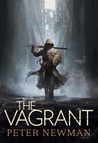
Review – The Vagrant

The Vagrant (The Vagrant, #1)

The Vagrant by Peter Newman

My rating: 5 of 5 stars


The Vagrant is a silent man, a wanderer with a magic sword, a baby, and a goat. This is the story of his journey through a post-Demonic apocalypse world and the family he starts to build in it.

I loved this book, in a way that kind of astounds me. I bought it on the recommendation of its similarities to Dark Souls, and that recommendation was spot on. The core idea, the feeling of a world and powerful entities within it caught in decay and decline, is evoked perfectly here, and at the same time the glimpse into how people adapt to, and sometimes even embrace, corruption feels so unspeakably real. At the same time, the bleak world is studded with both hope and humor, for a perfect balance of darkness and light. And more than anything, the Vagrant is a good man, a decent man, and it shows in his every action and reaction.

The characterization in The Vagrant is outstanding. I can only assume that Peter Newman is a truly gifted observer of the world, because the way that every character in the books feels true to the core could only come from heart-deep understanding. Even the goat, THE GOAT, is a fully fleshed character while still remaining truly and utterly goatlike. It’s amazing. And Vesper, the baby! She’s perfect. She’s a baby, and a person, and full of character it’s almost painful.

It’s almost shocking, really, how human this book is considering how inhuman the world it depicts is. The people and land are growing ever more tainted by the Demonic invasion, and even the “pure” humanity in the north is wrapped in eerie light of entities that are anything but human. Yet between these two poles, people get on with their lives as they have ever done, and it’s beautiful in a way. There is badness there, of course, but there is also the Vagrant and his simple decency, wrapped up in the power of a sentient, unstoppable sword.

It’s a heady mixture, and one I can recommend wholeheartedly to fans of adventure, action, and human drama alike.


View all my reviews

David Mogo, Godhunter – Review

David Mogo, Godhunter

David Mogo, Godhunter by Suyi Davies Okungbowa

My rating: 4 of 5 stars


David Mogo, Godhunter by Suyi Davies Okungbowa
Review of a free Netgalley Review Copy.

David Mogo is a hunter of godlings, a cleaner of messes made by the minor deities running loose in Lagos, Nigeria after an event called the Fall, when Gods and Goddesses of Africa’s pantheon(s) come to earth and start raising havoc. He himself is a demigod, the son of an unknown goddess who possesses strength, stamina, and an attitude to match.
His mentor, Papa Udi, is a wizard and a man of few words, and together they begin to take on stronger gods who plan to take over…The world! (Or maybe just Lagos. Or Nigeria? Plans change).

This was a very fun read. The action is meaty and fast, the overall story engaging, and the characters unique and convincing. But for me, and I think for a lot of readers like me (American fantasy fans) the novelty of the setting, and the richness of the language involved, is what is most appealing.

The story and pacing are not incredibly unusual for this kind of urban fantasy–a damaged protagonist possesses extraordinary powers and uses them to battle beings with even more extraordinary powers in a modern setting in a real place. But the details are so much more inviting in this book.

For one thing, despite being an actual demigod, David is immensely human. He is unsure and hesitant at times, but driven by compassion and a desire to do good. He is not your usual urban fantasy banterer, either. He is sincere, if emotionally conflicted, and it’s refreshing.

The people around him are also complex and involved in their own stories, and things happen around the protagonist without him knowing, making the world seem that much more three-dimensional. And what a world!

I know almost nothing about Lagos, but this book brings the city to life in a way that only someone who truly loves it could. It is flawed (there is a shocking amount of feces mentioned) but vibrant, despite its fallen state in the book. I want to know so much more about the city and its people now.

The god characters are also a fun take. They appear to come from the Yoruba pantheon, based on the names, and their natures are both familiar (gods of war and birth are not uncommon in many pantheons) and new (their characters and expressions are unlike the more familiar European pantheons in many ways). I genuinely felt like I was experiencing something new every few pages, which has gotten to be a rare experience as I get older.

And then there are the languages!

This is where the book really shines. David, the protagonist and POV, uses fairly standard English. However, the characters around him use a variety of languages that you would actually encounter in Lagos. Papa Udi speaks Pidgin, which I imagine many American or European readers will find challenging. Some characters speak Yoruba, which David does not–so the words are left untranslated and an enigma. There are names of clothing and cars and places I have never heard of, and I find it almost thrilling to have that kind of linguistic adventurism in a book like this.

This is not a high-brow work of literature. This is not an essay about African culture. It’s an urban fantasy, a fun afternoon-snack book, that still doesn’t handhold its readers through linguistic challenge. I love it.

For those worried about that challenge, though, it’s OK. The book is clear enough that you can get through it fine without puzzling over the Pidgin or translating the Yoruba. You can just sit back and enjoy the ride as David battle gods, gets to know his roots, and becomes an even bigger bad-ass.

Thank you to the publisher and to Suyi Davies Okungbowa for the chance to read this book!


View all my reviews

Quill – Review

Quill (The Cartographer #1)

Quill by A.C. Cobble

My rating: 4 of 5 stars


Quill by A. C. Cobble
I was given a review copy by the author.

Quill is a story set in a different universe’s version of the British Empire, one that seems very familiar, but is wholly different. It happens in a world with magic, and spirits, and also airships and trains. There are guns and bombs, and sorcerers and druids, too.

It is the story of nobleman adventurer Oliver Wellesley, the Cartographer of the series title, who is very far down in the line of royal succession so he is merely rich and aimless, and also apparently a sex-magnet. He is finagled into investigating a murder which smacks of the ancient, forbidden art of sorcery, and is partnered with beautiful, sex-hungry (this comes up a lot) sorcerer-killer priestess, Sam No-last-name.

They jaunt all over this not-at-all British Empire (which pays little heed to the true costs of empire and colonialism) and meet sorcerers and hedge witches and lustful heiresses and, generally, spill a whole lot of blood.

It’s an adventure. It’s a romp. It’s two-fisted, leather-pantsed, drunken alley fighting fun.

There’s a lot to recommend this book. It’s got originality, it’s got some very nice structural planning (the alternating viewpoints work very well, and the character tics turn out to be actually quite meaningful), and the dialog isn’t weighed down by hyper-witty banter. People who like airships and hard-punching women will dig the story.

The pacing was nice, and never felt draggy either.

The writing is solid, if a bit too in love with certain turns of phrase (the euphemism “sanguine fluid” for blood appeared a few times, and bothers me still), and generally well-edited. There are more typos than you might find in a pro publication, but far less than in most self-pubs, so it’s on the good side. I was pleasantly surprised by the overall quality of the prose, honestly. It’s better than, say, Sanderson in many respects.

There are a few plot tunnels but they’re really not that important overall. It’s the kind of book that you should go into for a fun read, rather than looking for a deep reflection on human nature or what have you.

I liked it. I’d like to read the sequel, honestly, since the end kind of went for a semi-cliffhanger and I like these characters.

Thank you, A. C. Cobble, for the copy, and the fun read!


View all my reviews

Empire of Grass – Review

Empire of Grass (The Last King of Osten Ard #2)

Empire of Grass by Tad Williams

My rating: 5 of 5 stars


Empire of Grass by Tad Williams

The follow up to The Witchwood Crown, which itself was the followup to the incredible Memory, Sorrow and Thorn trilogy of 30 or so years ago, had enormous shoes to fill. The original series was a landmark in fantasy, and when Tad Williams opened the door to Osten Ard once more in 2017, expectations were understandably high.

The Witchwood Crown met those expectations and more, bringing readers a glimpse at that familiar realm after decades away. Characters we know and love return, while some are lost forever, and new faces were introduced: Prince Morgan, grandson of King Simon and King Miriamelle, his troll friend Sennec, the half-blood Norn Nerez, and many more. The Witchwood Crown placed our characters in deep peril, with a gut-punch of an ending, and with the Empire of Grass we finally get to take up the cause again after an agonizing wait.

But oh, it was worth the wait. This book is a middle book – it has very little closure and lots of progression. There is more movement and plot flow than in the first book, since the stage is all set, but even so this is not what I’d called a fast book. It is smooth and steady, but not racing.

That being said, the last 200 pages or so are breathtaking. So much happens, and of such import, that it is once again going to be a very hard wait for the next book, The Pilot’s Children.

I will also say, with the current state of the plot, it would not surprise me in the least of the final book ended up being split in two. There just seems like so much that still needs to happen before anything is resolved… But I suppose we shall see.

Anyway, if you have read Witchwood Crown, you should certainly read this book. If you haven’t read TWC, then by no means start with this one: go back to the beginning!


View all my reviews

One Word Kill – Review

One Word Kill (Impossible Times, #1)

One Word Kill by Mark Lawrence

My rating: 4 of 5 stars


One Word Kill by Mark Lawrence. Review copy from Netgalley.

A group of teen friends in 1986 united by their love of Dungeons & Dragons are pulled into a spiral of danger and adventure and growing pains. But in London, not Indiana. The comparisons to Stranger Things are inevitable, and perhaps even intentional, but although the heart of the story is often similar (misfit kids banding together to get through the pain of life, discover the joy of it, and also do crazy things together) it is altogether its own beast. It is, for one, a science fiction/time travel story, rather than a science fiction/cosmic horror story. Also, the adults are far less involved than in ST. But it still preserves that golden glow of love for a time, and an appreciation of the humanity of young people, that is the same.

The gentleness of this story, the warm heart it carries for its characters, is almost shocking coming from Lawrence’s previous stories–Jorg Ancrath was many things, but sensitive to the joy and pain of simple life he was not. And yet the characters in One Word Kill most certainly are. They are kids, and they act like it, but they are also filled with love for one another that often defies words, but drives their actions.

Nick, our protagonist, and his friend Mia tricking the emotionally closed off Simon into learning to dance so he could go to a party; the friends banding together to protect each other against a homicidal bully without a second thought; the acceptance of each other’s differences with natural grace. It’s a story of love.

There is, of course, pain here as well. The children (and they are children) lose things that can never be regained, and it is handled well.

The writing is fluid and natural, as well. Lawrence has always been a strong writer of dialog, but I was actually surprised at how earnest and real these characters feel. So many voices in his previous works were trapped by sarcastic insincerity I had almost come to expect it from the author, but this book alone proves me wrong. It’s a pleasant mistake to make.

One thing that perhaps I didn’t like as much is the kind of universalizing of D&D as a magical gift to all weirdos and misfits of the 80s. As one of those weirdos, I have to say D&D never offered me anything like the emotional panacea that is implied here. I much preferred the stories in books to the ones that people tried to make me be part of. But that’s a personal issue, and of course those who grew up with the monster manual in hand will likely feel differently.

But in summary, I enjoyed this book. I enjoyed watching the characters take their first fumbling steps out of childhood, I cringed at the pain they faced, and I am glad I got the chance to read Lawrence’s latest work.

Thank you to the publisher and the author for giving me the chance to review One Word Kill!


View all my reviews