Thoughts on The Book of Tea

Okakura Tenshin, The Book of Tea

Read it!

Review – Who We’re Reading when We’re Reading Murakami

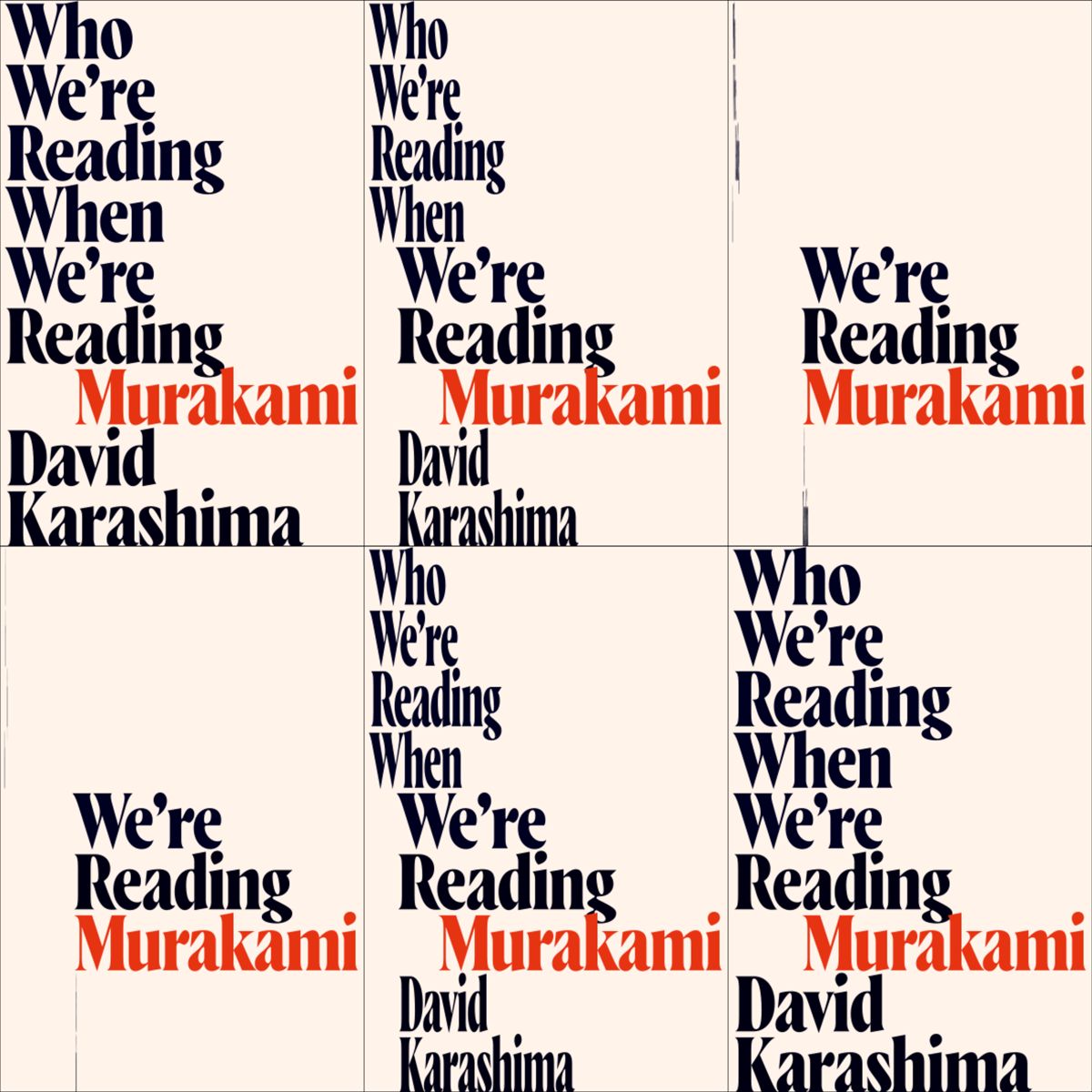
This animated gif of the cover is from the publisher’s website, linked through the title below.

Who We’re Reading when We’re Reading Murakami

by David Karashima

Soft Skull Press

I just finished this book after picking it up based on a passing comment by Matt Alt on social media. I did so not because I am particular fan of Murakami—I’m not—but because I wanted to actually know more about the issue hinted at in the title: how the personality and identity (the “who”) of the translator impacts the end translation.

To sum up, this very well researched and written book follows the whole process of how Haruki Murakami went from fresh new Japanese novelist to global literary darling. Karashima tracks down and talks to all the editors, translators, designers, agents, and the author himself to look at how Murakami’s work up through Wind-Up Bird Chronicle ended up in English.

The result is a really compelling example of how intentional and designed such a career is. Please don’t take that to mean I don’t believe the success is unwarranted or undeserved; I make no such judgment at all.

But it is clear that what people read from Murakami in English has been very tightly controlled by a large cadre of peripheral figures. They selected stories, they cut text, they created the legend. Which is not a surprise to me at all, having been a translator working on pieces for publication.

Which brings me to my only grump about this book: I’d very much like a bit more focus on the question in the title. I want more depth on the people. In parts, I want more concrete looks at how specific choices the individual translators made could influence a resulting literary work’s reception. There are tantalizing tastes of this, with a few examples of people bringing up translation choices, but I’d have loved more.

In all, though, this strikes me as a valuable tool to demonstrate the realities of the translation process to a reading public.

It’s well worth a read to anyone interested in Murakami, translation for publication, outer international fiction.

Review – Ceramics and Modernity in Japan

I’m trying lately to build a solid base of knowledge in ceramics, not only of aesthetics and mechanics, but of culture and context as well. This book, part of the Routledge Research in Art History series, is an excellent resource for exactly that.

The cover of the book Ceramics and Modernity in Japan.
The image is the abstract work Mr. Samsa’s Walk by Yagi Kazuo.

It features 11 scholarly essays (including the intro and epilogue) examining how the whole ceramics world—creating, seeking, purchasing, and appreciating—changed in post-Meiji Japan. The individual topics are relatively specific, but are well arranged and referenced enough to give an excellent overall grasp of the various issues at play.

The articles are all both rigorous and accessible, with the possible exception, perhaps, of “More than “Western”: Porcelain for the Meiji Emperor’s table” by Mary Redfern, which reads like something an undergraduate in social science might write to fill in a word count assignment. Study, overly erudite, and off questionable insight

Of particular interest to me are the many references to the interplay between attitudes toward other Asian nations during Japan’s colonial and post-colonial periods and the concurrent growth of the mingei movement under Yanagi Sōetsu. There is also a very illuminating reference to the circularity of how ceramic science from Europe influenced Japanese pottery, which in turn went on to influence the British studio pottery wave spearheaded by Bernard Leach.

These incidents fundamentally changed my perception of the mingei movement and Leach; particularly his “translation” of Yanagi’s work into “The Unnamed Craftsman.” The clear biases and, dare I say, agenda they shared makes much of what they say very suspect, even as it touches on some clearly vital issues of the intersection of art and Buddhist ideas.

Anyone who is interested in fort insight into the historical context of his Japan came to be “potter’s paradise,” the tension between art and craft in ceramics, and the roots of Japan’s enormous valuation of pottery and the “living national treasures” that create it would do well to read through this one.

Highly recommended.

Review – The Japanese Sake Bible

The Japanese Sake Bible: Everything You Need to Know About Great Sake – With Tasting Notes and Scores for 100 Top Brands by Brian Ashcraft

My rating: 5 of 5 stars


There are quite a few good books for sake beginners that introduce concepts like how it’s made, the different classifications, and the basic history. There are also very technical books that go into the chemistry and technical details of brewing and flavor.

This might be the only book that is both.

I’ve yet to encounter such a comprehensive discussion of sake-its history, its brewing, and the figures who have guided them both.

You can start this book from zero knowledge and end up with an admirable understanding of Japan’s national drink after finishing. It’s a truly well researched, nearly exhaustive look at sake. It’s not as technical (or difficult) as Gautier Rousille’s Nihonshu, or as intimate as John Gauntner’s Sake: The Hidden Stories, but exists as a bridge between them.

The tasting notes at the end offer a look at many of the most important modern brands, but tasting notes are always exercises in subjectivity so don’t get too caught up in them.

Overall, this is a stellar addition to the English language sake library.

Jump on it.


View all my reviews

Review – Penguin Highway

ペンギン・ハイウェイ by Tomihiko Morimi

My rating: 4 of 5 stars


Penguin Highway

This is a coming of age novel, a story of children facing reality bending mystery, and lots of talk about boobs.

Akireta Aoyama is a young boy with an analytical mind and an obsession with breasts. Not exactly in a prurient way, but in the confused way of a young boy on the cusp of puberty who knows he’s interested, but not exactly why.

One day, his small Japanese town is set abuzz by the sudden appearance of penguins… And that is only the beginning of the weirdness.

I read this novel as a bit of exploration of Japanese SF, and I fear it did little to deepen my understanding of the first. This is a shallow, wide ranging look at all kinds of things: friendship, death, reality, love and so on. The topics can be heady, but they’re all destiny with by children, so nothing goes very far-topics are touched on, then left to wander as the children go about their adventures.

The climax mixes utter predictability (there is very heavy foreshadowing of a certain event) and utter nonsense in a vaguely unsatisfying way. The characters are memorable and enjoyable, though, and there is enough going on to keep interest going.

But in the end, this felt like a pretty rote “kids in small Japanese town have weird adventures and grow up a little” kind of story, complete with Summer festival yukatas and the bully who ends up helping the heroes when they need it.


View all my reviews