So, as mentioned previously, my books are now in the Hikari City Public Library. But apparently that wasn’t the end of my library adventures.
The other day, I stopped by my neighborhood sake shop and the owner told me the library’s new head, who had taken over after my last donation, wanted to talk to me about boosting local library usage. Which, despite my enthusiasm for libraries, seemed like something beyond my skillset. But, hey, I’m always happy to meet and talk.
I talked to the new head, who in a small-town coincidence, knew me because our sons went to preschool together. He wanted to talk about things like running book recommendations from “interesting people” in the library newsletters and such, and briefly mentioned that the library would love to stock my sake book. I also happened to get a shipment of the US version of Strange Houses just before, so I brought one along, too.
So, we set up a little publicity stunt where I donated books to the library when a reporter from the local newspaper just happened to be there to get pictures!
Me and the library head in the Setouchi Times.
I have no idea if this will raise interest in the local library, but I certainly hope it does.
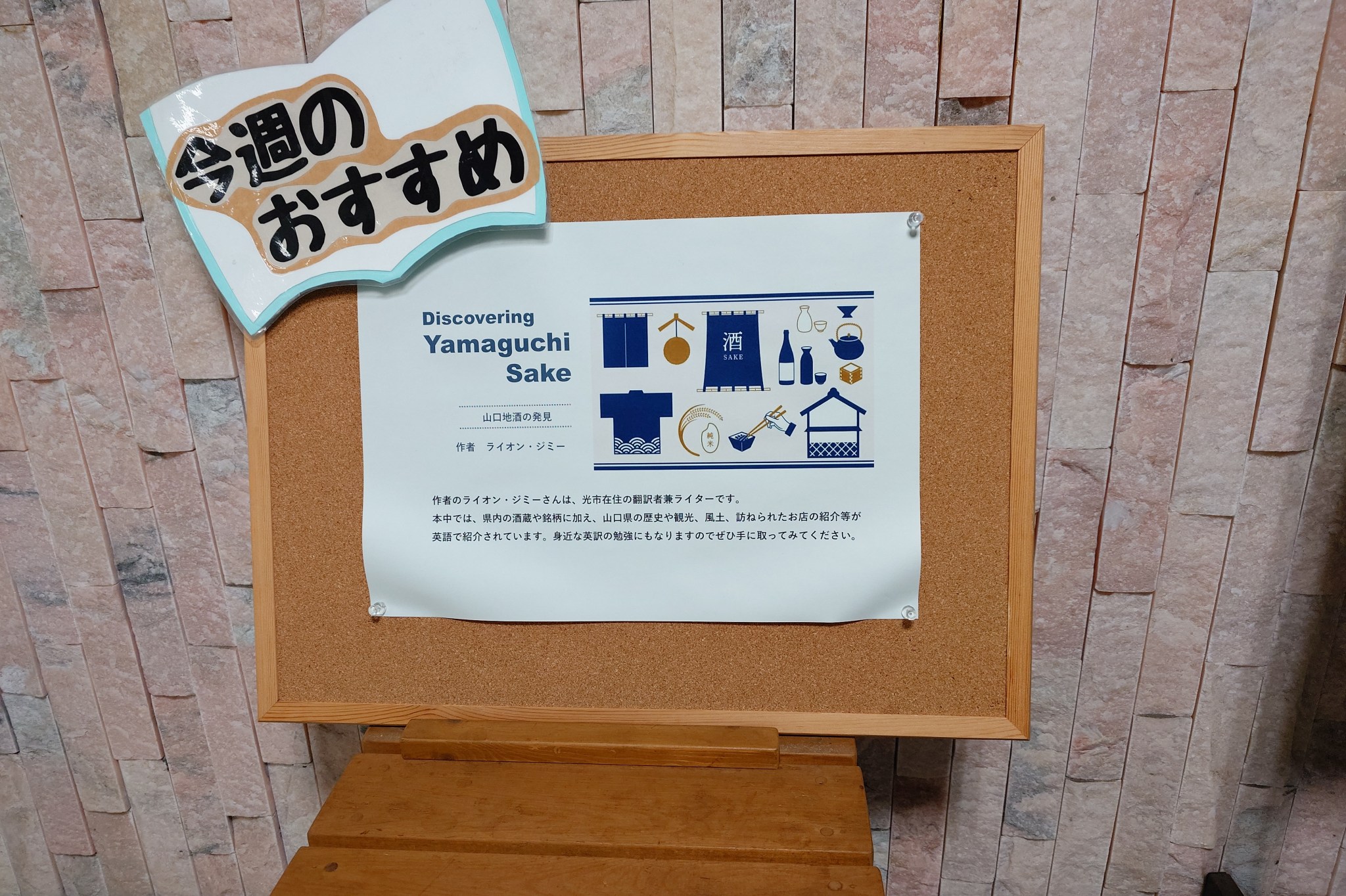
The library set out a recommendation board for my book.
When I got a whole bunch of comp copies of both editions of Strange Pictures, for more than I knew what to do with, the first place I went was to the library to see if I could donate some to put on their shelves.
Hikari Public Library is small and serves a relatively limited Japanese community, so there isn’t a lot of demand for English materials, but the staff not only accepted the books, they celebrated them. They were openly excited to get copies after seeing the local newspaper article about my Uketsu translations. I’m not sure I can explain how good that feels.
I’m one of those people for whom libraries are borderline sacred. I have been a ravenous reader since I was in first grade, and there were no bookstores in my small town. So, I practically lived in the library. The librarian, Mrs. Beard—who was almost laughably stereotypical librarian: little old lady in glasses on a chain—knew me by name and never tried too restrain my reading by age or “difficulty.” She just helped me find books to love.
That library was utterly foundational to who I am. It’s where I discovered Stephen King. Where I explored art and history and parts of the world that I never dreamed that I might actually one day get to see. It was where I started to see stories as more than just words on a page, but a way to live other people’s lives for a time.
I really could go on and on. The smell of all those old books, the quiet and cool spaces where you can just read and read as long as you want… You know, I’m sure, for yourself.
And now I’m right there on the shelves at the library. How lucky I am too live this life.
I learned about this book from a post on Bluesky, which included the a quote about translation as reading that sparked something in my brain. I had to read more, because I personally view translation as exactly that: I read the text in Japanese, understand it to the best of my ability, and then write my understanding in English. Here, I thought, was someone who not only understood translation the way I do, but who had a career’s worth of experience and the academic training to articulate it in ways I did not. It filled me with hope that I was perhaps not utterly unfounded in my approach to this work.
When I did get my hands on the book, I was not disappointed.
Searls divides this book roughly in half. Indeed, you could say the first half is “philosophy,” and the second is “translation.” He begins with a historical review of theories and approaches to translation, from the Latin roots of the word itself to German Romanticist views of language. He does get quite deep into the weeds, with elevated language and heavy ideas, but he clearly explains not only the meaning and importance of the language an ideas, but why he’s engaging with them.
It’s a refreshing style of academic book that not only maintains rigor, but opens the gate to those without steeping in the particular obfuscated style that plagues academic writing. It is challenging while remaining accessible, in other words.
But most important of all, it is thoroughly rooted in actual translation. Searls brings all the theoretical discussion back to what real, working translators do, not only in the literary realm but in the practical, business-focused work that most people use to pay the bills. The balance is delicate but solid, which is what is most impressive about the book.
All that being said, what takes this book from being a well-written academic treatise on translation and something that I would recommend to anyone even tangentially involved with translation as a practice (academics, budding translators, authors whose books are being translated, game developers looking into localization, the list goes on) is how it reframes the act itself in new words and ideas that just make beautiful, crystalline sense.
Rather than focusing on the common ideas of “fidelity/faithfulness,” freedom, or even accuracy, he talks about translation as an act of reading.
When I’m translating, I’m just reading-trying to pick up on as much as I can of the original utterance, its meaning and sound and allusions and tone and point of view and emotional impact. As I register what I feel is most important and indispensable, I try to write that indispensable thing in English; then, in revising, I reactivate the reading part of my mind and try to anticipate as much as I can of what an English-language reader with no access to the original will pick up on.
(page 224)
This is really the crux of the book, though the discussion of translating “utterance” rather than “words” also rings true. On page 107, for example, he says “To think of what we translate as ‘utterances’ sweeps away a huge amount of lexical analysis, because we don’t translate words of a language, we translate uses of language.” Thus, issues of “accuracy” are less important than issues of “communication.” When we translate, are we bringing the message/impact/effect/resonance that was actually vital in the original to the new audience?
Which, again, brings us back to reading. Because it is only by reading that the translator knows what is vital in the text, what Searls sometimes calls the “force” of it, to be able to bring it to the new audience. As such, rather than faithfulness to any monumental, immutable “original,” translation is always a question of how the translator read, and how they managed to share their reading with their new audience.
[…] [W]hat’s important to preserve depends on what the translator finds in the original-how the translator reads. Everyone thinks … that they’re “following the original,” but they’re working from different originals: each is trying to produce a text that matches, or does the same as (has the same force as), not the source text but his or her reading of the source text. Even the least literal translations, the most wildly divergent “imitations” or “reimaginings,” try to stay true to whatever ineffable aspect of the original’s vibe the writer of the new version feels they are taking up. That is why there is no objectively best translation, one that is “closest” to “the” original, as talk about faithfulness falsely implies.
(p. 195)
One of the things that has always struck me about translation is how every act of reading is different, no matter the language. Every person brings their own filters to reading (and listening and talking and writing). I am no different. So, whenever a translator experiences a text then takes that experience into a new language for new readers, inevitably, that new text will be colored by their filters. Our job, then, is to expand those filters, to be able to grasp as much of the text as we can, to bring all of that with us when we translate. But also, we need to accept that we will never encompass everything that the original was or potentially could be. All we can do is be the clearest filters we can. Searls, of course, puts it much better:
[W]hat I think a translation should be: Attentive to how the translating language works, overriding any demand for “equivalence” with how the original language works. Keeping in mind and keeping to heart the interests of readers, the author, and the author’s ideas. (This, by the way, is how we use the word “interests” in English.) Feeling some responsibility to enable, or at the very least try to enable, the original author and their new readers to interact with one another at their respective best. An act of care, and ultimately love.
(page 194)
And really, I’m not sure I can add anything else.
There is much more to this book. His formulation of translation in terms of arcs/arrows is fascinating, as well, and I think the practical examples are all excellent sources of education and rumination.
I honestly can’t recommend it enough to anyone even remotely interested in the theory, work, and indeed love of translation.
As I sit here typing this on December 31, ostensibly a holiday, I suddenly realize that it might be depressing to be talking about work. At the same time, I both love my job AND don’t honestly work that much (weekdays, 9-3, lots of days out for location visits, interviews, etc.). So, I’m not too fussed about it. I get plenty of time to mess around.
So, anyway, here is my 2024 working year in numbers:
Rough number of Japanese characters translated: 645,000
(Rough because some projects were more package-based than character based, and one novel overlapped New Year.)
Articles written: 15 (12 in Japanese)
Translation proposal packages written for publishers/rights agencies: 6
Novel translations completed: 3 (including the one that started in 2023)
Ceramic artists interviewed for book: 8
And none of that includes the hours spent taking pictures for books/articles, or reading for the job, or—most important of all!—the people I met. The numbers also don’t reflect the kind of seismic change that has happened in my work as I have become more plugged into the publishing industry. I’m now spending much less time on random corporate websites than I did last year (huzzah!) and more time with artists and creative people of all types. Again, Huzzah!
It has been a good year, professionally, and I think one that has sown the seeds for more good years to come. Fingers are crossed, wood is knocked on, salt is thrown over the shoulder, and every other good luck charm that might help it be so is invoked.
Personally, well, the world is what it is, but we’ve weathered things pretty well. I had a bad summer for a couple of reasons, but in general the Rion family in Japan has been blessed with pretty decent luck. I hope that 2025 is better, but I’d settle for roughly the same.
Anyway, I hope everyone has a lovely New Year, and wish you the best in 2025. To finish up, I am indeed curious. How were things for you in 2024?
There is a part of me that is almost embarrassed at the fact that, after having written and published one book, and having three translations published, with two more scheduled in the next year, I am JUST NOW realizing that hey, maybe I’m not just faking this? Maybe I’m in the book business?
I have been a reader since, well, ever. I think I started reading when I was five, and by the time I was in first grade I was burning through the library. Books were just… There. They were a fundamental building block of my identity. It’s not even something I consciously thought about, but hey. I love books and the reading (and purchasing, borrowing, lending, touching etc. thereof) about as much as anything I can think of.
And of course I always toyed with writing, the way a cat toys with a mouse that it never really intends to eat. “Someday, I shall pounce and then success will be mine!” I would think, while my prey sneaked away, limping but triumphant. Because, of course, writing takes perseverance and dedication and effort, and I sometimes fail to find those virtues in stock.
But now that I am not only someone whose name is on book covers, but someone whose name is familiar to PUBLISHERS and AUTHORS (a famous horror author just posted a pic of his ARC of Strange Pictures, with my name on the cover!!!), I think I can finally admit… This is something that I’ve wanted, without really knowing it, all my life.
I think I must have always wanted to be a book person. A writer, an editor, a guy in the biz. And I think that’s what I’ve got now. I’m visiting a book publisher and two international rights agencies in Tokyo at the end of the month. When I mentioned I would like to visit, they all said “Great! We’d love to meet! When?” rather than “Who are you again?”
The feeling of that. The—admittedly ego-centric, selfish, privileged, yes, I am so privileged and lucky but still—DAMN GOOD feeling of it is something else. I don’t deserve to have this good a life, but it’s here. So I guess I’ll live it.




 Jim Rion - Translator & Writer