I think I have to finally admit it. I’m a John Hornor Jacobs fan.
The first book of his I read was Southern Gods, a sweaty, gritty myth of music and cosmic horror that I think I picked up in a bundle not long after its 2011 release. I remember enjoying it, and when I revisited it in later years it’s held up.
But I didn’t really plug into him as a name to watch for until I read The Incorruptibles, his alternative history/dark fantasy book of an infernal-powered Roman Empire in the Old West that he into a trilogy.
Since, I’ve enjoyed all the books of his I’ve read (which is all of them but The Twelve-Fingered Boy trilogy), especially A Lush and Seething Hell. There is something about the weight of his prose that makes it feel rooted deep, in history and myth and humanity, while still just being fun.
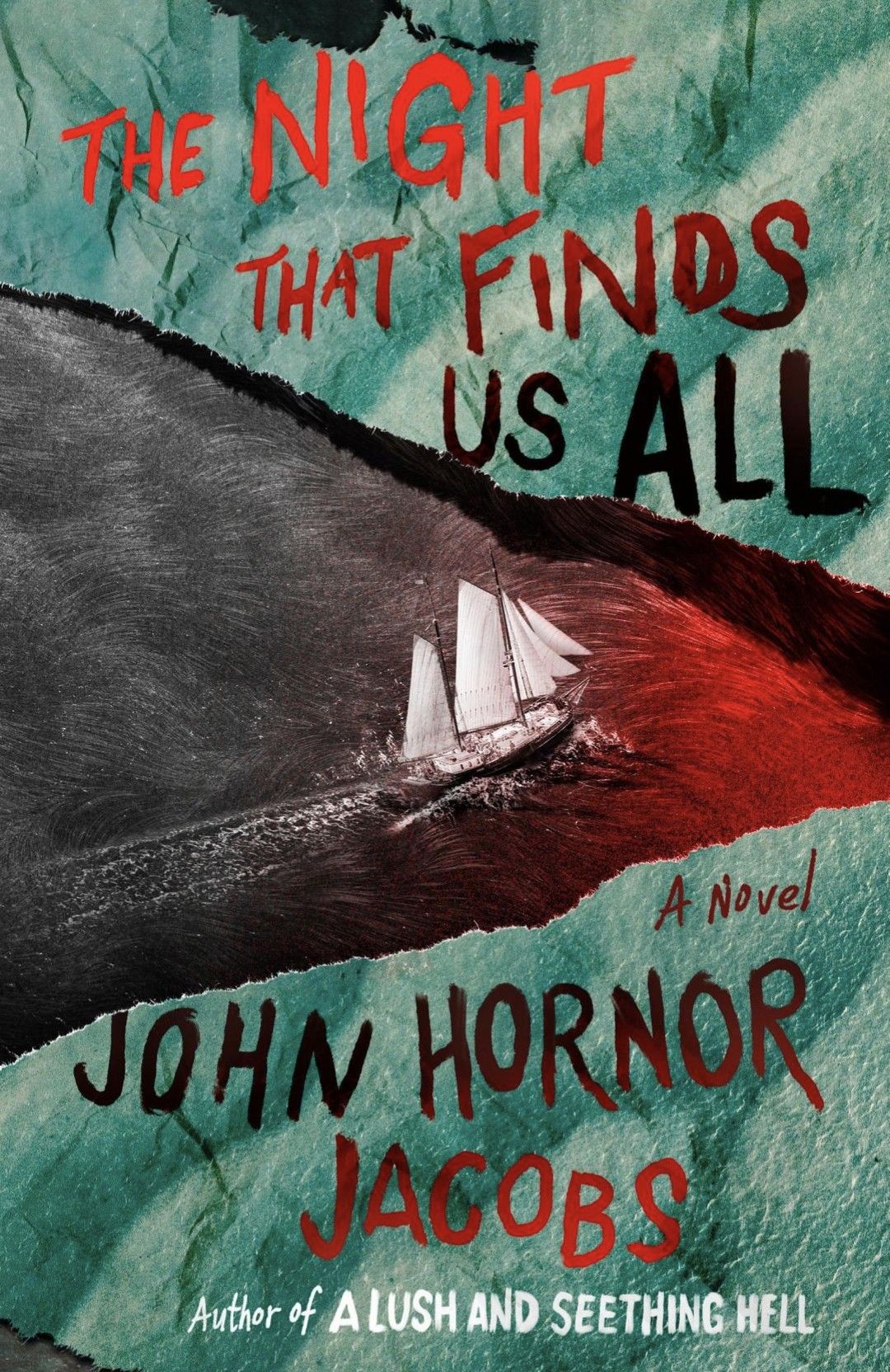
And so we come to his 2025 ocean-going cosmic horror The Night That Finds Us All.
It’s about Sam Vineworth (known affectionately as Sam Vines, which I would have bet was a Discworld nod but would have lost, according to the author), an alcoholic fuckup but he’ll of a sailor, recruited by a friend to help crew a century-old sailing ship from California to Britain.
The ship is, of course, much more than it appears. It has a shadowed history with more than a bit of blood, and it soon starts to prey on the crew.
Once again, Jacobs brings unpretentious flourishes of near-poetry.
I found myself thinking this voracious ocean came before mankind’s puny endeavors and will remain after, in some near future, eroding the shores and drowning the land and taking all our works with us, dragging them down to the bladderwracked mansions beneath the sea.
The bladderwracked mansions beneath the sea. God, what an image. Or…
The sky kills all the sea’s dreams.
This masterful imagery is matched by what I can only a scholar’s depth of nautical knowledge. Mizzens and reef sails and knots… It’s all here, and I’m not sure I understood it but I also duct think not understanding hurt at all. Because nothing hinged on those details, they only added in establishing that Sam, drunken mess that she is, knows her shit on a boat.
But be not afraid, this isn’t Moby Dick, with page-long paragraphs and endless digressions on marine wildlife. It’s a journey into a dark, cursed netherworld that’s full of dread and scares.
My English translation of Uketsu’s third, and longest, novel is out now worldwide.
The UK cover for Strange Buildings
Strange Buildings expands and improves on the core concept of Strange Houses, creating a multilayered narrative around the designs of 11 different buildings, which all end up woven into a much greater, and darker, story.
It reads to me as a much more mature, more assured work and I think it’s Uketsu’s best.
There was a lot to deal with in this one, as the many different chapters, or “Files,” take on different approaches and tones, giving me room to play with a variety of voices.
For example, in the excerpt from the old book in File 3, “The Watermill in the Woods,” I aimed for an old fashioned, somewhat stilted style, while File 7, “Uncle’s House,” called for the voice of a clever, if unschooled, boy.
It was a satisfying challenge to work on.
There is one big issue that arose in the translation that I would like to discuss, but it’s a bit of a spoiler. If you haven’t read the book yet, go do that now and come back when you’re done.
So, be warned:
MINOR PLOTSPOILERAHEAD
In the File 9, “Footsteps to Murder,” Hiroki Matsue reveals that he believes his father, who happens to be a Christian, murdered his mother and set fire to their house.
Later, our “great detective” Kurihara reasons this accusation away. Now, in the original Japanese version, his entire argument is basically: Mr. Matsue was not only Christian, his crucifix pendant indicates that he is Catholic, and the Catholic religion strictly forbids murder.
In Japan, where readers are by and large only vaguely aware of what being a Christian actually entails, that might fly. But not in any Western country, that’s for sure. I mean, come on, watch The Godfather. The climax of the movie is proof enough that it’s a flimsy idea.
Anyway.
My editor at Pushkin and I brought this up to Uketsu and proposed a couple of changes. We recommended adjusting the Christian angle to include pacifism and activism, but most importantly, we wanted to add an actual logical argument that helped take Mr. Matsue off the suspect list.
Uketsu agreed, and the story was changed.
I am generally uncomfortable with the idea of changing actual story points, and would never do so without active input from the author, but seriously, that particular idea struck me as nearly fatal to the story. I could see quite a few readers in the West refusing to take the book seriously after an argument like that. But, again, most Japanese readers wouldn’t even bat an eye at it. Only about 1% of the population is Christian here, so most people here don’t even know a believer.
So, we had a very successful book in Japan that we were pretty sure needed more than just words changed to really succeed in English. It needed structural changes, too. I think it worked out pretty well, and the core of the story remainss exactly as Uketsu intended it.
This was another ARC from Tenebrous Press, which is doing lots of cool things with horror in the weird mode. Many of the books they put out fall outside my personal taste zone, but I always appreciate the creativity and drive behind them. But this one fell well within that zone.
I am going to struggle to summarize this one because it is… Nebulous. I think it qualifies as a collection of short stories, but all of the stories fit together to create a much bigger story, which is probably why Tenebrous lists it as a novel on the website. The stories are, or the novel is, all set in and talk about the town of Olyoke, built on a swamp in Tennessee, but the Tennessee is arguably not the one we know. Because things happen in Olyoke that do not happen in our world, and no one really seems to question that.
The swamp is full of gray-eyed worms and gray-eyed people who have lived there since long before. Ghosts of people who never died haunt the religious/music theme park. The men who drained swampland to build the town vanished in the night or went mad because they drank the water flowing from a mysterious girl trapped in a tree. And people in the town dream of other worlds where they have other faces, and an approaching cataclysm that is either a cleansing flame or an unstoppable titan was foretold by one of several prophets who founded cults in the town.
It is all capital-w Weird.
And it is not just the subject matter that dodges easy grasp. The way Endwell approaches the writing is squirmy, too. Things are simply left unexplained, such as who the hell “Holly” is, the subject of the theme park that dominates the town’s center. Or why the town is overrun by red-frogs, which also seem to carry a plague?
Then there is the language use. Endwell approaches language in a not-too-unusual manner, except for the (very “now”) flexibility of pronoun use, which comes across at first as quite gender-aware until you meet someone who goes by “it” who might, actually, not be a someone?
Now, I will say that things come together. There are lots of unanswered questions but they are of the sort that really don’t need answers. And the ending, as such, does not leave the reader dissatisfied so much as… In a state of wonder. Dazed, even. Because this collection, or novel, or whatever it is seems to be swirling somewhere above mere storytelling, much as the figure on the cover swirls above the world.
This was a fascinating book. An eminently readable book. And, dare I say, an enjoyable one, if a bit outre. For those who look for stories that avoid pat explanations and neatly tied-up ends, this is definitely one worth pre-ordering.
Quick heads up: This (rather long) story contains some implied darkness involving pregnancy/babies. Nothing graphic.
He guided the car down a broad road. She stared idly out at the passing scenery. The car wound across a plateau dotted with pale projections of limestone, like stone fingers grasping at the sky.
“That was a nice museum,” He said. Silence made Him nervous. Made Him fear that She was growing tired of him.
“Yeah. I just wish I could have understood anything.”
“Sorry. I should have guessed they wouldn’t have English signs. Not that I could read them that well, either.”
“It’s OK. The exhibits were cool. That Jomon pottery blew my mind. It makes things feel a bit more real, you know, how people have been doing the same stuf here for so long.”
“Yeah. That’s what I love about it. You can see this unbroken line going back thousands of years..”
They descended from the plateau into wooded lowlands, turning onto country roads through tiny clusters of houses barely identifiable as towns. He settled a bit as the road straightened and widened.
“All that time. I wonder what else is left behind. Have you ever thought about if people can leave a mark on places? Kind of like a fingerprint, but more… Emotional.”
“A psychic imprint, or something? Like in the Shining?”
“When you put it like that, it makes it sound kind of crazy.”
“No, I don’t mean it like that. I agree, actually. I’ve been to places where bad stuff happened, really bad stuff, and I swear I could feel it. It was terrible.”
“Oh, yeah. You used to live in Germany, didn’t you?”
He didn’t answer.
They drove slowly under the spreading shade trees until He—driving and nervous about the left-sidedness of it all—sighed in relief at the sight of a sign reading “Ubadō Cave” underneath more Japanese text.
“There it is,” He said and She—tired, slightly bored, but happy to be away from the crowds in Kyoto and Tokyo—said “Well navigated, Ensign.”
She aimed her phone at a passing building. “I’m not sure I trust Google translate. It says that place has ‘electron baths’ which surely isn’t a thing, right?”
“Distrusting Google is generally a good stance to take,” He said.
“It says this place is called ‘theft cave.’ Like a JRPG setting or something. Is that right?”
“I mean, what did I just say about trusting Google? But maybe. Hard to tell what it actually means without the Chinese characters. They just use kana on the sign.”
“You think the thieves left anything behind? Like a treasure trove in there somewhere?”
“We shall soon see.”
He turned the car into an empty parking lot and stopped beside a small, wooden building that looked to be a public toilet. Beyond was a wide grassy space with wooden swing sets and a jungle gym.
She said, “This just looks like a park. Do they have caves in parks?”
He said, “It is a park, but I think they put the park outside the cave. Not the other way around.”
“Makes sense.”
“This is going to be fun. Don’t you think?” He said. He fidgeted, running His right index finger in a circle around His thumb like He always did when He was nervous. She knew He thought She was just humoring him. Going along. That She wanted to do other things but was keeping quiet for His sake. He was wrong, but She kind of liked the careful way He was looking at Her now.
“The blogs I read about this place all said it’s a really easy walk to the exploration part at the end. It’s a little tight and dark after that, but not ‘Ted the Caver’ tight. Not getting-trapped-in-the-dark tight. What do you think? Are you OK with that? Not, you know…” He trailed off.
“I’m OK,” She said.
“Cool,” He said, relief clear in his voice.
They stepped out into the steaming air of the Japanese summer. A storm a couple of days before had brought short-lived relief, but now all that rain had turned into humidity that made even just breathing a misery. She found herself looking forward to the cave, which would surely be cooler than this.
The sound of cicadas was deafening. The small trees planted alongside the parking lot were filled with their squat, thumblike bodies, squirming over each other as they fought to send out their harsh calls, occasionally dislodging rivals which would fly off to another nearby tree with an annoyed buzz. She shuddered slightly at the sight and sound.
They walked through the park and followed the signs pointing the way to the cave. There was a small building of wood outside the entrance, with a glassed in ticket desk. He went over to try to get tickets using his third-year Japanese and a dictionary app. He staunchly refused to use AI translators. Called them “the death of human skill.”
He managed to get tickets, and with them rented hard hats, rubber boots, and flashlights. A park staff member led Them to a large sign with a map of the cave labeled in Japanese and did his best to explain.
“One kilometer, it’s so easy. Lots of lights and smooth path. Eto ne… There’s water, so you need boots. Also, drips. But no problem. Then, you can explore! No more paths, and it’s dark, OK? So use flashlights. And here,” he pointed at a section just past the halfway point. “Low. Very low.” He bent over nearly double. “Like this. Ten meters.” He stood up and pointed at the helmets. “Don’t take off the helmets, OK? Very low.”
OK, They both said.
“And very important!” He pointed at a pool of water at a bend in the path. “Here, this is deep! Very deep! Be careful, OK?”
They changed into the boots and as They stored Their shoes in lockers, She muttered to Him, “So, you’re taking me into a pitch black, unpaved cave with a bottomless pit inside, but it’s all in good fun, right?”
He snorted.
They followed the concrete path in. It ran alongside a small stream that flowed past quickly, singing over the rocks as it carried water from beneath the mountain out into the world.
The path went around a bulging rock wall and the cave mouth came into view. It was larger than She’d imagined, a maw towering over their heads, wide enough to drive into. There was an iron gate, lockable but wide open now. She stopped and held up her phone to take a picture. He held back to let Her.
To the right of the gate, hidden in heavy shadow, was a temple. Or was it a shrine? She wasn’t totally clear on the difference. There was a scarlet gate, which She associated with shrines, but beyond it was a small shelter over a seated figure, its hands folded, which looked more like the statues They’d seen at Buddhist temples.
They stopped and dropped some coins in the box in front of it and self-consciously folded Their own hands. More in respect than prayer. Faith was not something They thought about much.
Then they stepped into the tall, narrow mouth.
Inside was surprising. There were lights to the side and above. It was not at all dark, but dim, somehow. They turned on their flashlights, which served little purpose except to make them feel like they were somehow in control of the light.
Their empty hands found each other.
“It’s so big in here,” She said. There was no sense of confinement. No hint at the massive weight of the mountain suspended over Them.
The ceiling vaulted yards above Their heads, and the walls faded into the gloom on either side, visible only in spots where lights illuminated particularly unusual formations and signs they mostly could not read. The concrete path followed a stream flowing from the depths beyond, carving a narrow channel down the center of the space.
They walked slowly. He said, “I wonder if people ever lived in here during all the thousands of years this area has been inhabited.”
“They must have, right?” She said. “It’s accessible. There’s water. It’s cool in summer and warm in winter. Shelter and water, that’s half of what you need to survive”
“The website said some famous general hid out here after he lost a battle once. Like, a thousand years ago or something.”
She nodded. “So people knew about it.”
“Yeah. So, surely someone lived here at some point. It isn’t hidden or anything. But then, it goes on for miles. Who knows, maybe the dark was too scary. Or something bad was back there.”
“Oh, God, don’t say that,” She half laughed.
They walked on in silence for a moment, savoring the coolness after the suffocating heat outside. She stared up, shining Her light onto a patch of dark on the roof that resolved itself into a writhing mass of bats.
“Maybe they ate bats,” She said.
“Why would they eat bats?”
“No crops in here. No fish, either, the stream’s too shallow.”
He grunted, walked in silent thought for a while. Finally, He said, “Well, maybe they stayed near the front and just gathered what they needed nearby. Until farming came. All those rocks outside, it probably made more sense to move to more open ground.”
“When was that?” She asked.
“Maybe 2,000 years ago? I think rice farming is how the Yayoi period started. Then you started to get larger communities.”
“And then came cities. And work and traffic and pollution and all that garbage, so they made this a national park to keep it clean.”
He gave a single, loud laugh. “Long story short. But yeah, I guess agriculture really is the root of all evils. I mean, hunting and gathering was a tough life, it wasn’t like farming solved everything. You went from natural population control to artificial, for one thing.”
“What’s that supposed to mean?”
“Well, we studied it in my anthropology course last year. Like, hunter gatherer societies had to work hard to survive, but that also limited how big any band could grow on its own. It was kind of a natural process. When things got hard, people just died. But farming gives people a bit more leeway. More food, stable homes, bigger families, division of labour. More complexity, more social pressure. Until a bad harvest comes. And then all those people you could support with your crops are suddenly fucked.”
“So, what does that have to do with population control? Did they, just, let people starve, then?”
“Oh,” His mouth snapped shut, as if in realization of exactly where this conversation was leading. “Um. It’s not important.”
“No, no, you brought it up. Now you have to explain.”
“Well, my professor said that lots and lots of agricultural societies ended up with some kind of socially sanctioned process of population control. To eliminate drains on resources when things got tight.”
He stopped. She waited. Her expression was hard.
“Basically, it means that people who couldn’t help provide food or labor or whatever were deemed a burden. So, they were… Forced out of the group.”
“And cutting them out of the group meant letting them die. So, old people were exiled, or something?”
“Yeah, and other people who couldn’t work.”
“Other…” She stopped walking. Her face went rigid. “Like babies, you’re saying. They killed babies.”
He had stopped with her. “Hey, I’m sorry. I was just…”
“No. That’s not… I mean, you’re not making this up, right? It happened?”
He paused. Took a deep breath.
“Well, yeah. I guess you’ve probably heard of it in Sparta, right? How they would apparently leave old people and unhealthy or unwanted babies on the hills. Exposed. Left them to die, basically.”
“And what about in other places?”
“Lots of places did it. At some point, to some extent, I guess it happened almost everywhere.”
The silence that followed His quiet admission lingered too long.
“Did they do it in Japan?”
He slid his arms around Her and rested His chin on Her head.
“Yeah. It was in this book I read. I guess in some places, they did it until pretty recently. They called it mabiki. It means pruning. Weeding a garden.”
“Fuck,” She breathed out.
“Sorry.”
“It’s not you. It’s this fucking world.”
“I know.”
They stood like that for a moment. She put Her arms around Him as well. Then, as if by a silent signal, They parted. Their hands found each other again, and They walked on together.
The air was cool, but heavy. More than humid, it was damp. Water dripped from the ceiling, from countless stalactites large and small, teeth growing slowly closed. The stream continued beside them. No longer running through a deep bed but now closer. He stopped. Let go of Her hand. Crouched beside the water and reached down.
“It’s so cold,” He said.
“I bet,” She said. “It hasn’t seen the sun in forever.”
She watched him staring at the water for a moment.
He said, not looking up from the water, “Are you really OK?” He did not need to specify what He meant.
“Yeah. Of course. Not like I’m going to start throwing up at the drop of a hat or anything. It’s still early.”
“That’s not it. I mean, it is. But… Do you know what you want to do?”
She didn’t answer. Didn’t know how to answer.
He stood. “I’m sorry. I just keep thinking.”
“Don’t be sorry. We have to think about it. But not right now. Let’s just keep going. OK?” She held out a hand.
He smiled. Took it.
“OK.”
They walked on. They admired limestone formations older than any human nation. Glittering deposits of crystal. Tiny patches of plant life huddled around spotlights. There were signs, too, mostly untranslated but with the occasional English name. Persimmon Boulder. The Stone Ship.
The ceiling came lower. The walls closed in. And They came to a much larger sign.
End of Tourist Course.
Beyond was pitch black. Their flashlights showed how the ceiling descended further. Just beyond the sign, it came down until only about three feet remained between it and the rocky ground. There was a slight raised arch above the stream, as if centuries of floods had carved an opening, but They would have to bend over double, almost crawling, to get through.
They stared at it for a moment. He said, “That really is narrow.”
“But it’s just a little ways, right?” She asked.
“That’s what the guy said. Just a few seconds. What do you think?”
“We’re here. Let’s go for it.”
“You sure?” He asked again. He kept asking and asking, and it was starting to grate.
She just sighed and stepped off the walkway and onto the jumble of smooth rocks that covered the cave floor.
He followed.
They passed through the low spot and, just as the staff member had said, it was over.
On the other side, the cave opened up into unfathomable darkness. Their flashlights danced through the black, picking out rocks glittering with crystal deposits and walls dotted with the fossils of unidentifiable sea creatures.
He turned around to look back the way they came, gasped. “Look behind us,” He almost whispered.
She turned as well. His light was on the slope of the roof as it neared the floor. The pale limestone was pockmarked and studded with accretions, but smooth spaces here and there were marked with black lines. writing.
It looked like charcoal, mostly, in different hands and layered in places, dark and smudged in spots, but the characters were clear to see. She knew no Japanese and there was no reception in the cave, so Google would be no help.
He stepped close and tried to decipher what he could.
“This looks like someone’s name. Tanimoto? And overe here is a date…” He fell into thought. “Taisho nine. That’s one of those imperial dates. I think in the nineteen twenties?”
“So this graffiti has been here for over a hundred years.”
“Some of it, yeah. No weather down here. Nothing to wash the marks away.”
“Jesus.”
“Yeah,” He agreed.
They stood looking over the wall of notes for a few moments more.
Finally, She turned back to the dark and said, “Let’s see what else is here.”
He followed.
The footing underneath was difficult. Rocks rolled and slipped beneath Their feet, and in places they had to climb over larger boulders. They helped each other through the difficult spots.
The cave curved, so that despite the size of the cave, it felt like They were walking in a room that moved with Them, opening in front and closing behind.
They both felt increasingly removed from the world. They were wrapped in the dark, in the cool, in the pale, rocky bones of the earth.
“Oh, hey,” She said. “There’s that pool the guy warned us about.”
“It is deep, very deep!” He laughed. He stepped to the rim of the pool.
“Be careful,” She said. She was worried. More and more worried every day, lately, about Him and Her and whatever might lay ahead.
He stood by the water and shone his light into it. The water should have been crystal clear, but even with the light it only showed them blackness, unbroken past the rough rock walls at the rim.
“I wonder how deep it really is?” He mused.
“Deep enough,” She said.
He dug in His pockets and pulled out a coin, silver, one of those fifty yen ones with a hole in it. “Make a wish,” He said, and tossed it. She watched the silvery reflection flicker as it plummeted into the void. It took far too long to go out of sight. She looked up and saw He had his eyes closed. Then, They opened.
“What’d you wish for?” She whispered. For some reason, Her heart was pounding, Her pulse loud in her ears.
He didn’t answer, just stared into the darkness.
Then, He looked at her and smiled wanly. “If I tell you, it won’t come true.”
“Right.”
They turned and walked further into the darkness, leaving behind the void under the water for one under the stone.
They played their lights over the walls.
“Hey, you know what?” He asked.
“What?” She asked.
“We should turn the lights off. Just for a minute.”
She couldn’t answer right away. She didn’t want her voice to betray the spike of panic that the thought sent shooting through her.
“I mean, I don’t know if we’ll ever be able to experience this kind of dark again. Utter, empty blackness like this. Just for a count of five.”
“Um. Yeah. But hold my hand?”
“Of course.”
He took the proffered hand in His.
“Turn your flashlight off, and I’ll turn mine off on a count of three. Then I’ll just keep it off for a count of five. OK?”
“OK.”
She slid the flashlight switch, and the dark squeezed in.
“Right. Here I go. One, two, three.” His light went off and they were wrapped in a darkness so profound it seemed to absorb even sound.
He began to count again. “One. Two. Three. Four—” but before the final number passed His lips, the whole world seemed to jump sideways.
Booming noise filled the space around them. The floor leaped beneath Them.
They clutched each other to keep from falling to the ground. The shaking ended almost instantly, though, and the thunderous echoes faded.
Her flashlight came on. He had dropped His, but They found it at Their feet.
“What the fuck was that?” She asked. “It had to be an earthquake, right? We have to get out of here.”
He did not argue, just took Her hand and pulled Her back the way They had come.
It was a struggle to rush over the jumbled rock of the floor, made no easier by the fear, but They avoided injury.
Then They reached the narrow gap giving entrance to this part of the cave and stopped. Had to stop.
“Fuck,” He said. He sank to his knees.
She said nothing, only panted breathlessly.
A section of rock along the downward slope of the roof on this side of the gap had sheared off like a giant slab of quarried stone and now closed the path completely, wall to wall. It hung out over the stream, leaving it free to run down its rocky bed. She went over and crouched there, but the water itself was only a few inches deep, too shallow to pass through.
He moaned, then, and She knew He was on the verge of losing grip.
“It’s OK. It’ll be OK, I mean. They know we’re here. And it’s Japan. They’re, like, the best in the world at earthquake rescue stuff, right?” She said, soothingly. Trying to convince Herself as much as Him.
He stood up. He didn’t look at Her. Only nodded.
“Yeah. They are. Right.”
He turned and even in the white LED glow She could see how pale He was. How tight the lines in His face.
She took His hand.
He closed His eyes. Took a deep breath. Let it out slowly. “So, let’s… Let’s think. For now, we need to be ready to be stuck here for a while. So, um. Let’s only use one flashlight at a time to conserve batteries. Turn our phones off, too. If the flashlights go dead, we can switch to phone lights. I have a battery pack, so we should have light for…A while, I guess. Not sure. Um. Food. I’ve got some nuts and stuff in my bag. You have anything?”
“I have a box of protein bars. I think there are four left,” She said.
“We can hold off the hunger pangs for a little while, then, until they can get us out. Water,” He looked at the stream, “we have. I imagine it’s clean enough. Cave spring water and all.”
She forced herself to smile. “Desperate times.”
He laughed. It was also forced.
“So, let’s see if we can at least make a smooth place to sit down for a minute.” She turned off Her flashlight as He took charge.
He looked around. The single flashlight held back the dark for a few yards. Enough to get a sense of the ground. He took a couple of steps, and She followed to stay as close to the light as possible.
“What’s that?”
He pointed into the darkness at the far side of the cave. There was a spill of blocky stones spreading away from a patch of deeper darkness on the wall. He turned His flashlight toward it, and They saw there was a gap in the wall.
“That wasn’t on the map that guy showed us,” She said. There had been a few small openings off the main path of the cave, but they were blocked by gates and stark warnings. This one was not.
“I don’t think it was there before,” he said. “Was it?”
She shrugged in the dark. “I didn’t see it, at least.”
“No, look,” He walked over to the rocks at the base of the opening. “These rocks weren’t here. They must have fallen out. Look, they’re shaped different.”
He picked one up, struggling to hold it in one hand. It was large. Heavy. And unusually regular.
“They’re shaped. Worked by hand into blocks. Like bricks, almost. Except for one side, which is rough like the walls.”
She joined him and looked as He played His light over the rock in His hands. He was right.
They inspected the opening. It was obvious, now, how the rocks had been fitted into the space to block it. The outside facing parts had matched the natural stone of the wall. The gloom must have helped hide this one patch of worked stones. But now, the shaking had dislodged them.
“And look, there’s water flowing here. I bet all that rain the other day had something to do with it, too.”
“Do you think it might be a way out?” She asked, trying not to sound hopeful.
“Probably not, no,” He answered, “But…” He held a hand into the opening. “I think I feel a breeze. It might not be a way out, but there could be an opening. Maybe enough for a phone signal or something.”
He looked at Her, almost pleading. She nodded. “Why not? Give us something to do, at least.”
They went inside. The gap was wide enough to walk through, though it led into unknown darkness. The bottom was, if anything, smoother than the cave They had already walked, though caked in mud and detritus. There had to be an opening to let so much debris inside.
As They got deeper, the movement of air became more evident. Not quite a breeze, more the gentle breath of the cave, but it was undeniable. And warmer.
The dark tunnel also seemed to be growing wider.
Soon, They noticed an unmistakable glow in the dimness. There was light ahead.
Their movement quickened. Neither said a word, but the slim possibility of escape spurred Them on.
Then, a turn in the tunnel took Them out into an open space as large as a house.
Above Their heads, a narrow slit showed a sliver of blue sky, letting in light that set Them blinking after so long in the dark.
“What the hell…” He said. As Her eyes adjusted, She knew immediately what He meant.
The space was roughly circular. The walls were hidden in shadow, while the center was illuminated by the patch of sky almost as if by a spotlight. Beneath it was a pile of filthy rubbish. A few straggly weeds poked out, encrusted in a thin layer of dried mud. The walls also had a layer of mud reaching up to about knee height. The room must have flooded recently.
They walked slowly in. The excitement inspired by the hope of escape had faded in the light of this bizarre room.
She reached the center and kicked at the weed-entangled mass on the floor.
“There’s stuff in here. A bunch of… What are these? Boards?”
She bent down and rummaged through the mess. She stood up, holding a wooden board about the size of her hand. It was shaped like a rectangle with one rounded side, a hole in that side.
“This is one of those plaques, isn’t it? Like we saw at the shrine in Nara.”
“Yeah, it looks like it. An ema. A prayer tablet.”
The ema was warped and swollen with water damage. She futilely wiped at the face of it, trying to reveal any writing.
He knelt and began digging around.
“Here’s another one. There’s tons. What the hell?”
She tossed the ema aside and looked around the room some more.
He turned back to the hole in the roof. It was much too high to reach, but He held His phone up toward it, vainly seeking a signal.
“Hey,” She said. He didn’t respond. “Hey!”
He finally turned toward Her. The gloom hid His expression.
“Sorry,” He said. “I feel like I should be able to get some bars or something…”
“Let’s get out of here. Back to the main cave. This place is creepy.”
“Hold on, though. There’s a little light here. And maybe we can send a signal out.”
“A signal? Like, what, wave a flag? They know we’re here. Or, they think we’re in the main cave. Which is where we should be in case anyone does get through the…” She trailed off. She didn’t want to say the words “cave in,” as true as they were. It was too much. Too real. Too weighted with fear and death.
“Right, you’re right, sorry. But just… Just one more minute, OK? Maybe…” He trailed off, waving His phone again. She realized this was His way of keeping hold on fear, keep it from running wild. She could handle another minute. Or two.
She crouched down again and hugged Her knees. Her eyes fell on the muddy mess sprawling across the floor of the cave.
She noticed an ema that was less faded and distorted than others. She used another to scrape the mud off its surface, revealing a drawing and writing. The drawing was crude, done in what looked like marker. It showed a stick figure dressed in a skirt suit. There was something around its neck that, after some thinking, She decided looked like the neckerchiefs She had seen on schoolgirls in the cities.
She sat contemplating it, wondering about its journey to this place, until He finally stepped close and crouched beside her.
“I guess it’s no good. Sorry,” He said. His voice sounded defeated.
“No. You were right to try. But look at this,” She said. She hoped His own curiosity was as strong as Hers, could give Them both something else to focus on for a moment.
He picked up the ema and shined His light on it.
“Can you read it?” She asked.
“A bit, I guess. Let’s see.”
He pointed at the first row of characters.
“This says Kumasaki High School, Third Year, Second Class.”
His finger moved slowly as he stumbled over the words. “This looks like a name. Kunimoto… Ummm.. Emi? Maybe? Names are hard.”
His finger moved to the bottom row.
“Oh. Oh wow. This says…” He paused and stared for a moment. “It says ‘I’d like her to die.’ In, like, a very polite way. Holy shit.”
“Wait, someone used some kind of sacred shrine tablet to wish for someone to die? Some high school kid?”
“Um. I guess.”
They both looked down at the scattered and piled debris below them. Other boards shone through gaps in the mud.
He pulled another one and cleared the mud.
It had more writing, but no picture. There was a short sentence and then what even she could see was the same word repeated over and over, filling the face.
“’Takeda Jun in Tsuga District, U— City. Die die die’ … It just says ‘die’ over and over and over..”
“Do you think they’re all like that?”
“I don’t know. Do we want to know?”
They did, of course. There was fear and panic over Their own plight howling just behind a barely maintained veil of calm. The morbid curiosity helped turn Their minds from the emotional free fall.
They searched for more readable ema. They found a few, though most were illegible. All bore similar messages. A name, some identifying information, and a wish for death or, sometimes, only illness or pain.
There were too many to be an accident. “People have been dropping these in here on purpose, haven’t they?” She said.
Yeah, I guess so. And… For so long. Some of these are actually rotting away. It takes a long time for lacquered wood to rot…”
The eeriness of the plaques was too much for her to bear any longer. She stood straight, kneading tightened Her lower back.
She looked around and began to wonder about the areas still hidden in shadow. She turned Her flashlight to the left and saw a statue set into an alcove.
“Hey, what’s that,” She said.
He looked up from the mass of tablets, blinking in confusion, then noticed the circle of light.
“Oh, wow. That looks like a jizo. The little statues we keep seeing along the roads.”
They went closer to the statue. It wasn’t very weathered, likely because there was so little weather that could reach in here, but it was streaked with an uneven mineral crust from water running down the wall at its back. Limestone, like the formations in the main cave.
“It must have been here for years. Centuries, maybe? How long does it take to grow a deposit like that?” She asked.
“I don’t know.”
“And is it really the same statue? It looks different. Not as cute.”
The other jizo They’d seen tended toward short, squat, and round-headed. He had told Her on first seeing one that they were often associated with children, and people put them up both to pray for safety and to mourn loss. Which was why they were often alongside roads, a frequent focus for both needs.
This one was not like those. The figure was seated. And thin. Its hands were not folded. The statue’s right hand was held upright by its chest, like one half of praying hands. Its left arm was crooked at one side, as if to cradle something, but empty. The head was bowed, eyes looking downward. She followed its gaze and saw a stone lump poking out of a mound of mud at the statue’s base. She used one foot to push aside the mud and realized it was a stone child lying at its feet. It hadn’t fallen, though, it was carved there. She looked back up at the statue’s empty arm, and now realized that it angled slightly downward, the hand lowered on its wrist. As if reaching for the child. Or as if just having dropped it…
“Fuck,” she breathed. A chill ran down her spine.
The statue disturbed Her, for a reason She didn’t really understand. She looked away from it, back down at the ground. The mud was piled higher around the statue. She wondered if it hid anything else, so She kicked at a large mass. The top layer fell away and uncovered a clump of ema held together by layers of thick, firm clay. She crouched over them and tugged them apart. As she got deeper, the ema grew increasingly better preserved, as if the clay had kept the worst of water and air from them. He knelt to help, markedly quiet.
“Wait, what is this?” She said. The final ema had come free of the clay with a jerk. It left a depression in the mud, and something was embedded at the bottom, just barely exposed. It was sticklike, white, almost shining through the dark mud. One end had a knobby protrusion.
“That looks like…” She trailed off.
“A bone, yeah. Some kind of animal. Deer, maybe. We know they’re around here.”
“A small deer, though. Maybe a tanuki?”
He poked at the mud around the bone, gingerly, “Hold on…” He said. He scraped at a mass, slowly exposing another patch of white. Rounded. A squiggly crack. An opening, not a break but smooth. Natural.
“Oh.” He said. “Oh no.”
He had unearthed a skull, smaller than His fist, delicate and rounded. It was not a tanuki, nor a deer, nor a monkey.
She couldn’t speak. Couldn’t breathe. She stood and backed away, clutching Her midsection, the space where, for the last six weeks, new life had been growing.
The air in the cave grew thick, heavy, hard to breathe. The gloom darkened as a cloud or something worse obscured the sun outside.
He looked at the skull, the dead bone that had once been a baby, living, maybe even loved. He looked at the statue, its tilted arm, the baby sprawled at its feet.
The piled ema, bearing decades—perhaps centuries—of dark prayers.
“We…” He tried to speak. Choked. Tried again.
“We have to get out of here.”
He turned toward Her.
She had backed up against the far wall. Her face was stark, eyes staring. Tears streamed down Her cheeks.
He could hear Her strangled breath. See Her pain.
“Hey, let’s go. Let’s just go. OK?”
She nodded.
And then there was a pinging, metallic sound. Something falling onto stone. They both looked around, followed the sound to the jizo statue. A small silver coin with a hole in it lay on its lap.
She moaned. He turned to Her and started to speak, but could not. His eyes widened. They were not looking at Her, but at the wall behind. She turned.
The shadows there, grown heavy as the tiny spot of sunlight faded above, moved. Stretched. Flickered. She jumped away and turned Her flashlight, hoping the shadows would vanish in its light, but instead of fading they… Solidified.
Protrusions erupted from the great mass of shadow. They resolved into clear shapes. Fingers. Arms. Rounded voids like faceless heads. Tiny. Infant sized. The mass writhed and jittered as it moved down the wall to the floor. It seemed to be reaching out for Her in mute need. Hunger. Loneliness.
She backed toward Him, slipping and stumbling over the muddy floor.
And then They both began to hear the sound. A whisper, at first, like the wind in a bamboo forest. It grew slowly, and they recognized it. Keening. Weeping.
The crying of babies.
Dozens. Hundreds. Countless voices, clear but distant, as if heard across a wide river from an unseen shore.
She pressed close to Him, and Her free hand found His. Gripped.
But even amid all the fear, She couldn’t help feeling a wave of pity. So many. So many tiny lives given to the darkness here.
Neither spoke.
The light in the small slit of sky faded further, and as it did the shadows advanced, breaking away from the wall and creeping over the floor.
They did not move like people, like living things. They jerked. Jumped. Juddered like a film pasted together from cutting room floor scraps.
But they moved, nevertheless.
The pair backed away, but then He turned His head to check behind Them. She heard Him moan in despair and knew. They were surrounded.
He tried to say something. Choked. Sobbed. Finally managed to make words.
“I’m sorry,” He said. The words were a whisper, nearer to breath than speech.
“So am I,” She said. He only shook His head in refutation and remorse.
The shadow things closed in. They had nowhere else to go, no room to escape. They squeezed together, sharing what They both knew was the last warmth and life and breath left to Them.
Then.
One shadow reached, stretched, deformed toward Her leg and when it touched Her, She spasmed as if electricity ran through her body. The touch was cold. So cold.
Her hand tightened on His. Fear gave Her strength.
The shadow began to pull, gently at first. Cold fingers plucking at her legs. Her eyes widened and met His, gaping in mute panic, and then countless arms of shadow wrapped around Her leg and pulled. The living darkness was no longer simply void, no mere absence. It was a force. A hunger made solid. And when it pulled Her, She went. She fell to the floor, splattering half-dried mud and tossing clumps of wooden ema. He tried to hold onto Her, tried to keep Her beside him, but Her warm flesh slipped from his fingers and He fell to His knees as She went. She shrieked as the shadow pulled Her across the floor. “No!” She cried out, and His voice joined Hers. “No! Not like this! I didn’t mean like this!” She stared at Him, hands reaching vainly for salvation, and He saw confusion and then realization fill them before She vanished into the hungry, lonely darkness.
He stared at the darker shadows where She once had been and sobbed as He whispered again, “I didn’t mean like this.”
As if awakened by the sound of His voice, the shadows stirred once more. He did not resist when they came.
The December sun was setting over the quiet inland sea as I walked alone along the river, slowly approaching the nearby mouth. I call it a river, but it’s more of a stream. Not even ten meters wide, a meter deep at most, rolling with reed-covered sandbars and clumps of trash washed down from the towns dotting its length. This town was the last of those, standing where the river flows into the sea.
Here, it met the beach and flowed over it in a winding curve that changed with every rainstorm as the sand shifted in its own fluid way. Above the beach, there was a massive plate of riveted steel on hydraulic pivots—a floodgate to block the river in case of tsunami or storm surge in the autumn typhoon season.
I visited this place nearly every day. The river mouth was a prime spot for birds, especially kingfishers. They streak over the water like flying jewels, all turquoise and sienna and keen eyes and sharp beaks. Too beautiful to be so common.
I approached slowly, not wanting to spook any birds that might be there, which was silly because the passing cars and bikes took no such pains. Still. It is always better to go slowly when seeking beauty.
It was late in the day, and the setting sunlight flowed heavy and golden over the calm river surface, like honey. There were two bridges near the gate, one a bit upstream for cars and a pedestrian bridge downstream just inside the floodgate, and the bridges framed a section of river like a painting.
I moved to the middle of the upstream bridge to watch a handful of eastern spot billed ducks approaching from under the gate. I took a few shots as they passed beneath me, then noticed the silhouettes.
Beyond the gate, the beach had encroached on the river mouth, leaving a long tongue of sand that nearly blocked it entirely. A narrow channel let the water out at one side, but the near-total blockage meant you could essentially walk across the whole width of the river. Someone was doing that now, I assumed, because though they were hidden by the far bridge and the gate, the sun revealed their shapes.
The sun approaching the distant horizon cast their wavering silhouettes on the golden water. Children, from the size and the way they seemed to take such glee in movement. Running, chasing, leaping, the ground they tread casting a pool of shadow to be their stage.
I focused and shot, trying to capture the frantic motion. I was mesmerized by the shimmering dark forms, their limbs stretching and fading into the wave-dancing light.
Soon, the children ran off along the beach. Their whoops and screams faded into the distance.
The light was fading by the moment as the sun sank lower. I took one more fruitless look around for birds, then decided to simply enjoy the play of darkening color across the water. But when I looked again, there was a single shadow there, standing, still.
The figure seemed to reach out. The distortion of the waves made it seem almost to be waving at me. Beckoning. Whoever it was had no way to even know I was there, of course. The gates and bridge blocked me, and I could cast no shadow. But, still, I was drawn.
I once more followed the river toward the sea, climbing a gentle slope up toward the stone and concrete walkway that lined the beach for most of its length. When I reached the top, and the sandbar came into sight, I saw no one. The sand was empty.
I looked to each side. No one in sight. No figures running, no children hiding. I descended from the walk toward the river and checked for any nooks or crannies along the gate where someone might hide. Nothing
Where could they have gone? No one had come past me on either side of the river. No one lurked in the shadow of the bridge.
But there had been someone.
I walked to the sand bar. It was pocked with footprints, a meaningless jumble left by who knew how many feet.
I stood where I thought the beckoning figure must have been. I looked toward the sea, where the sun was just beginning to edge the horizon. I turned back to the water. The patch of golden light was staining red in the dusk, and the pool of darkness at my feet grew upward, swallowing my legs. But, no. Not just mine. There were two silhouettes there. Mine and…
A still figure, dark on the water, stood to my right. Where I had walked just a moment ago. The warmth of the sun on my back could not dispel the chill that ran down my spine. The hairs on my neck stood tall. I was frozen in place, the camera hanging from my neck, my arms limp.
The dark figure on the water’s surface reached out. Toward me.
A cold hand slipped into mine as the sun finally sank and darkness spread upon the surface of the water.
It pulled me forward, and I found no resistance within me. Together, we stepped forward into the cold dark. It was deeper than it looked. Than it should have been.
But no. I opened my eyes to find I still stood on the sand, dry and alone. The sun had set, and the sky was masked in streaks of purple and scarlet. The water was dark and bare.
I began my way home along the dusk shrouded river and through streets now lit in islands of white light, but I could not help but feel that I no longer walked alone.



 Jim Rion - Translator & Writer