The Japan Association of Translators Book special interest group has invited me to speak online about my budding career as a literary translator and my work translating Uketsu.
I plan to lay out how I got started on this path, the luck behind the Uketsu translations, and perhaps find some advice for those looking to get into the game themselves.
The schedule is April 18th from 3:00-4:30, Japan time. It’ll be on Zoom.
My English translation of Uketsu’s third, and longest, novel is out now worldwide.
The UK cover for Strange Buildings
Strange Buildings expands and improves on the core concept of Strange Houses, creating a multilayered narrative around the designs of 11 different buildings, which all end up woven into a much greater, and darker, story.
It reads to me as a much more mature, more assured work and I think it’s Uketsu’s best.
There was a lot to deal with in this one, as the many different chapters, or “Files,” take on different approaches and tones, giving me room to play with a variety of voices.
For example, in the excerpt from the old book in File 3, “The Watermill in the Woods,” I aimed for an old fashioned, somewhat stilted style, while File 7, “Uncle’s House,” called for the voice of a clever, if unschooled, boy.
It was a satisfying challenge to work on.
There is one big issue that arose in the translation that I would like to discuss, but it’s a bit of a spoiler. If you haven’t read the book yet, go do that now and come back when you’re done.
So, be warned:
MINOR PLOTSPOILERAHEAD
In the File 9, “Footsteps to Murder,” Hiroki Matsue reveals that he believes his father, who happens to be a Christian, murdered his mother and set fire to their house.
Later, our “great detective” Kurihara reasons this accusation away. Now, in the original Japanese version, his entire argument is basically: Mr. Matsue was not only Christian, his crucifix pendant indicates that he is Catholic, and the Catholic religion strictly forbids murder.
In Japan, where readers are by and large only vaguely aware of what being a Christian actually entails, that might fly. But not in any Western country, that’s for sure. I mean, come on, watch The Godfather. The climax of the movie is proof enough that it’s a flimsy idea.
Anyway.
My editor at Pushkin and I brought this up to Uketsu and proposed a couple of changes. We recommended adjusting the Christian angle to include pacifism and activism, but most importantly, we wanted to add an actual logical argument that helped take Mr. Matsue off the suspect list.
Uketsu agreed, and the story was changed.
I am generally uncomfortable with the idea of changing actual story points, and would never do so without active input from the author, but seriously, that particular idea struck me as nearly fatal to the story. I could see quite a few readers in the West refusing to take the book seriously after an argument like that. But, again, most Japanese readers wouldn’t even bat an eye at it. Only about 1% of the population is Christian here, so most people here don’t even know a believer.
So, we had a very successful book in Japan that we were pretty sure needed more than just words changed to really succeed in English. It needed structural changes, too. I think it worked out pretty well, and the core of the story remainss exactly as Uketsu intended it.
The Ark is a mystery/thriller in the honkaku mode. It tells the story of a group of seven friends from university who meet up and hike to an old abandoned underground facility one of them found. They end up deciding to stay the night and a family of three also show up, rather mysteriously, then they all get trapped when an earthquake blocks the door.
Complications start piling up, and then bodies start piling up, and the whole thing becomes a tense, claustrophobic journey into pitch-black nihilism. This is a book where the ending hits like a punch in the gut.
Translators often talk about the linguistic challenges of the job, of trying to find the right way to convey the author’s message and so on.
It’s less common, I think, to talk about the emotional element.
The act of translation starts (and proceeds, and ends!) with reading. Reading deeply. Reading repeatedly. Eking out all the nuance and meaning I can from a work. I can’t speak for everyone, but when I translate a book I get emotionally invested in a way I rarely do otherwise. I have to, or the whole thing falls flat.
Which means that in translating a dark work like this, I am immersed in all that bleakness and cold-blooded murder for literal months.
It was hard to translate The Ark. Unpleasant. It weighed on me.
Which is not to say there is anything wrong with the book. It’s tight, clever, and written from a place of real care for the genre. It’s a good book. Very good.
But it’s not a happy one. I was glad when I was finished with this one.
And now it’s out there for readers to experience for themselves. There are some who will love the weight of the tension, like a mountain hanging above your head. Others will hate the breathless atmosphere of creeping doom, like water slowly rising up to steal your breath. But for fans of deduction-focused mysteries and darker tales, I think this one will satisfy indeed.
2026 is well under way. January has blurred by, and as February approaches I am stunned to realize that I have two translations coming out next month.
First up is a title that has probably flown under the radar for many. The Ark by Haruo Yuki is a dark mystery about a group of university friends and one hapless family trapped in a bizarre underground building after an earthquake. Not only are they in danger of drowning as water floods the building with no way out, one of their group begins murdering the others for unfathomable reasons.
This one was, if I’m honest, very difficult to translate. Not on a technical level, but on an emotional one. Translation is an act of reading. The deepest kind of reading. As a translator, I try to wring every bit of nuance out of a book, plumb the depths of every reference, and to do that I have to read the book repeatedly. And this one is bleak. Almost nihilistic. But at the same time, it is a deeply clever book, and compelling in its exploration of how people behave in the most extreme of situations.
I think this one will appeal particularly to hard-core mystery fans. It comes out February 12, 2026 from Pushkin Vintage Press.
And later that month comes the long awaited Strange Buildings by Uketsu. This is his third novel, and the follow-up to Strange Houses. It is an entirely new story, but once again features “The Author” and Kurihara looking into secrets hidden within floor plans. This time, the chilling mystery spreads across Japan and goes into some of the darkest places imaginable.
It really feels like a bit step up for Uketsu as an author. More ambitious, more confident, and more skillful. If you liked either of his other books, you will LOVE Strange Buildings. But do be warned: it includes frank discussion of the exploitation of women and children, and heartbreaking descriptions of child abuse.
And, of course, I have not been sitting idle in the meantime. I have two more translations underway, with another two in contract negotiations. Keep your eye on this blog for updates!
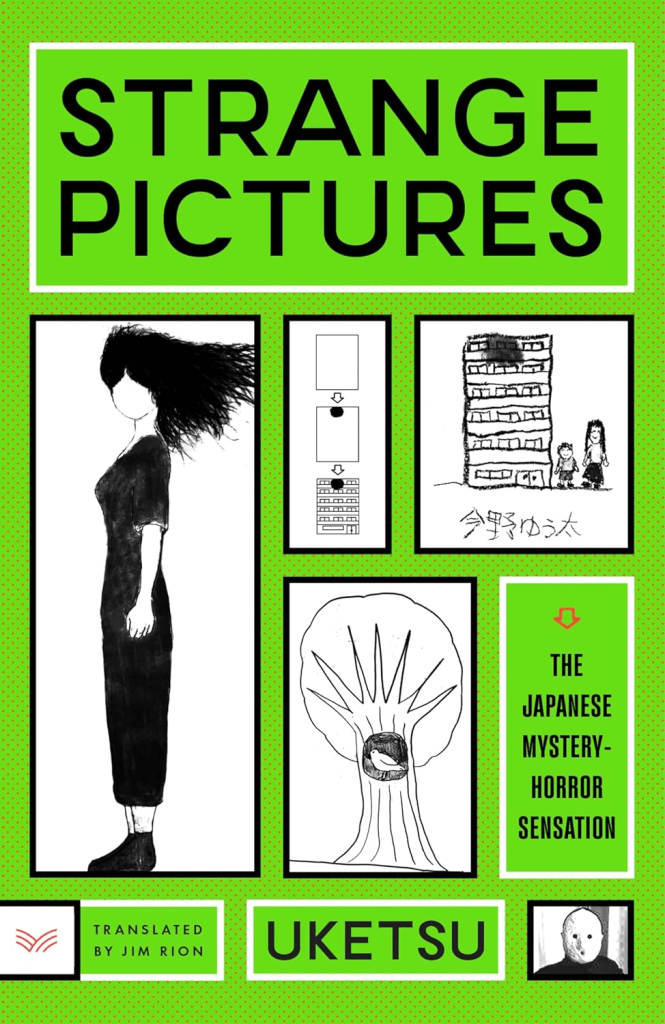
Strange Pictures, my translation of 変な絵 by Uketsu, was published January 16 in both the United Kingdom and the United States. The two versions are the same translation but tweaked for local audiences a bit. Interestingly, the UK version is being marketed as a mystery, while the US is leaning more towards horror. Both are perfectly correct, because Uketsu calls himself a horror writer while clearly using mystery styles and tropes in the books.
The UK cover for Strange Pictures from Pushkin Vertigo
With the release of this book a bit behind us, I’d like to discuss a couple of issues that I dealt with in the translation. Before we go on, let me just say that some of these are spoilery, so PLEASE. If you haven’t read the book yet, save this post for after that.
US cover for Strange Pictures from HarperVia
**Spoilers for Strange Pictures Ahead! You have been warned!**
The first tricky issue that comes to mind when I look back on translating Strange Pictures deals with the second chapter, centered on young Konno Yuta. Within the story, Yuta is learning to write his name in Japanese characters, “kanji,” for the first time. That stirs a memory of seeing his mother’s gravestone, and he starts to draw that gravestone, but changes his mind and converts it to a picture of the apartment building where he lives now with his grandmother—his “mama.” That picture starts out with a large rectangle in which he begins to draw his family name in Japanese: 今野. A fellow student later tells the teacher she saw him draw “A triangle inside a rectangle.” Looking at the first character, of course, you can see the triangle at the top.
Now, how do do all this in English? Well, I kept the Japanese. Indeed, since the reader doesn’t need to READ the Japanese, only see the shape of the character, it seemed obvious. Particularly since the child wrote his name in crayon on the picture, so it’s already evident to readers. I’m hoping that it doesn’t confuse anyone. But we shall see!
The second issue was, well, trickier. It involves the name of a blog that comes up in the very first chapter, and gets a call back at the end. The blog in Japanese is 七篠レン こころの日記, Nanashi Ren kokoro no nikki. It translates to something like “Nanashi Ren’s Diary of the Heart.” The problem is the personal name: Nanashi Ren. This is both a pun, as “Nanashi” can also mean “No-name” AND it turns out very late in the book to be a little trick related to the core mystery.
The trick is complex and based on the fact that in Japanese, there are three writing systems. Kanji are Chinese characters, complex figures that can have both a meaning and a number of “readings,” meaning the pronunciation attached to them. Then there are hiragana, a phonetic system used to write out the readings of words, without the kanji there to carry extra meaning. Finally, there are katakana, a similar system to hiragana that is visually different and used for, well, various purposes to stand out from hiragana.
Hiragana themselves are made of up a few strokes that come together to form characters, but can also sometimes resemble other characters.
It works like this: In the original Japanese, the actual author of the blog is Konno Takeshi 今野武司、or こんのたけし in Hiragana. He creates a pseudonym by breaking the elements of those hiragana up into parts that resemble other hiragana or katakana, mixing them up, and making a new name to which he matches a kanji. There’s a diagram in the original that makes it easier to parse, but it’s super complex and OBVIOUSLY impossible to do in English.
I mean, to be honest, it barely works as a “trick” in Japanese. No one would ever figure it out without being told, because it’s just too complex and arbitrary. It also only fits part of the actual title in Japanese. It’s one of those things that seems incredibly clever after the fact, but nothing within the book itself could guide readers to it.
So, after hours, days, weeks of going back and forth over it, I finally decided with the editor at Pushkin, and Uketsu’s blessing, that we should just use an anagram. Then, having decided that, we couldn’t find any satisfactory anagram using Takeshi Konno. At which point, the editor at Harper Via chimed with with the idea of using some other Japanese name, and with Uketsu said OK. So, that’s how Nanashi Ren Kokoro no Nikki written by Konno Takeshi became Oh No, Not Raku! written by Haruto Konno.


 Jim Rion - Translator & Writer