Translating The Ark

I do, in fact, translate more than just Uketsu books, and on February 12th the latest such was released in the UK.

The Ark by Haruo Yuki.

The Ark is a mystery/thriller in the honkaku mode. It tells the story of a group of seven friends from university who meet up and hike to an old abandoned underground facility one of them found. They end up deciding to stay the night and a family of three also show up, rather mysteriously, then they all get trapped when an earthquake blocks the door.

Complications start piling up, and then bodies start piling up, and the whole thing becomes a tense, claustrophobic journey into pitch-black nihilism. This is a book where the ending hits like a punch in the gut.

Translators often talk about the linguistic challenges of the job, of trying to find the right way to convey the author’s message and so on.

It’s less common, I think, to talk about the emotional element.

The act of translation starts (and proceeds, and ends!) with reading. Reading deeply. Reading repeatedly. Eking out all the nuance and meaning I can from a work. I can’t speak for everyone, but when I translate a book I get emotionally invested in a way I rarely do otherwise. I have to, or the whole thing falls flat.

Which means that in translating a dark work like this, I am immersed in all that bleakness and cold-blooded murder for literal months.

It was hard to translate The Ark. Unpleasant. It weighed on me.

Which is not to say there is anything wrong with the book. It’s tight, clever, and written from a place of real care for the genre. It’s a good book. Very good.

But it’s not a happy one. I was glad when I was finished with this one.

And now it’s out there for readers to experience for themselves. There are some who will love the weight of the tension, like a mountain hanging above your head. Others will hate the breathless atmosphere of creeping doom, like water slowly rising up to steal your breath. But for fans of deduction-focused mysteries and darker tales, I think this one will satisfy indeed.

Exploring Choice in Translation – A Case Study

A lot of the talk about translation done by people who don’t think all that deeply about it—even professional translators!—focuses on things like accuracy and faithfulness, but I find that tends to work around assumptions that are worth investigating. Like, when something is “accurate,” we tend to think of it as closely reflecting some kind of observable truth or fact. In the case of, say, a machine manual, accuracy does often come down to a reflection of the physical specifications of the machine and its use.

But when we are translating communication of a less tangible sort, things aren’t so clear. Even in the realm of non-fiction, writers often layer intent and meaning and reference in ways that force translators to decide which layer to convey in the translation, because there is no sensible way to convey them all together in the same way as the original does. They have to choose.

I was recently reading a book in translation that got me thinking about that kind of choice.

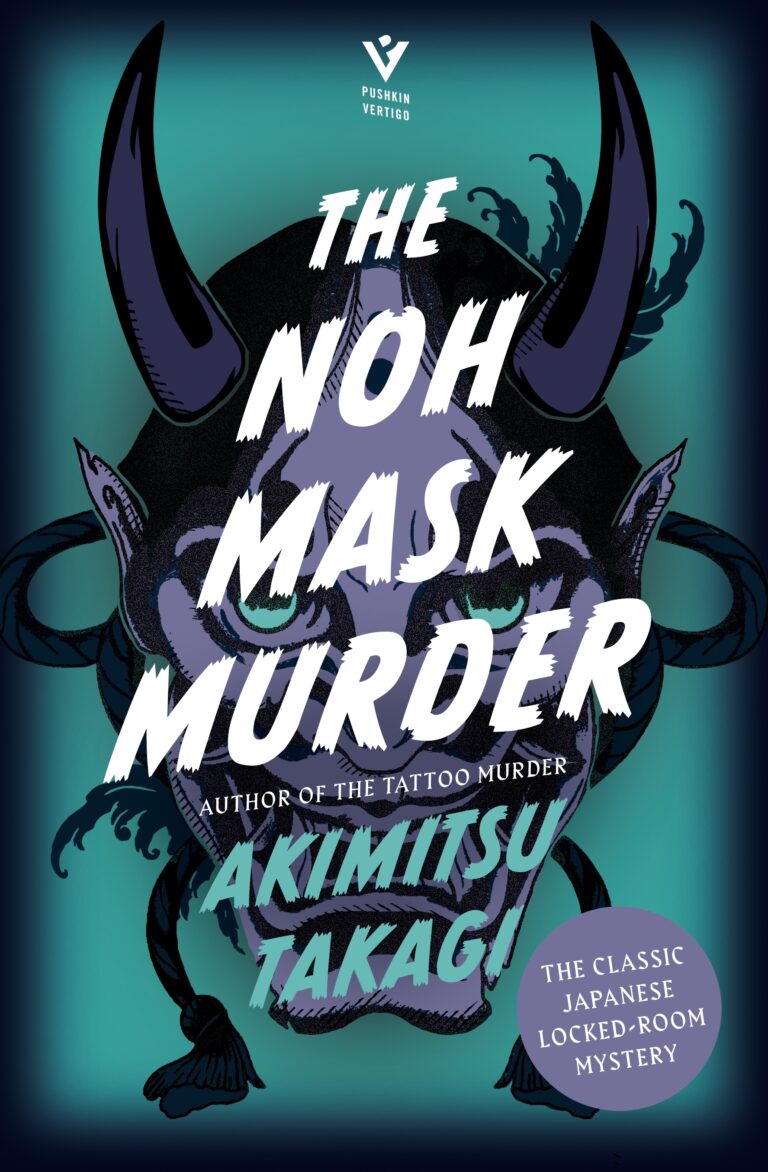
The cover of The Noh Mask Murder by Akimitsu Takagi. It features a blue-green background with a drawing of a horned, demonic mask.

The book was The Noh Mask Murder by Akimitsu Takagi in a translation by Jesse Kirkwood. Now, let me preface this by saying the translation was great. The book itself is lurid and its prose rather purple, but Kirkwood made it readable and interesting. So, don’t even think of taking anything I say here as a criticism.

But there was one single passage that made me stop and wonder, really wonder, what was going on, and it had nothing at all to do with the murder.

The scene is this. Near the beginning of the book, we are in the POV of an older public prosecutor reminiscing about attending a local festival with a lost love. He says “and yet the face of my companion back then, asking me to wait while she bought me a whelk egg case, had been lost to the winds of time.”

Record scratch.

Whelk egg case? What the fuck? I’ve lived in Japan for over twenty years. I’ve been to countless small town festivals and fish markets. I’ve never, ever seen a whelk egg case at any of them. I do know that whelks themselves are fairly popular seafood, so I could only assume it was some kind of regional dish. But “egg case?” Not “eggs” or “egg sac” or some other more… Appetizing word?

I had to figure this out, for my own sake. My dictionary told me that the Japanese for “whelk egg case” is 海ホオズキ umi hoozuki and a quick google search brought me to a page on Wikipedia with the explanation: “かつての日本ではグンバイホオズキ等の卵嚢が、口に含んで音を鳴らして遊ぶ使い捨ての玩具として縁日や海辺の駄菓子屋で売られていた。” Or, roughly, “Once, in Japan, the egg cases of whelks were used as a kind of disposable toy, taken into the mouth to make noise, often sold on fair days or at cheap snack shops near the seaside.”

Further searching took me to this Japanese page that talks about how they used to be sold. It describes a “buzzing” sound when you use them. So… You put them in your mouth and blow, and they make a buzzing sound

They’re like kazoos. Weird, snail-made kazoos.

Which, in fact, subtly changed my reading of this (mostly unimportant) scene. Without the investigation, I assumed it was some little seafood snack. So, the man is wistfully remembering a thoughtful girl who bought him food when he was hungry. But after I knew what was going on, my view of the girl changes. She’s whimsical, fun, trying to buy the serious guy a little children’s toy at a festival stall.

She’s the playmate rather, than the mother figure.

Now, I have no way of knowing the late writer’s intent. My experience of the reading in both cases might be totally different from someone else’s. But this, I think, is a very clear example of how even a very minor choice can influence the reading experience of a translation.

Kirkwood translated 海ホオズキ 100% accurately as “whelk egg casing” and was perfectly justified in doing so. That’s what the writer wrote, end of story. Mostly.

But. If I had translated this, I might well have chosen to translate it “kazoo” or even “whistle.” Because that would better convey what I felt was happening between those two people at that local festival to readers in English, which arguably is more valuable to readers than accurately translating the word 海ホオズキ. To once again paraphrase Damion Searls, it’s about translating the usage rather than just the word.

Now, I have no idea what kind of path led to the choice that Kirkwood made. Or even if it was a choice as such. He might not have given it all that much thought. I also know that editors have enormous say in the final choices made in a book, so there might have been some behind the scenes conversation about this. Or not. Who knows!

So, let me once again reiterate that I do not, in any way, shape or form, even want to imply that there is something wrong with this translation. There isn’t! It’s just an interesting thought experiment about choice, “accuracy,” and the reading experience.