The Japan Association of Translators Book special interest group has invited me to speak online about my budding career as a literary translator and my work translating Uketsu.
I plan to lay out how I got started on this path, the luck behind the Uketsu translations, and perhaps find some advice for those looking to get into the game themselves.
The schedule is April 18th from 3:00-4:30, Japan time. It’ll be on Zoom.
My English translation of Uketsu’s third, and longest, novel is out now worldwide.
The UK cover for Strange Buildings
Strange Buildings expands and improves on the core concept of Strange Houses, creating a multilayered narrative around the designs of 11 different buildings, which all end up woven into a much greater, and darker, story.
It reads to me as a much more mature, more assured work and I think it’s Uketsu’s best.
There was a lot to deal with in this one, as the many different chapters, or “Files,” take on different approaches and tones, giving me room to play with a variety of voices.
For example, in the excerpt from the old book in File 3, “The Watermill in the Woods,” I aimed for an old fashioned, somewhat stilted style, while File 7, “Uncle’s House,” called for the voice of a clever, if unschooled, boy.
It was a satisfying challenge to work on.
There is one big issue that arose in the translation that I would like to discuss, but it’s a bit of a spoiler. If you haven’t read the book yet, go do that now and come back when you’re done.
So, be warned:
MINOR PLOTSPOILERAHEAD
In the File 9, “Footsteps to Murder,” Hiroki Matsue reveals that he believes his father, who happens to be a Christian, murdered his mother and set fire to their house.
Later, our “great detective” Kurihara reasons this accusation away. Now, in the original Japanese version, his entire argument is basically: Mr. Matsue was not only Christian, his crucifix pendant indicates that he is Catholic, and the Catholic religion strictly forbids murder.
In Japan, where readers are by and large only vaguely aware of what being a Christian actually entails, that might fly. But not in any Western country, that’s for sure. I mean, come on, watch The Godfather. The climax of the movie is proof enough that it’s a flimsy idea.
Anyway.
My editor at Pushkin and I brought this up to Uketsu and proposed a couple of changes. We recommended adjusting the Christian angle to include pacifism and activism, but most importantly, we wanted to add an actual logical argument that helped take Mr. Matsue off the suspect list.
Uketsu agreed, and the story was changed.
I am generally uncomfortable with the idea of changing actual story points, and would never do so without active input from the author, but seriously, that particular idea struck me as nearly fatal to the story. I could see quite a few readers in the West refusing to take the book seriously after an argument like that. But, again, most Japanese readers wouldn’t even bat an eye at it. Only about 1% of the population is Christian here, so most people here don’t even know a believer.
So, we had a very successful book in Japan that we were pretty sure needed more than just words changed to really succeed in English. It needed structural changes, too. I think it worked out pretty well, and the core of the story remainss exactly as Uketsu intended it.
2026 is well under way. January has blurred by, and as February approaches I am stunned to realize that I have two translations coming out next month.
First up is a title that has probably flown under the radar for many. The Ark by Haruo Yuki is a dark mystery about a group of university friends and one hapless family trapped in a bizarre underground building after an earthquake. Not only are they in danger of drowning as water floods the building with no way out, one of their group begins murdering the others for unfathomable reasons.
This one was, if I’m honest, very difficult to translate. Not on a technical level, but on an emotional one. Translation is an act of reading. The deepest kind of reading. As a translator, I try to wring every bit of nuance out of a book, plumb the depths of every reference, and to do that I have to read the book repeatedly. And this one is bleak. Almost nihilistic. But at the same time, it is a deeply clever book, and compelling in its exploration of how people behave in the most extreme of situations.
I think this one will appeal particularly to hard-core mystery fans. It comes out February 12, 2026 from Pushkin Vintage Press.
And later that month comes the long awaited Strange Buildings by Uketsu. This is his third novel, and the follow-up to Strange Houses. It is an entirely new story, but once again features “The Author” and Kurihara looking into secrets hidden within floor plans. This time, the chilling mystery spreads across Japan and goes into some of the darkest places imaginable.
It really feels like a bit step up for Uketsu as an author. More ambitious, more confident, and more skillful. If you liked either of his other books, you will LOVE Strange Buildings. But do be warned: it includes frank discussion of the exploitation of women and children, and heartbreaking descriptions of child abuse.
And, of course, I have not been sitting idle in the meantime. I have two more translations underway, with another two in contract negotiations. Keep your eye on this blog for updates!
I seem to have become known as “Uketsu’s English translator,” which is certainly not a bad thing to be. But it does mean I get quite a lot of questions about the works, some of which I can’t even answer. Like, no, I don’t know how Uketsu got his ideas. No, I haven’t seen under his mask.
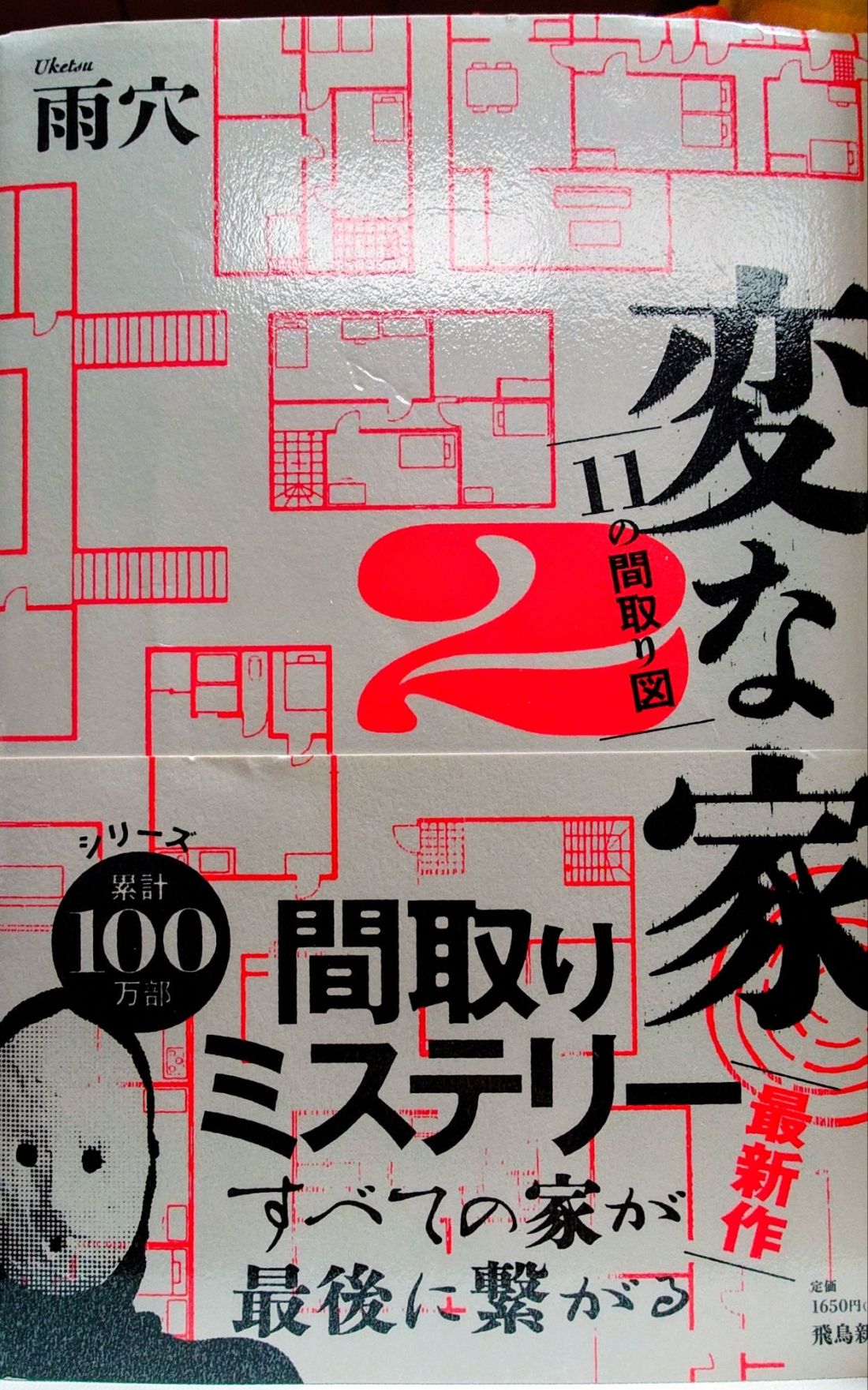
The Japanese cover to Henna Ie 2, coming soon in English as Strange Buildings.
But some questions, I can answer. And the most common of those is: Are you translating more Uketsu?
The answer? Yes, yes I am.
Uketsu currently has four books in print. Henna Ie (Strange Houses), Henna E (Strange Pictures), Henna Ie 2 (Strange Houses 2), and Henna Chizu (Strange Maps). Obviously, the first two are out and selling like hotcakes.
Henna Ie 2 is currently in editing and is scheduled for release in February 2026 under the title Strange Buildings. It’s quite an ambitious book that takes the core idea of Strange Houses in totally wild new places. It is also extremely dark, and there are some disturbing elements that are a departure from the first two books.
Henna Chizu was just released in Japan and the plan is certainly in place, but work hasn’t started yet. I have read the book, though, and it strikes me as the closest to a conventional “mystery” of all Uketsu’s work. It’s kind of a Kurihara memoir, talking about a puzzle in his family history, and he gets to play the great detective, solving not only his own family mystery but a couple of other murders. It should be a fun one to translate, with a very neat little trick. It also delves into Kurihara as a character and makes him quite human.
So, yes, there are more strange Uketsu books coming in English. I hope you all enjoy!
It has been a couple of months since Strange Houses, Uketsu’s debut novel in Japan and second in English translation, came out in both the US and UK. I figure it’s about time to address some of the particular issues translating this one, given that people have probably had a chance to read it.
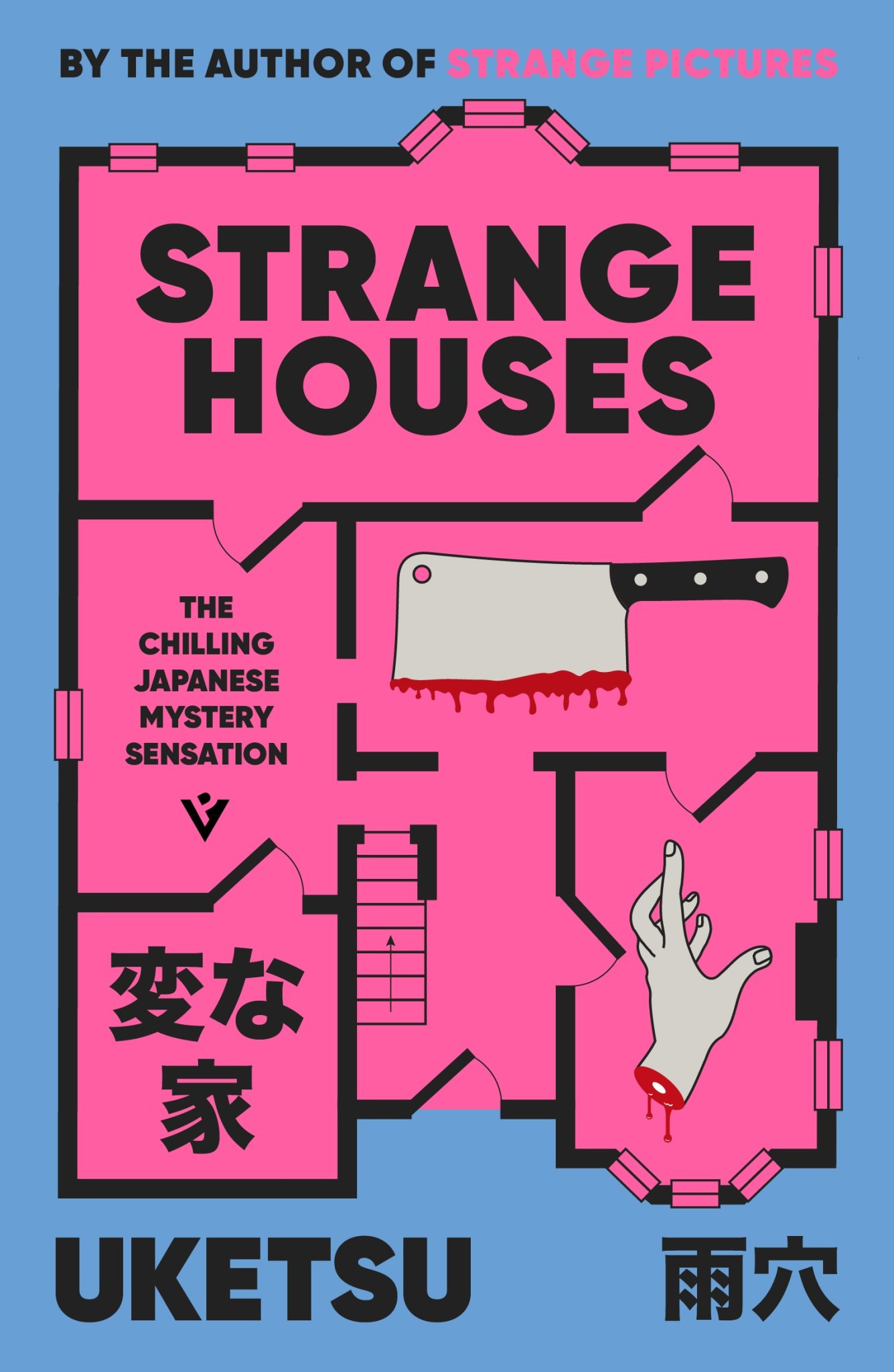
The UK cover of Strange Houses by Uketsu.
Just to warn you, this is not a spoiler free effort. I won’t go out of the way to include hidden details, but I’m going to go where I’m led.
So.
To recap a bit, I first encountered Uketsu as a YouTuber. My wife became a fan during the height of the pandemic and introduced me in 2022. I shared her interest, but being more interested in books than videos, I was pleased to see that he was also publishing books. Strange Houses actually began from a long-form video and a simultaneous story published on the fiction site Omokoro. An editor at the publisher Asuka Shinsha then reached out to Uketsu and said it would make a great novel if expanded. The existing story became the first chapter of the novel, and I think this helps explains some of the roughness that people might notice in Strange Houses as a whole. Don’t get me wrong, I love the mood and characters it introduces, but in terms of storytelling it is a little loose. And the ending is… Eh. It has its flaws, though I honestly believe the charms outweigh them.
That story is about a friend reaching out to Uketsu about an odd house he was thinking of buying. Poking into the house’s design, Uketsu’s other friend, Kurihara, speculated that the house had been designed for the purpose of murdering and dismembering people. The original friend ended up not buying the house because a dismembered body was discovered in a nearby wooded area and it just felt like a bad omen.
Now, here is where we get to the “translation issue.” In the original publication, that first dead body—the dismembered body missing its left hand, which becomes a significant plot point as other bodies missing hands are discovered—is never mentioned again. The conclusion seems to wrap up all kinds of plot points, but no one even says “Hey, what about that one guy.”
The English editor and I were both rather nonplussed by that. It seemed a rather significant plot point, indeed the instigating incident for the whole book, to just let fade into nothing.
We reached out to Uketsu about this, and about the possibility of adding something, even some simple comment like “It’s crazy that the first body was just a coincidence” so it didn’t feel like people just forgot about a whole dismembered body.
His response was initial surprise, since, as he said. “In the two years since publication not a single person has even asked about that.” But then he said that there was a new mass market paperback edition (or bunkoban) coming out in Japan with a new Afterword “by Kurihara,” which added some doubts and twists to the story as recounted by the fictional Uketsu. Real world Uketsu proposed both adding the Afterword to the English version and making some adjustments that would incorporate the initial body into the doubts Kurihara expressed, which was both a rather neat solution to our doubts and a very cool idea in general.
What this also means is that the English version of Strange Houses is in a very real way a different story from either version in Japanese—and I want to emphasize, it was made so by Uketsu himself. This wasn’t some rogue decision by the editor and I.
I think this should tell you something about the “literary” translation process. On top of cultural/linguistic issues, translators are some of the closest readers you’ll ever find. We dig deep, deep, deep into the stories we translate because, honestly, most of us are terrified of missing something important. We get confused. Sometimes it’s because we do miss things. Sometimes it’s because the author missed something. And sometimes it’s because of a gap in values, world-view, or cultural assumptions. And that’s where we, as translators, start to dig and clarify so we can ensure that the readers of the translated story have the best experience possible.
It also speaks to the role of editors. I think many people assume that in publishing, the author is some kind of towering, monolithic talent whose words are inviolate. It just isn’t true. Editors have enormous power to shape a story and even an author’s voice, and almost always for the better. You think it’s a coincidence that F. Scott Fitzgerald, Thomas Wolfe, and Ernest Hemingway all just happened to be discovered by the same editor? Look up Maxwell Perkins. It is an edifying example of how editors can influence literary output. The same is true of translation, perhaps even more so. See my review of Who We’re Reading when we Read Haruki Murakami for more on that.
So, yeah, it turns out that published stories are far more collaborative than is often believed. That’s not a bad thing! It makes the experience better for readers, if a bit stressful for writers…


 Jim Rion - Translator & Writer