The Japan Association of Translators Book special interest group has invited me to speak online about my budding career as a literary translator and my work translating Uketsu.
I plan to lay out how I got started on this path, the luck behind the Uketsu translations, and perhaps find some advice for those looking to get into the game themselves.
The schedule is April 18th from 3:00-4:30, Japan time. It’ll be on Zoom.
I seem to have become known as “Uketsu’s English translator,” which is certainly not a bad thing to be. But it does mean I get quite a lot of questions about the works, some of which I can’t even answer. Like, no, I don’t know how Uketsu got his ideas. No, I haven’t seen under his mask.
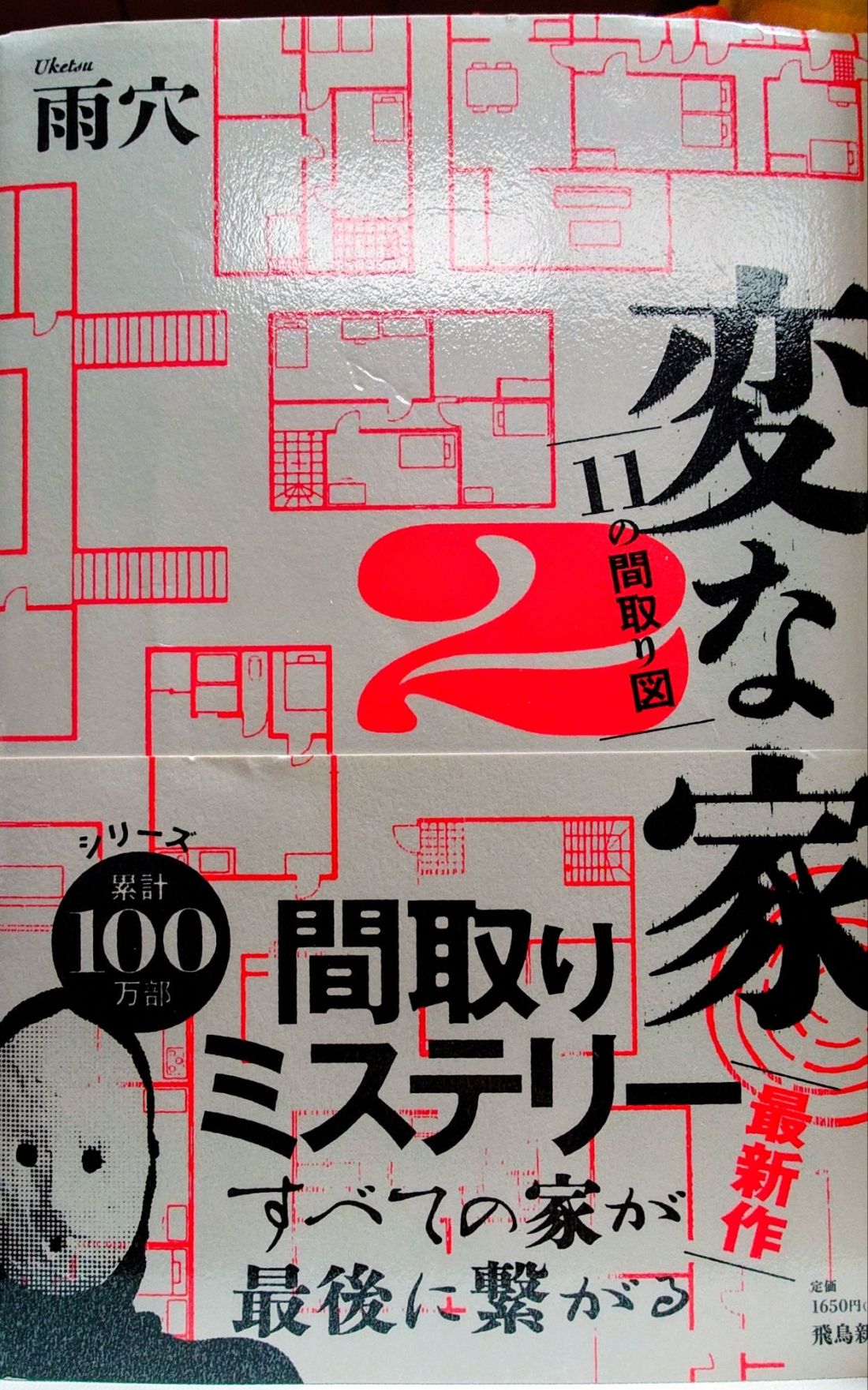
The Japanese cover to Henna Ie 2, coming soon in English as Strange Buildings.
But some questions, I can answer. And the most common of those is: Are you translating more Uketsu?
The answer? Yes, yes I am.
Uketsu currently has four books in print. Henna Ie (Strange Houses), Henna E (Strange Pictures), Henna Ie 2 (Strange Houses 2), and Henna Chizu (Strange Maps). Obviously, the first two are out and selling like hotcakes.
Henna Ie 2 is currently in editing and is scheduled for release in February 2026 under the title Strange Buildings. It’s quite an ambitious book that takes the core idea of Strange Houses in totally wild new places. It is also extremely dark, and there are some disturbing elements that are a departure from the first two books.
Henna Chizu was just released in Japan and the plan is certainly in place, but work hasn’t started yet. I have read the book, though, and it strikes me as the closest to a conventional “mystery” of all Uketsu’s work. It’s kind of a Kurihara memoir, talking about a puzzle in his family history, and he gets to play the great detective, solving not only his own family mystery but a couple of other murders. It should be a fun one to translate, with a very neat little trick. It also delves into Kurihara as a character and makes him quite human.
So, yes, there are more strange Uketsu books coming in English. I hope you all enjoy!
Strange Pictures, my translation of 変な絵 by Uketsu, was published January 16 in both the United Kingdom and the United States. The two versions are the same translation but tweaked for local audiences a bit. Interestingly, the UK version is being marketed as a mystery, while the US is leaning more towards horror. Both are perfectly correct, because Uketsu calls himself a horror writer while clearly using mystery styles and tropes in the books.
The UK cover for Strange Pictures from Pushkin Vertigo
With the release of this book a bit behind us, I’d like to discuss a couple of issues that I dealt with in the translation. Before we go on, let me just say that some of these are spoilery, so PLEASE. If you haven’t read the book yet, save this post for after that.
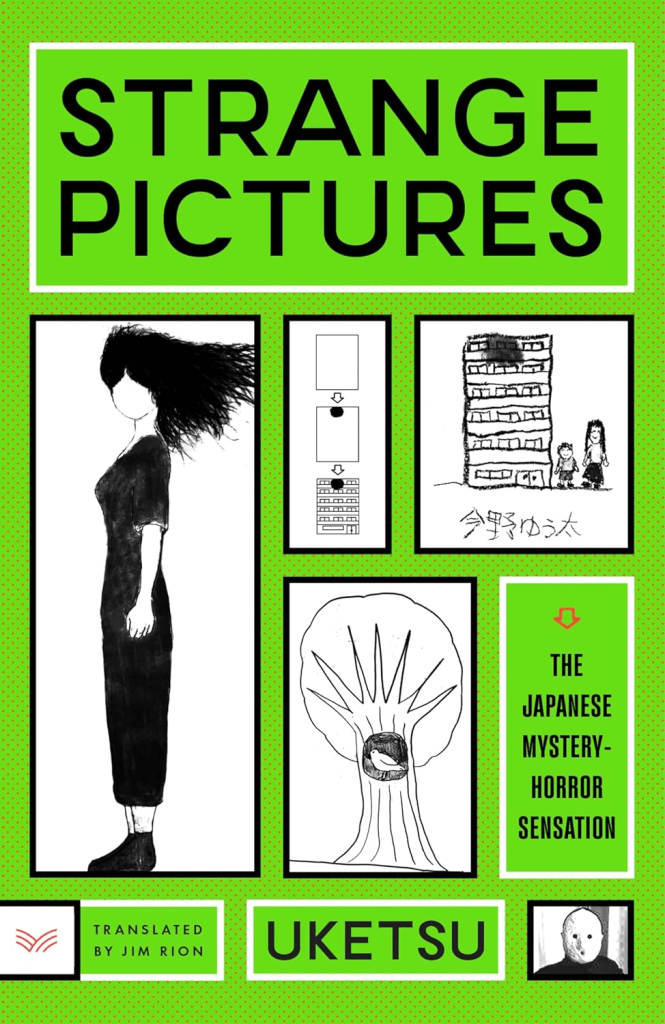
US cover for Strange Pictures from HarperVia
**Spoilers for Strange Pictures Ahead! You have been warned!**
The first tricky issue that comes to mind when I look back on translating Strange Pictures deals with the second chapter, centered on young Konno Yuta. Within the story, Yuta is learning to write his name in Japanese characters, “kanji,” for the first time. That stirs a memory of seeing his mother’s gravestone, and he starts to draw that gravestone, but changes his mind and converts it to a picture of the apartment building where he lives now with his grandmother—his “mama.” That picture starts out with a large rectangle in which he begins to draw his family name in Japanese: 今野. A fellow student later tells the teacher she saw him draw “A triangle inside a rectangle.” Looking at the first character, of course, you can see the triangle at the top.
Now, how do do all this in English? Well, I kept the Japanese. Indeed, since the reader doesn’t need to READ the Japanese, only see the shape of the character, it seemed obvious. Particularly since the child wrote his name in crayon on the picture, so it’s already evident to readers. I’m hoping that it doesn’t confuse anyone. But we shall see!
The second issue was, well, trickier. It involves the name of a blog that comes up in the very first chapter, and gets a call back at the end. The blog in Japanese is 七篠レン こころの日記, Nanashi Ren kokoro no nikki. It translates to something like “Nanashi Ren’s Diary of the Heart.” The problem is the personal name: Nanashi Ren. This is both a pun, as “Nanashi” can also mean “No-name” AND it turns out very late in the book to be a little trick related to the core mystery.
The trick is complex and based on the fact that in Japanese, there are three writing systems. Kanji are Chinese characters, complex figures that can have both a meaning and a number of “readings,” meaning the pronunciation attached to them. Then there are hiragana, a phonetic system used to write out the readings of words, without the kanji there to carry extra meaning. Finally, there are katakana, a similar system to hiragana that is visually different and used for, well, various purposes to stand out from hiragana.
Hiragana themselves are made of up a few strokes that come together to form characters, but can also sometimes resemble other characters.
It works like this: In the original Japanese, the actual author of the blog is Konno Takeshi 今野武司、or こんのたけし in Hiragana. He creates a pseudonym by breaking the elements of those hiragana up into parts that resemble other hiragana or katakana, mixing them up, and making a new name to which he matches a kanji. There’s a diagram in the original that makes it easier to parse, but it’s super complex and OBVIOUSLY impossible to do in English.
I mean, to be honest, it barely works as a “trick” in Japanese. No one would ever figure it out without being told, because it’s just too complex and arbitrary. It also only fits part of the actual title in Japanese. It’s one of those things that seems incredibly clever after the fact, but nothing within the book itself could guide readers to it.
So, after hours, days, weeks of going back and forth over it, I finally decided with the editor at Pushkin, and Uketsu’s blessing, that we should just use an anagram. Then, having decided that, we couldn’t find any satisfactory anagram using Takeshi Konno. At which point, the editor at Harper Via chimed with with the idea of using some other Japanese name, and with Uketsu said OK. So, that’s how Nanashi Ren Kokoro no Nikki written by Konno Takeshi became Oh No, Not Raku! written by Haruto Konno.
There is a part of me that is almost embarrassed at the fact that, after having written and published one book, and having three translations published, with two more scheduled in the next year, I am JUST NOW realizing that hey, maybe I’m not just faking this? Maybe I’m in the book business?
I have been a reader since, well, ever. I think I started reading when I was five, and by the time I was in first grade I was burning through the library. Books were just… There. They were a fundamental building block of my identity. It’s not even something I consciously thought about, but hey. I love books and the reading (and purchasing, borrowing, lending, touching etc. thereof) about as much as anything I can think of.
And of course I always toyed with writing, the way a cat toys with a mouse that it never really intends to eat. “Someday, I shall pounce and then success will be mine!” I would think, while my prey sneaked away, limping but triumphant. Because, of course, writing takes perseverance and dedication and effort, and I sometimes fail to find those virtues in stock.
But now that I am not only someone whose name is on book covers, but someone whose name is familiar to PUBLISHERS and AUTHORS (a famous horror author just posted a pic of his ARC of Strange Pictures, with my name on the cover!!!), I think I can finally admit… This is something that I’ve wanted, without really knowing it, all my life.
I think I must have always wanted to be a book person. A writer, an editor, a guy in the biz. And I think that’s what I’ve got now. I’m visiting a book publisher and two international rights agencies in Tokyo at the end of the month. When I mentioned I would like to visit, they all said “Great! We’d love to meet! When?” rather than “Who are you again?”
The feeling of that. The—admittedly ego-centric, selfish, privileged, yes, I am so privileged and lucky but still—DAMN GOOD feeling of it is something else. I don’t deserve to have this good a life, but it’s here. So I guess I’ll live it.
There’s this… I suppose “content creator” is the right term, though I hate it, in Japan called Uketsu. Uketsu is a mystery. He (it seems they’re a he, or at least the agencies involved have confirmed that for international sales purposes) writes articles for websites, creates narrative and music videos on YouTube, and publishes books, all in this very strange overlap of creepy, humorous, and cute. Uketsu appears in a black body suit and white mask, and uses a voice changer set to a rather cute, high pitched tone.
My first hint that Uketsu should be a “he.” Internet Writing Man…
My wife started out watching the videos in late 2021, I think, and got me hooked. Then I found the articles, and soon came the books, and my translator sense started tingling. I wanted to bring this very odd, very unusual ouevre to English audiences, and I thought it would sell. So, around the end of 2022, I put together a little sample of the debut book Strange Houses (変な家) and author intro for Pushkin Vertigo, with whom I had just finished working on Seishi Yokomizo’s The Devil’s Flute Murders (available now wherever you buy your books!). I sent it—as well as my strong personal recommendation to get on this very new, very original author—to Daniel Seton, the editor I’d worked with on that previous book. I made sure to mention my belief that, while Strange Houses was a fascinating book, Uketu’s second Strange Pictures 変な絵, was perhaps a more solidly structured, more confident work. Pushkin started doing their whole thing.
The video that started things off, Strange Houses 変は家, with English subtitles.
I’ve only seen the process from the outside, so I can’t say exactly how it works. I’m assuming there was some kind of internal meeting and review process, and they probably asked someone else to read the books and give impressions. I know for sure that last does happen because I’ve done it for other works. Anyway, sometime in the spring of 2023, Pushkin told me that they had made a successful offer on Uketu’s two books (these have since been announced officially, so I think I’m safe to say that much) and Daniel asked if I would be available to translate them.
Of course, of course, of course.
At that point, it was simply a happy outcome. I had set my sights on getting a project through, and it had been successful. I could get about my work as a translator, like I had so many times before.
Then, things began to change. It started to feel like this was going to be a big deal.
Earlier this year, right around when I finished the initial draft for Strange Pictures—which Pushkin (rightly, in my opinion) decided to release first, despite it technically being Uketsu’s second book—I heard that the author had become “the” hot topic at the Frankfurter Buchmesse, the largest international book event in the world. Someone from a major international author agency contacted me because they were handling international rights for all the languages except English (since Pushkin had beaten everyone else to the punch on that…) and wanted my help putting together PR material. Pushkin asked me for quotes to use in their press releases and promotional materials.
I’d never experienced that sense of being “plugged in” with anything before. My previous translations for publication had been much more subdued, even with the Yokomizo book. It’s all very unexpected, and I don’t know what might be coming next. There’s this silly little part of me that’s like, “Movie deal when? Netflix series next?” but of course, I’m just the translator. None of that has anything to do with me.
Still.
It feels new. It feels exciting to be part of a thing that makes a splash. I’m glad I could help share Uketsu’s very weird but very fun work with a broader audience and I hope it brings him more well deserved success. Whatever comes, I think it’s OK to feel a bit of pride that I helped get Pushkin and Uketsu together before anyone else.
When the time comes, I plan to post something a bit more detailed about the books as they come out, but for now, take this as an announcement, too. Strange Pictures is scheduled for release in January 2025 from Pushkin Vintage, translation by me. Jim Rion. Strange Houses will follow. Both have also been sub-licensed to an American publisher, but I don’t know their schedule.


 Jim Rion - Translator & Writer