The Jason Ogg Theory of Luck

I’m a lucky guy, all in all. Bad things have happened in my life, but I’ve made it through them more or less intact. I have a loving, healthy family. A career that is basically ideal. And through it all, I’ve been able to experience the world in ways I never dreamed of.

I sometimes feel like I’m so lucky it’s kind of scary. Because luck can turn on you in an instant, can’t it? All this can disappear like a tears in the rain (IYKYN). That thought has haunted me in a very real way, and I think I’ve developed a weird psychological tick because of it.

The thing that made me understand my own way of interacting with life’s vicissitudes was a bit in one of Terry Pratchett’s Discworld books, about the blacksmith Jason Ogg. Because of the fundamental importance of a skilled blacksmith, and the magical nature of the Discworld, Jason Ogg can shoe anything. Donkeys, unicorns, even Death’s pale horse. But to have the power to shoe anything that comes to you for shoeing, you have to shoe anything that comes. If Death comes to you to shoe his horse, you shoe his horse. If your drunk friends bring an ant for shoeing as a joke, you shoe the ant. If you deny the request to use a power, you lose the power.

A blessing must be used, or you lose it. That is how I have come to interact with what I view as my luck. In practical terms, that means that if a chance that seems “lucky” comes along, I take it.

When someone emailed me years ago asking if I was interested in coming to Japan to teach English, I wasn’t, actually. But it seemed like a lucky chance, so I took it. And now I have lived in Japan, happily, for two decades.

When my barber asked if I wanted to go out to dinner with him and his niece, whom I had never met, I went. I married his niece a year later.

When my wife and I went for a walk one day in the neighborhood and saw a house with a for sale sign in the window, we took a tour and made an offer that day because it felt perfect to me. We’ve lived in it for almost 11 years now, and never plan to move.

This tendency of mine, to say “yes” to pretty much every major opportunity that comes down the line has also guided my career. It’s how I survived the bankruptcy of the English school I first worked at, it’s how I became a semi-regular TV guest, and it’s now guiding my literary translation work.

As if to reinforce the idea, the lucky chances keep coming, and I’ve not had to say “no” to any yet. That idea, that I have not had to say no, is perhaps the other half of my theory of luck. Because, if you want to say yes to opportunities, you need to be able to take them. You need skills, flexibility, time, attitude… You need to be open and prepared. Which is why I study things almost constantly, because you never know when you’ll need to know, oh, trends in the Japanese mystery publishing industry.

Anyway. I was just thinking about this, because sometimes I wonder what would have happened if I had said “no” to some of the things that have come along. But all in all, I’m glad I didn’t.
Enough with the LLM BS, Already

I know that, in doing this, I contribute to the problem in its own way, but I simply can’t bear it anymore.

The AI frenzy I have seen among my fellow translators has to stop. It feels like I’m watching otherwise intelligent, literate folks suddenly spouting flat earth theory.

LLM/Generative AI/Whatever you want to call it doesn’t actually do what it says it does. It isn’t a useful tool. It doesn’t think, it doesn’t translate, it doesn’t explain. LLMs are sophisticated statistical algorithms that spit out words they got off the internet in “likely arrangements.” Any meaning that those words seem to have is provided solely by the reader. Any time you ignore the fact that nothing of what LLMs generate is rooted in factual reality, you are deceiving yourself. The idea that some part of the communication might be “wrong” is, in itself, a mistake. It’s all generated the same way, from statistical analysis and algorithmic generation. The good and the bad are both equally likely. Seemingly accurate BS and clearly inaccurate BS are both equally BS.

The industry calls LLM mistakes “hallucinations” but they’re really just expressions of the nature of the beast.

https://www.lakera.ai/blog/guide-to-hallucinations-in-large-language-models

The great success of LLMs is only in that they *feel* right, so no one really takes the time to check if they are, actually, so. It certainly seems amazing that the words string together in clear sentences that we can interpret as more or less connected to our prompts. But we are professionals at working with words. We should be holding our work to a higher standard that “Eh, it feels right.”

Because folks, there’s nothing under there. It’s empty. Let’s take a recent Facebook post froma a translator I saw. It was a query about the pros and cons of different translations of a tricky term. The results included sources, for example, and a lot of double talk that boiled down to “it all depends on the context.” If you actually took the time to read those sources, though, none of them actually supported any of the points of the response. They were just linked by including the terms in question. Sometimes. One of them was actually Vietnamese, which is odd given that the query was in English and talking about Japanese. But it had a (poor) English gloss of a phrase including the term, so… Source?

That is what LLMs *do*. They were trained not to be right, but to sound right. To be really convincing liars. (Which is actually a pretty easy thing to get away with when discussing elevated academic ideas, because they’ve been dominated by empty bloviating for decades, anyway. I’m sure LLM generated philosophy and linguistics papers are already filling journals, because no one ever read or understood that shit anyway.)

The trick of LLMs is, quite literally, a scam. As in, they seem to have evolved parallel to techniques designed specifically to fool people. The datasets were trained to generate sentences that felt right, rather than be right, by having them rated by non-expert users in developing nations. It is, as the kids say, all vibes. And the result is that the patterns are now set to be convincing, but nothing more.

You can see what I’m getting at here:

and here:

https://softwarecrisis.dev/letters/llmentalist/

The upshot is, if you adopt LLMs into your work flow, you are intentionally adopting a bullshit engine. Nothing that comes from an LLM should ever be trusted. There is no accountability for the inevitable errors and fabrications that they bring to your work. If ChatGPT were an employee, you’d fire them almost immediately for fraud. Which you would know if you applied critical thinking to the results you’re getting, rather than allowing the facade of legibility convince you that “The Machine Understands!”

What we as translators should be doing is not wondering how to use AI, we should be educating our clients about the dangers of trusting. Any work that is done by AI is without value. Literally. If the results of AI are good enough for a given task, it was never worth doing in the first place. Which is not to say that everything we do is equally valuable. Indeed, corporate boilerplate has always been BS, so a BS engine might, in fact, be exactly what you need to do that. Whether you feel comfortable engaging in that cycle is another matter.

And that’s not even getting into the heavy environmental cost of each query, or the deeply immoral and exploitative labor practices that have lead to the current status, or the terrible people running these shows.

I know that it seems like this is the way the world is going, but we don’t have to embrace the idiocy.

Anyway, all this is to say, enough already. Damn.

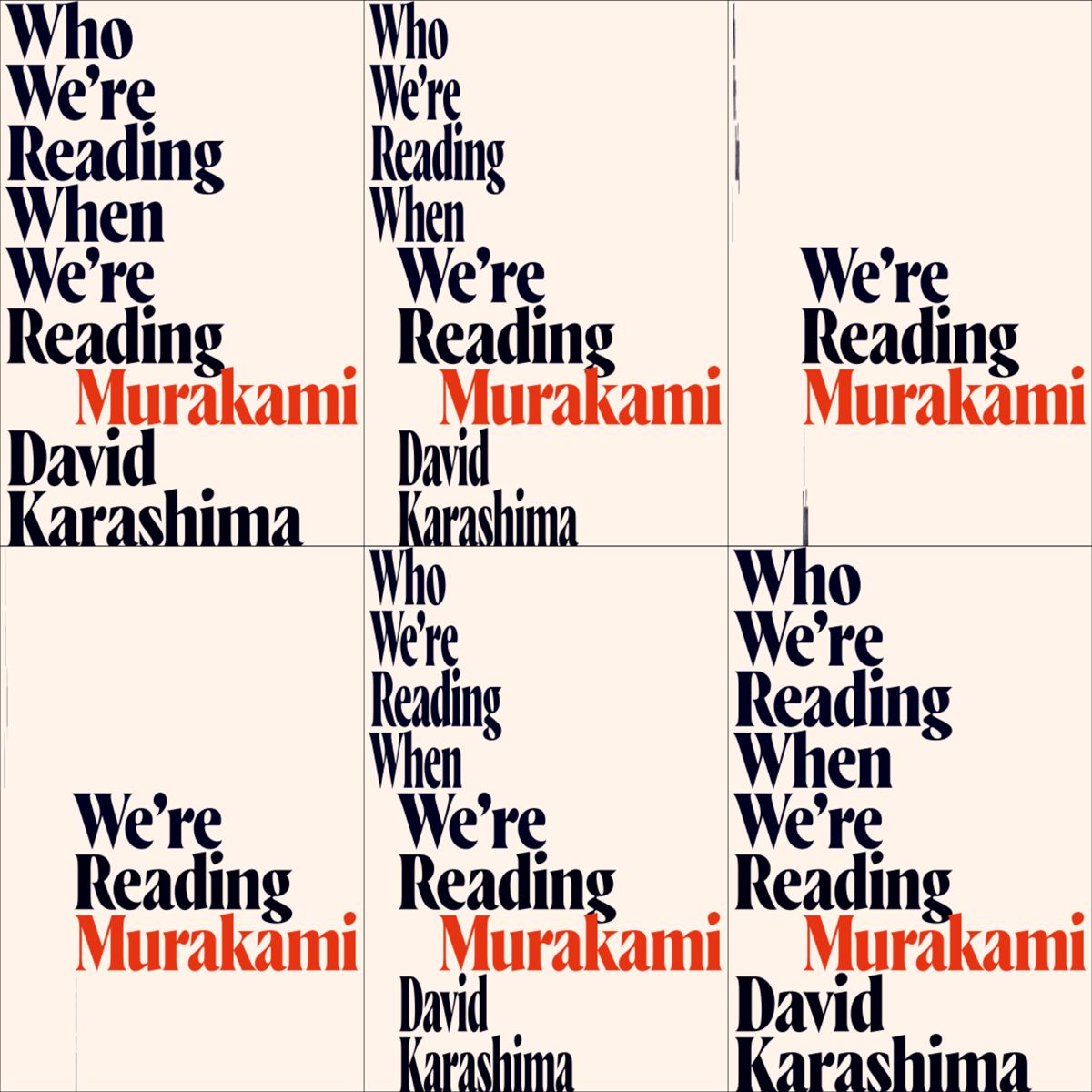
Review – Who We’re Reading when We’re Reading Murakami

This animated gif of the cover is from the publisher’s website, linked through the title below.

Who We’re Reading when We’re Reading Murakami

by David Karashima

Soft Skull Press

I just finished this book after picking it up based on a passing comment by Matt Alt on social media. I did so not because I am particular fan of Murakami—I’m not—but because I wanted to actually know more about the issue hinted at in the title: how the personality and identity (the “who”) of the translator impacts the end translation.

To sum up, this very well researched and written book follows the whole process of how Haruki Murakami went from fresh new Japanese novelist to global literary darling. Karashima tracks down and talks to all the editors, translators, designers, agents, and the author himself to look at how Murakami’s work up through Wind-Up Bird Chronicle ended up in English.

The result is a really compelling example of how intentional and designed such a career is. Please don’t take that to mean I don’t believe the success is unwarranted or undeserved; I make no such judgment at all.

But it is clear that what people read from Murakami in English has been very tightly controlled by a large cadre of peripheral figures. They selected stories, they cut text, they created the legend. Which is not a surprise to me at all, having been a translator working on pieces for publication.

Which brings me to my only grump about this book: I’d very much like a bit more focus on the question in the title. I want more depth on the people. In parts, I want more concrete looks at how specific choices the individual translators made could influence a resulting literary work’s reception. There are tantalizing tastes of this, with a few examples of people bringing up translation choices, but I’d have loved more.

In all, though, this strikes me as a valuable tool to demonstrate the realities of the translation process to a reading public.

It’s well worth a read to anyone interested in Murakami, translation for publication, outer international fiction.

Getting Used to Time in the Spotlight

I started out as a small-pond/big-fish kind of guy. I grew up in a the country and was an academic achiever at an early age, so I would end up in the local paper for some kind of academic award every once in a while. But growing up in a small town, even in the larger network of small towns that make up rural communities, means everyone knows you anyway. So the little bit of notoriety I had was nothing to brag about.

Even that much was short lived. When I went on to university, of course, the pond got much bigger and so did the other fish. I faded into the background, and that was all right with me. I did my thing, writing and teaching and so on, and ended up eventually becoming a translator: the ultimate invisible man. The rare work that I could put my name on was still so niche as to be almost unknown. I just kept on working in the shadows of my office/cave.

That lasted pretty much until this year. This year, I am not only publishing my own book, Discovering Yamaguchi Sake, but I’m putting out a translation of a Seishi Yokomizo Mystery, The Devil’s Flute Murders, from Pushkin Press. The first is a big deal for me personally, the second is just a plain old BIG DEAL. And so people are starting to notice me.

I’m being interviewed on podcasts. Asked to do online events. Planning book signing parties and presentations about my career. Emotionally, I’m in this totally new spot where my ego is tickled pink but my anxiety is headed through the roof, and I’m just bouncing between them like a ping pong ball. It’s not something I’m used to, and I am very tempted to just shout to the heavens “What have I done?!”

But I asked for this. I pursued these projects and enjoyed doing them. I never really stopped to think about what it would mean to do so, but I did it and now I suppose I need to learn to enjoy this tiny taste of attention.

Does anyone have any tips on how to do that without having an anxiety attack?

A tricky term – オカルト

Today’s conundrum: Is オカルト a false friend for “occult,” or not?


In Japan, for example, writers who dabble in horror, mystery, and stories with a weird, dark edge are often labeled オカルト (okaruto, a direct transliteration of “occult), and there are things like オカルトサークル (okaruto sa-kuru – occult circles), which are clubs that discuss and share information about things like urban legends (a very common theme on オカルト websites, it appears), strange true crime stuff, and related fiction.

But calling those “occult writers” or “occult clubs” seems, to me, to have entirely different connotations. I feel like the label “occult” is strongly associated with witchcraft and mystical secrets, rather than “eerie stuff in general.” The dictionary definition tends to point that way, too, but of course dictionaries always lag behind popular usage.

A look at the massive Wikipedia list of “occult writers” in English clearly shows a leaning that way: people like Anton LaVey, Aleister Crowley, Madame Blavatsky, and Simon Magus. More popular writers listed include Lovecraft, Robert Anton Wilson, Carlos Castaneda, and W. B. Yeats. Clearly, these writer seem connected by a focus on mysticism and the secret layers of reality, rather than “could-be-true scary stuff.” Again, this is not any kind of definitive list, but I do think it reflects the popular perception of the word.

The upshot of all this is, if I wanted to write about a Japanese オカルト writer, what would I call them? An eerie writer? A dark writer? A writer of the hidden world?

I wonder if anyone else thinks about this stuff?