A Tale of Two Horror Movies

Much like (from what I hear) the English speaking world, Japan is having a bit of a horror “moment.” In print and on the screen, what has always been a pretty solid side-branch of the entertainment mix has begun to blossom into something bigger and more mainstream. We can point to new authors like Uketsu or Nashi, and older ones bringing out new work like Koji Suzuki’s new novel Ubiquitous, as signifiers in the publishing world. On screens, though, I think the most interesting examples are to be found in shorts, like the YouTube creepfest My house walk-through or (hands down my favorite horror shorts) Fake Documentary Q.

I am not a scholar of the cinema or Japanese horror or anything, but I do keep my eyes open, and I stumbled on a collection of horror shorts on Amazon that were apparently all entrants in a biennial competition sponsored by Kadokawa, the Japan Horror Film Competition. I watched, and there were some real bangers in there, including one called みなに幸あれ/Best Wishes to All. Lo and behold, I later saw a full feature length version with the same name—Ah! I realized. The winner of that competition got their short made into a full-length feature film!

And it was well worth doing. Best Wishes to All—which apparently now has an English release—was a creepy, surreal, original, and ambitious movie. Excellent acting, excellent screenplay, the whole shebang. It also presented an approach to horror that stood outside the usual ghosts and curses of “J-horror” with the kind of social edge that makes good horror great.

The story, essentially, is about a young nurse in Tokyo going home to visit her grandparents in the countryside and discovering a dark secret–one that redefines her entire understanding of life and the world. It also touches on how Japan’s young people are almost seen as fodder for older generations’ expanding lifespans, and the sacrifices of some that society demands for happiness for others. And also, it has old people acting like pigs. Pretty wild.

And when I saw that the second contest collection was out, *and* that the winner movie was also coming, I was hopeful indeed! Shorts were clearly fertile ground for original horror, and Kadokawa et al. were throwing money at it, so I was eager for more. The winner of that round, and the film that came from it, was ミッシング・チャイルド・ヴィデオテープ/Missing Child Videotape.

I think I’m not alone in the eagerness I felt for this one. It seemed to combine some of the same ambition and originality that BWtA had with beloved tropes of cursed videos, haunted mountainsides, and family trauma. The short was a quiet, brooding story with a hefty dose of chilling menace.

The feature film, though… Well, that was something else. I should say here that, while I’m not planning to out-and-out spoil the story, I will be looking at elements that might end up ruining the movie for you. So, if you are hoping to watch Missing Child Videotape—or Best Wishes to All, for that matter—save this to read for later. And watch the latter IMMEDIATELY.

So. Just like the short, Missing Child Videotape is about two young friends, Keita (Kyosuke in the shot) and Tsukasa (Hiromu in the short). Keita gets a package from home which includes a VCR tape. It is one he made as a child, when out playing with his younger brother. The two boys stumble on some vaguely industrial looking abandoned building and play hide-and-seek. The younger brother goes to hide, despite his fear, and is never seen again. The child is, well, missing.

Tsukasa is apparently a “spiritual sensitive” and can see ghosts. He reacts strongly to the tape… Oh! It must be cursed.

Soon after, the film truly diverges from the short. They both deal with the emotional trauma of a lost child and brother, but while the short is all about suggestion and menace and dread, the film veers toward folk horror and weird mountain towns and a reporter running from ghosts… With a dose of time loops and places that don’t exist… Well. Lots of stuff. It never goes wacky with it. It always maintains its slow, heavy, almost emotionless tone. But honestly, from a purely plot-based perspective, it shares more with Shiraishi’s Senritsu Kaiki File Kowasugi! series than with its spiritual companion, Best Wishes to All.

Let’s just say, I have problems with the movie version of MCV. It tries to be too many things and fails at most of them. It takes the “unexplained” much too far, such that it becomes almost nonsensical. Individual elements are fascinating and worth exploring, but they are left behind to fade into background noise, and rather than leaving the fear of the unknown, they left me with the dissatisfaction of the seemingly unconnected. I mean, there was this whole story about how the mountain was a garbage heap for kami that basically went unmentioned for the rest of the movie?! Come on! And the reporter was running from some kind of ghost. Why? Who is she, actually? What is she muttering under her breath when she’s scared? Why is she essentially set dressing most of the time?

I can only assume that the demands of turning a twenty-minute short into a 100-minute feature put too much pressure on the story, and the production team struggled to find effective filler. So, the end result feels like they just started throwing things at it to see what stuck.

Meanwhile, Best Wishes to All seems to avoid that pitfall by taking some of the surreality of the short and leaning into it. Even as it sometimes borders on the absurd, it’s an absurdity that remains rooted in the qualities that made the short work so well, creating a kind of incomprehensible view of reality that is as confounding for the protagonist as for the audience. In expanding the short, the filmmakers preserved its essential nature, just writ large.

Anyway, what does all this signify? I think what I’m getting at is, the value of the horror short today is clearly difficult to translate to long form media, but not impossibly so. I just hope that the pressures of making bigger budget, larger-scale works don’t harm get in the way of the vibrance of the smaller scale scene.
Strange Houses is Out Today in the US

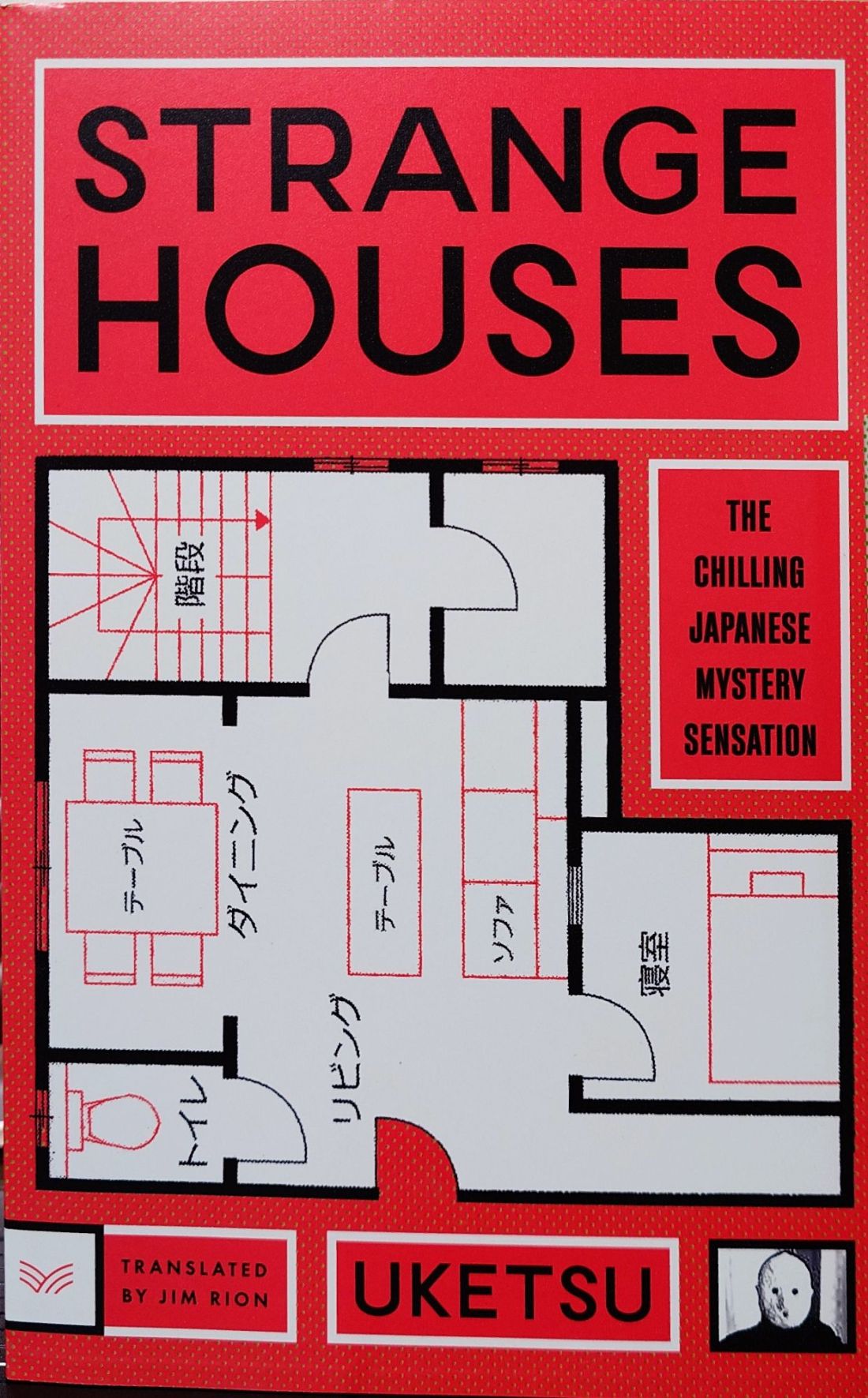
The cover of the US edition of Strange Houses by Uketsu. It is salmon colored with an image of a house floor plan. In the bottom right corner is a picture of the author, Uketsu, wearing a white mask. In the bottom left it reads "Translated by Jim Rion."
The US edition of Strange Houses from HarperVia.

June 3rd is the official release date for the US edition. It is June 3rd in Japan, so I’ll go ahead and announce it now, but your time zone might demand you wait a bit. Apparently the UK pub date has been listed as July 3rd? That strikes me as odd… Anyway.

Confusingly, the original Henna Ie was Uketsu’s debut work in Japan, while Henna E was his second. Anyway, both are now out in English and I hope people like this new addition. I have mentioned this before but I feel like Strange Pictures is a better written, better structured novel, which is natural as Strange Houses is a debut work written as an extension of a short video (basically the first chapter of the book) at the behest of a publisher.

Still, I really like this one. There is such creepiness in it, such oddness, that I find myself drawn back to it sometimes.

I’ll write something a bit more in depth about the translation process later, when people have had a chance to read it, but for now, just know this is a shorter work, with a weirder climax, than Strange Pictures, and worth investigating for people who like dark, bloody secrets and weird family histories.

If you’d like to buy this one, here’s a UK link (releasing July 3rd. WEIRD): Strange Houses on Blackwell’s

And here’s a US link: Strange Houses on Bookshop.org

I’m in the library

Figuratively as well as literally.

A tabletop display of The Devil's Flute Murders and the U. S. And U. K. Versions of Strange Pictures, along with a photocopy of a newspaper article about the translation of Strange Pictures.
My books on display.

When I got a whole bunch of comp copies of both editions of Strange Pictures, for more than I knew what to do with, the first place I went was to the library to see if I could donate some to put on their shelves.

Hikari Public Library is small and serves a relatively limited Japanese community, so there isn’t a lot of demand for English materials, but the staff not only accepted the books, they celebrated them. They were openly excited to get copies after seeing the local newspaper article about my Uketsu translations. I’m not sure I can explain how good that feels.

I’m one of those people for whom libraries are borderline sacred. I have been a ravenous reader since I was in first grade, and there were no bookstores in my small town. So, I practically lived in the library. The librarian, Mrs. Beard—who was almost laughably stereotypical librarian: little old lady in glasses on a chain—knew me by name and never tried too restrain my reading by age or “difficulty.” She just helped me find books to love.

That library was utterly foundational to who I am. It’s where I discovered Stephen King. Where I explored art and history and parts of the world that I never dreamed that I might actually one day get to see. It was where I started to see stories as more than just words on a page, but a way to live other people’s lives for a time.

I really could go on and on. The smell of all those old books, the quiet and cool spaces where you can just read and read as long as you want… You know, I’m sure, for yourself.

And now I’m right there on the shelves at the library. How lucky I am too live this life.

Translating Strange Pictures

Strange Pictures, my translation of 変な絵 by Uketsu, was published January 16 in both the United Kingdom and the United States. The two versions are the same translation but tweaked for local audiences a bit. Interestingly, the UK version is being marketed as a mystery, while the US is leaning more towards horror. Both are perfectly correct, because Uketsu calls himself a horror writer while clearly using mystery styles and tropes in the books.

The UK cover for Strange Pictures from Pushkin Vertigo

With the release of this book a bit behind us, I’d like to discuss a couple of issues that I dealt with in the translation. Before we go on, let me just say that some of these are spoilery, so PLEASE. If you haven’t read the book yet, save this post for after that.

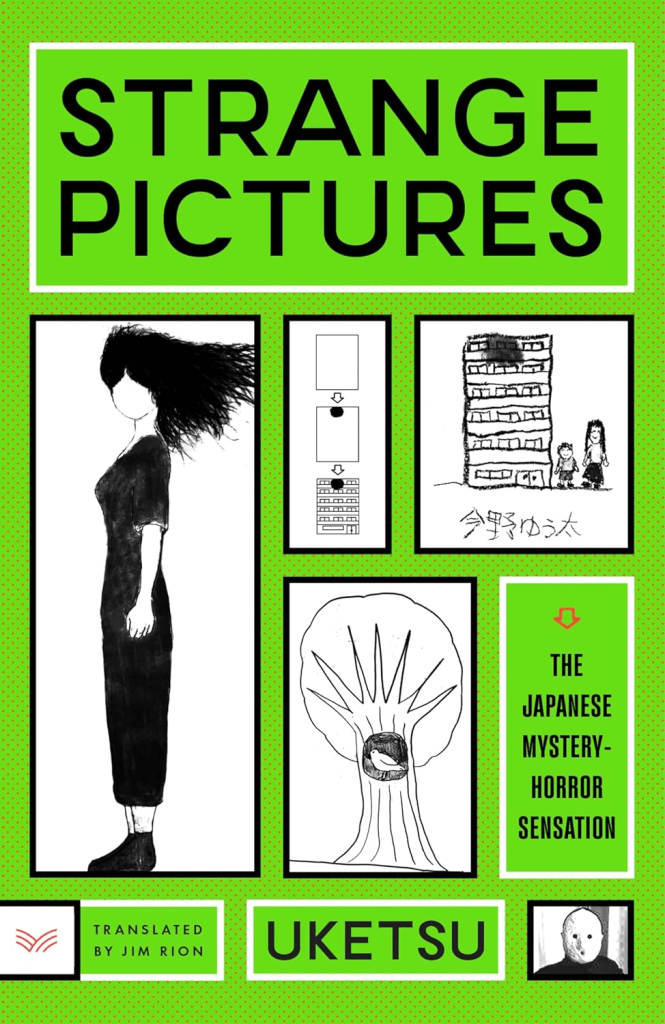
US cover for Strange Pictures from HarperVia

**Spoilers for Strange Pictures Ahead! You have been warned!**

The first tricky issue that comes to mind when I look back on translating Strange Pictures deals with the second chapter, centered on young Konno Yuta. Within the story, Yuta is learning to write his name in Japanese characters, “kanji,” for the first time. That stirs a memory of seeing his mother’s gravestone, and he starts to draw that gravestone, but changes his mind and converts it to a picture of the apartment building where he lives now with his grandmother—his “mama.” That picture starts out with a large rectangle in which he begins to draw his family name in Japanese: 今野. A fellow student later tells the teacher she saw him draw “A triangle inside a rectangle.” Looking at the first character, of course, you can see the triangle at the top.

Now, how do do all this in English? Well, I kept the Japanese. Indeed, since the reader doesn’t need to READ the Japanese, only see the shape of the character, it seemed obvious. Particularly since the child wrote his name in crayon on the picture, so it’s already evident to readers. I’m hoping that it doesn’t confuse anyone. But we shall see!

The second issue was, well, trickier. It involves the name of a blog that comes up in the very first chapter, and gets a call back at the end. The blog in Japanese is 七篠レン こころの日記, Nanashi Ren kokoro no nikki. It translates to something like “Nanashi Ren’s Diary of the Heart.” The problem is the personal name: Nanashi Ren. This is both a pun, as “Nanashi” can also mean “No-name” AND it turns out very late in the book to be a little trick related to the core mystery.

The trick is complex and based on the fact that in Japanese, there are three writing systems. Kanji are Chinese characters, complex figures that can have both a meaning and a number of “readings,” meaning the pronunciation attached to them. Then there are hiragana, a phonetic system used to write out the readings of words, without the kanji there to carry extra meaning. Finally, there are katakana, a similar system to hiragana that is visually different and used for, well, various purposes to stand out from hiragana.

Hiragana themselves are made of up a few strokes that come together to form characters, but can also sometimes resemble other characters.

It works like this: In the original Japanese, the actual author of the blog is Konno Takeshi 今野武司、or こんのたけし in Hiragana. He creates a pseudonym by breaking the elements of those hiragana up into parts that resemble other hiragana or katakana, mixing them up, and making a new name to which he matches a kanji. There’s a diagram in the original that makes it easier to parse, but it’s super complex and OBVIOUSLY impossible to do in English.

I mean, to be honest, it barely works as a “trick” in Japanese. No one would ever figure it out without being told, because it’s just too complex and arbitrary. It also only fits part of the actual title in Japanese. It’s one of those things that seems incredibly clever after the fact, but nothing within the book itself could guide readers to it.

So, after hours, days, weeks of going back and forth over it, I finally decided with the editor at Pushkin, and Uketsu’s blessing, that we should just use an anagram. Then, having decided that, we couldn’t find any satisfactory anagram using Takeshi Konno. At which point, the editor at Harper Via chimed with with the idea of using some other Japanese name, and with Uketsu said OK. So, that’s how Nanashi Ren Kokoro no Nikki written by Konno Takeshi became Oh No, Not Raku! written by Haruto Konno.

I think this is what I wanted all along

There is a part of me that is almost embarrassed at the fact that, after having written and published one book, and having three translations published, with two more scheduled in the next year, I am JUST NOW realizing that hey, maybe I’m not just faking this? Maybe I’m in the book business?

I have been a reader since, well, ever. I think I started reading when I was five, and by the time I was in first grade I was burning through the library. Books were just… There. They were a fundamental building block of my identity. It’s not even something I consciously thought about, but hey. I love books and the reading (and purchasing, borrowing, lending, touching etc. thereof) about as much as anything I can think of.

And of course I always toyed with writing, the way a cat toys with a mouse that it never really intends to eat. “Someday, I shall pounce and then success will be mine!” I would think, while my prey sneaked away, limping but triumphant. Because, of course, writing takes perseverance and dedication and effort, and I sometimes fail to find those virtues in stock.

But now that I am not only someone whose name is on book covers, but someone whose name is familiar to PUBLISHERS and AUTHORS (a famous horror author just posted a pic of his ARC of Strange Pictures, with my name on the cover!!!), I think I can finally admit… This is something that I’ve wanted, without really knowing it, all my life.

I think I must have always wanted to be a book person. A writer, an editor, a guy in the biz. And I think that’s what I’ve got now. I’m visiting a book publisher and two international rights agencies in Tokyo at the end of the month. When I mentioned I would like to visit, they all said “Great! We’d love to meet! When?” rather than “Who are you again?”

The feeling of that. The—admittedly ego-centric, selfish, privileged, yes, I am so privileged and lucky but still—DAMN GOOD feeling of it is something else. I don’t deserve to have this good a life, but it’s here. So I guess I’ll live it.

Anyway. Feels good to get that off my chest.

You know what also feels good? My name in a starred review in Publishers Weekly.

By the way, please maybe consider buying my book, Discovering Yamaguchi Sake. And the ones I translated that are also kind of mine. Thank you!