
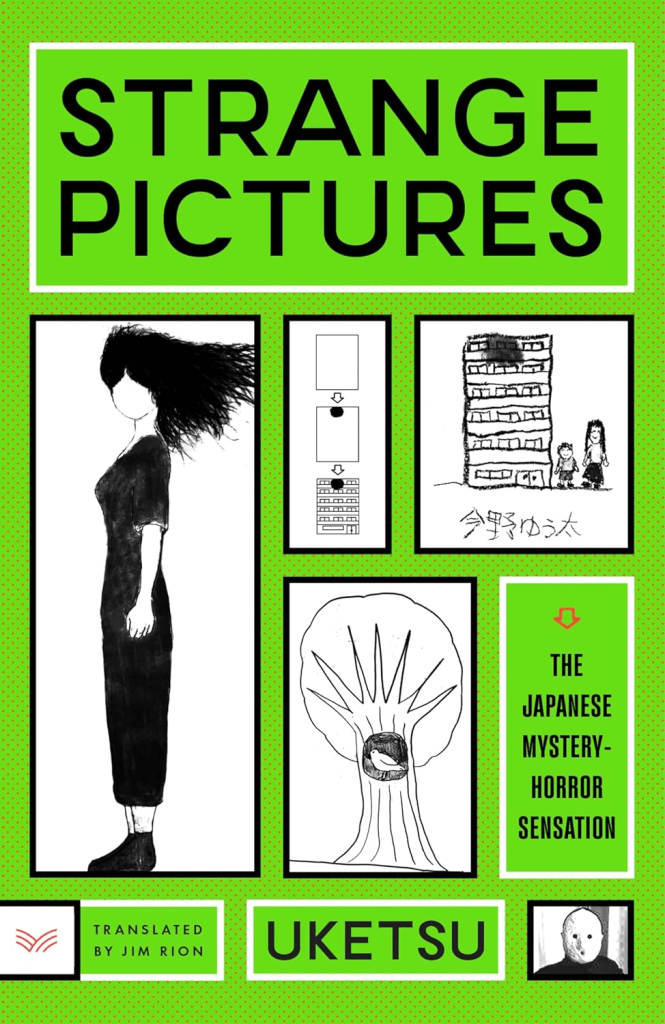
Strange Pictures, my translation of 変な絵 by Uketsu, was published January 16 in both the United Kingdom and the United States. The two versions are the same translation but tweaked for local audiences a bit. Interestingly, the UK version is being marketed as a mystery, while the US is leaning more towards horror. Both are perfectly correct, because Uketsu calls himself a horror writer while clearly using mystery styles and tropes in the books.

With the release of this book a bit behind us, I’d like to discuss a couple of issues that I dealt with in the translation. Before we go on, let me just say that some of these are spoilery, so PLEASE. If you haven’t read the book yet, save this post for after that.
**Spoilers for Strange Pictures Ahead! You have been warned!**
The first tricky issue that comes to mind when I look back on translating Strange Pictures deals with the second chapter, centered on young Konno Yuta. Within the story, Yuta is learning to write his name in Japanese characters, “kanji,” for the first time. That stirs a memory of seeing his mother’s gravestone, and he starts to draw that gravestone, but changes his mind and converts it to a picture of the apartment building where he lives now with his grandmother—his “mama.” That picture starts out with a large rectangle in which he begins to draw his family name in Japanese: 今野. A fellow student later tells the teacher she saw him draw “A triangle inside a rectangle.” Looking at the first character, of course, you can see the triangle at the top.
Now, how do do all this in English? Well, I kept the Japanese. Indeed, since the reader doesn’t need to READ the Japanese, only see the shape of the character, it seemed obvious. Particularly since the child wrote his name in crayon on the picture, so it’s already evident to readers. I’m hoping that it doesn’t confuse anyone. But we shall see!
The second issue was, well, trickier. It involves the name of a blog that comes up in the very first chapter, and gets a call back at the end. The blog in Japanese is 七篠レン こころの日記, Nanashi Ren kokoro no nikki. It translates to something like “Nanashi Ren’s Diary of the Heart.” The problem is the personal name: Nanashi Ren. This is both a pun, as “Nanashi” can also mean “No-name” AND it turns out very late in the book to be a little trick related to the core mystery.
The trick is complex and based on the fact that in Japanese, there are three writing systems. Kanji are Chinese characters, complex figures that can have both a meaning and a number of “readings,” meaning the pronunciation attached to them. Then there are hiragana, a phonetic system used to write out the readings of words, without the kanji there to carry extra meaning. Finally, there are katakana, a similar system to hiragana that is visually different and used for, well, various purposes to stand out from hiragana.
Hiragana themselves are made of up a few strokes that come together to form characters, but can also sometimes resemble other characters.
It works like this: In the original Japanese, the actual author of the blog is Konno Takeshi 今野武司、or こんのたけし in Hiragana. He creates a pseudonym by breaking the elements of those hiragana up into parts that resemble other hiragana or katakana, mixing them up, and making a new name to which he matches a kanji. There’s a diagram in the original that makes it easier to parse, but it’s super complex and OBVIOUSLY impossible to do in English.
I mean, to be honest, it barely works as a “trick” in Japanese. No one would ever figure it out without being told, because it’s just too complex and arbitrary. It also only fits part of the actual title in Japanese. It’s one of those things that seems incredibly clever after the fact, but nothing within the book itself could guide readers to it.
So, after hours, days, weeks of going back and forth over it, I finally decided with the editor at Pushkin, and Uketsu’s blessing, that we should just use an anagram. Then, having decided that, we couldn’t find any satisfactory anagram using Takeshi Konno. At which point, the editor at Harper Via chimed with with the idea of using some other Japanese name, and with Uketsu said OK. So, that’s how Nanashi Ren Kokoro no Nikki written by Konno Takeshi became Oh No, Not Raku! written by Haruto Konno.
Discover more from Jim Rion - Translator & Writer
Subscribe to get the latest posts sent to your email.
 Jim Rion - Translator & Writer
2 thoughts on “Translating Strange Pictures”