An American living in Yamaguchi prefecture, Japan. Translator, writer, and cat servant. Author of Discovering Yamaguchi Sake, translator of The Devil's Flute Murders, Strange Pictures, and more.
I did a foolish thing. I not only agreed to help plan IJET-33, an international translation conference (in a reduced role, but still) during a period when I was supposed to be finishing up the manuscript for my latest novel translation, I also volunteered to do a presentation at that same conference. All while still holding down the remaining tatters of my regular translation and checking work.
Folks, it took a lot out of me. The two weeks before that conference were… Well, they’re a blur. I do remember some numb-brain level exhaustion, and some tears, and some unkind thoughts about the whole world.
And unsurprisingly, I found almost no leeway in the past couple of months for words. It was a struggle to keep up with my obligations, much less work in voluntary stuff like this blog or even social media. Hell, I didn’t even get any good bird pictures taken!
But the presentation is past (it went really well, or so they tell me). The conference was a rousing success. The manuscript is in and edits will wait until June. I have dug up from all the various jobs that I had let pile up. I am, in other words, recovered enough to find words to spare. Hence, this.
I plan to post something about my presentation here soon, but for now, I just want to let the internet know I’m still here.
Oh! And Strange Houses comes out next month in the UK and US. Preorder, reserve at your library, go and read and enjoy!
When I got a whole bunch of comp copies of both editions of Strange Pictures, for more than I knew what to do with, the first place I went was to the library to see if I could donate some to put on their shelves.
Hikari Public Library is small and serves a relatively limited Japanese community, so there isn’t a lot of demand for English materials, but the staff not only accepted the books, they celebrated them. They were openly excited to get copies after seeing the local newspaper article about my Uketsu translations. I’m not sure I can explain how good that feels.
I’m one of those people for whom libraries are borderline sacred. I have been a ravenous reader since I was in first grade, and there were no bookstores in my small town. So, I practically lived in the library. The librarian, Mrs. Beard—who was almost laughably stereotypical librarian: little old lady in glasses on a chain—knew me by name and never tried too restrain my reading by age or “difficulty.” She just helped me find books to love.
That library was utterly foundational to who I am. It’s where I discovered Stephen King. Where I explored art and history and parts of the world that I never dreamed that I might actually one day get to see. It was where I started to see stories as more than just words on a page, but a way to live other people’s lives for a time.
I really could go on and on. The smell of all those old books, the quiet and cool spaces where you can just read and read as long as you want… You know, I’m sure, for yourself.
And now I’m right there on the shelves at the library. How lucky I am too live this life.
I have lost track of how many of these I have written, AND of how many I have posted to my blog. So, forget the numbers. Forget the lists. Let’s just do this thing.
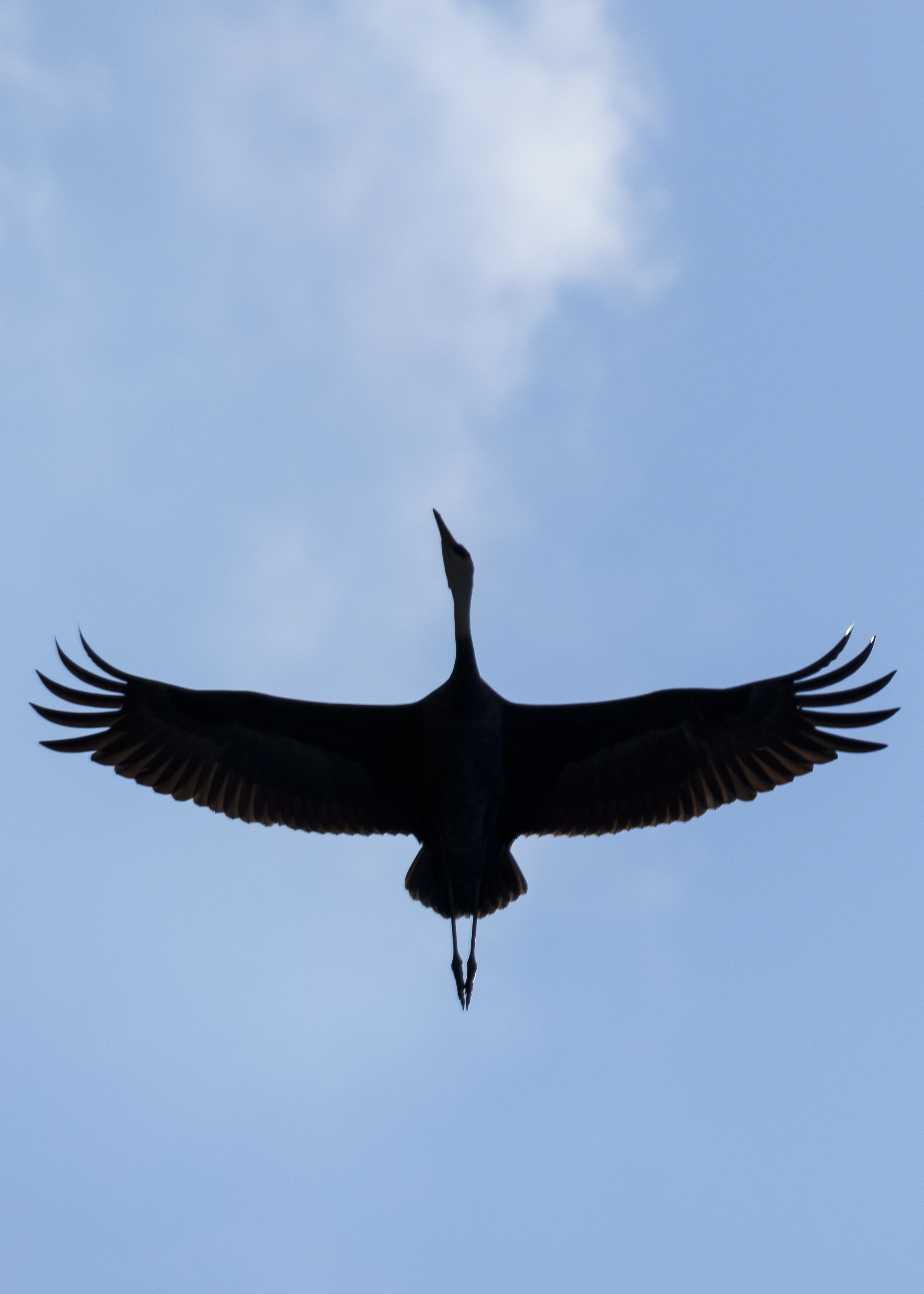
This column went out early this month and describes my joining a local birdwatching excursion to see the hooded cranes/ナベヅル of Yashiro district. These birds are not particularly rare, and over 10,000 nest down south in Kagoshima Prefecture. However, the only spot on the island of Honshu where any come to spend the winter is in this tiny farming town in the mountains here. This year, 13 birds came, and the local birders all had to go try to get good pics. I have discussed this before, but technically we are only supposed to watch and photography from a designated “observation post” which is often a real pain, as sometimes the birds don’t come anywhere near. This time, though, was different.
Eight birds in two groups came close on either side, and a few even flew right over our heads. It was quite a chance.
I learned about this book from a post on Bluesky, which included the a quote about translation as reading that sparked something in my brain. I had to read more, because I personally view translation as exactly that: I read the text in Japanese, understand it to the best of my ability, and then write my understanding in English. Here, I thought, was someone who not only understood translation the way I do, but who had a career’s worth of experience and the academic training to articulate it in ways I did not. It filled me with hope that I was perhaps not utterly unfounded in my approach to this work.
When I did get my hands on the book, I was not disappointed.
Searls divides this book roughly in half. Indeed, you could say the first half is “philosophy,” and the second is “translation.” He begins with a historical review of theories and approaches to translation, from the Latin roots of the word itself to German Romanticist views of language. He does get quite deep into the weeds, with elevated language and heavy ideas, but he clearly explains not only the meaning and importance of the language an ideas, but why he’s engaging with them.
It’s a refreshing style of academic book that not only maintains rigor, but opens the gate to those without steeping in the particular obfuscated style that plagues academic writing. It is challenging while remaining accessible, in other words.
But most important of all, it is thoroughly rooted in actual translation. Searls brings all the theoretical discussion back to what real, working translators do, not only in the literary realm but in the practical, business-focused work that most people use to pay the bills. The balance is delicate but solid, which is what is most impressive about the book.
All that being said, what takes this book from being a well-written academic treatise on translation and something that I would recommend to anyone even tangentially involved with translation as a practice (academics, budding translators, authors whose books are being translated, game developers looking into localization, the list goes on) is how it reframes the act itself in new words and ideas that just make beautiful, crystalline sense.
Rather than focusing on the common ideas of “fidelity/faithfulness,” freedom, or even accuracy, he talks about translation as an act of reading.
When I’m translating, I’m just reading-trying to pick up on as much as I can of the original utterance, its meaning and sound and allusions and tone and point of view and emotional impact. As I register what I feel is most important and indispensable, I try to write that indispensable thing in English; then, in revising, I reactivate the reading part of my mind and try to anticipate as much as I can of what an English-language reader with no access to the original will pick up on.
(page 224)
This is really the crux of the book, though the discussion of translating “utterance” rather than “words” also rings true. On page 107, for example, he says “To think of what we translate as ‘utterances’ sweeps away a huge amount of lexical analysis, because we don’t translate words of a language, we translate uses of language.” Thus, issues of “accuracy” are less important than issues of “communication.” When we translate, are we bringing the message/impact/effect/resonance that was actually vital in the original to the new audience?
Which, again, brings us back to reading. Because it is only by reading that the translator knows what is vital in the text, what Searls sometimes calls the “force” of it, to be able to bring it to the new audience. As such, rather than faithfulness to any monumental, immutable “original,” translation is always a question of how the translator read, and how they managed to share their reading with their new audience.
[…] [W]hat’s important to preserve depends on what the translator finds in the original-how the translator reads. Everyone thinks … that they’re “following the original,” but they’re working from different originals: each is trying to produce a text that matches, or does the same as (has the same force as), not the source text but his or her reading of the source text. Even the least literal translations, the most wildly divergent “imitations” or “reimaginings,” try to stay true to whatever ineffable aspect of the original’s vibe the writer of the new version feels they are taking up. That is why there is no objectively best translation, one that is “closest” to “the” original, as talk about faithfulness falsely implies.
(p. 195)
One of the things that has always struck me about translation is how every act of reading is different, no matter the language. Every person brings their own filters to reading (and listening and talking and writing). I am no different. So, whenever a translator experiences a text then takes that experience into a new language for new readers, inevitably, that new text will be colored by their filters. Our job, then, is to expand those filters, to be able to grasp as much of the text as we can, to bring all of that with us when we translate. But also, we need to accept that we will never encompass everything that the original was or potentially could be. All we can do is be the clearest filters we can. Searls, of course, puts it much better:
[W]hat I think a translation should be: Attentive to how the translating language works, overriding any demand for “equivalence” with how the original language works. Keeping in mind and keeping to heart the interests of readers, the author, and the author’s ideas. (This, by the way, is how we use the word “interests” in English.) Feeling some responsibility to enable, or at the very least try to enable, the original author and their new readers to interact with one another at their respective best. An act of care, and ultimately love.
(page 194)
And really, I’m not sure I can add anything else.
There is much more to this book. His formulation of translation in terms of arcs/arrows is fascinating, as well, and I think the practical examples are all excellent sources of education and rumination.
I honestly can’t recommend it enough to anyone even remotely interested in the theory, work, and indeed love of translation.
As I become more and more a “literary” translator, I find myself beginning to approach reading as a professional duty, even as I remain steadfastly fixated on choosing books that I think will actually be interesting. This book, a collection of horror stories by a single author, was solidly on both sides of that equation. Japan is in the middle of a bit of a horror story boom, due in no small part to Uketsu’s success, and given my own connection to Uketsu now, I’m kind of in a horror boom, too. With publishers on both sides of the Pacific now plumbing the genre for the Next Big Thing, I am trying to keep up myself to see if I can spot something interesting.
Nashi is an author often associated with Uketsu in the media, it seems, along with Sesuji. One reason might be that they all use pseudonyms with seemingly random meanings. Nashi uses the Japanese character for “pear,” 梨, although there is a stated nod to another character with the same pronunciation, 無し, which means “nothing.” Which would be suitably “horror-esque” on its own, but having read 6, I wonder if there isn’t some other meaning.
This anthology is, in its own way, utterly unique while also being part of a tradition of literature that goes back basically as far as literate goes. In short, it is religious allegory as entertainment fiction. Yes, this thin tome of horror stories follows in the footsteps of Milton and, um, C. S. Lewis? Anyway.
Let’s pull back a minute. 6 comprises six stories, of course. They appear, at first, unconnected, but much like other recent horror hits, there are threads that join them that only become clear as you read further. The story names are all in the Roman alphabet, and contain hints to both their individual content and to the larger meaning of the book. The stories are ROOFy, FIVE by five, FOURierists, THREE times three, TWOnk, and ONE [sic, sic, sic after sic]. Now, I would say the pattern is clear except for ROOFy, which I can’t for the life of me connect to “six.” Even in Japanese, it would be roku or ro. But hey, the world is a flexible place. **EDIT** I finally reached out to the author to sort this out, and I can’t believe that I missed the central metaphor of the book’s structure: elevators. This elevator starts at the roof and takes you to the basement! I can’t believe I missed that for so long.
ROOFy is a nightmare fairy tale, a story in the first person about a young girl who visits a little amusement park on the rooftop of a department store. She wishes she could play there forever without all the other people in the way and, when she comes out of the bathroom, it seems her wish has come true. Her parents are gone, as are all the other children. She has the park to herself… But then it begins to change. It is filled with decay and corruption, and… Well, no spoilers.
FIVE by five presents the story of a magazine writer who disappears and leaves behind stories with odd changes, and the editor who is tracking the reporter’s steps to see what might have happened to him. His investigation takes him to a mountain town with odd stone towers bearing metal antennae along the road, and glimpses of an eerie truth.
As the other stories progress, we find more connections to this disappeared writer and the impact on the editor, but what comes even more clear is something… Other. Because these aren’t just horror stories skirting around the pseudo-documentary style that has grown so common now. They are clear, open Buddhist allegory. The six stories address the Six Realms of Samsara: the realm of gods, the realm of demigods (or asura), the realm of humans, the realm of animals, the realm of hungry ghosts, and the realm of hell. It is a trip through the realms, woven with a story about an impossible death (really. Not, like, in the mystery sense), and a break in the order of the universe. The stories themselves openly mention Samsara and the six realms, so the allegory is pretty on the nose, but for someone who grew up outside the Buddhist tradition, it’s fascinatingly unfamiliar ground.
It is, in other words, heavy, heady stuff. It is also properly “horror” in the traditional sense, but the way this book haunts me is not in the scary stuff. No, it’s the way it presents an almost nihilistic (nihil meaning, of course, “nothing”, which is also one way of understanding liberation from worldly desires in Buddhism, or becoming “Nothing”—See?) view of the Buddhist cosmology. Because the core of Buddhist belief is freedom from the wheel of samsara, of escape from eternal rebirth in a cycle of suffering, but this story offers a counterpoint: a way of escape that breaks the wheel itself, upsetting the order and questioning the very possibility of liberation.
It deserves reading, in my opinion, and is worth it for both horror seekers and those interested in meatier, chewier problems like “What does living even mean if death is not just inevitable, it is inevitable an infinite number of times?”
I’m feeling like this isn’t so much a review as me just meandering about the book. But I am glad I read it, and I will read it again, and it was pretty creepy and chilling in parts, so I think it’s a recommendation for those who like reading that sort of thing. Maybe I’ll even try to see if someone wants to pay for it to be translated?




 Jim Rion - Translator & Writer