Today is the Day! Discovering Yamaguchi Sake

Today, 21 February 2023, is the official release date of my first authored book, Discovering Yamaguchi Sake.

The cover of the book Discovering Yamaguchi Sake by Jim Rion, foreword by Melinda Joe. It features small images of labels from 23 sake breweries in Yamaguchi Prefecture.

It’s hard to believe the day has finally come. I first conceived of the idea way back in the spring of 2020, when the pandemic was first making its presence known and I found myself with extra time to fill. I must be honest—it was kind of a whim at first. I was looking for something to do with my time and my interest in sake, and I wanted to help bring attention to the local brewing scene. But when I got started, it all just seemed to take on its own momentum and somehow I managed to make it all the way through.

It has been such a fun, interesting ride, too. I met so many wonderful people, and learned tons that I doubt I ever would have without this. And above all, I have been so, so moved at how supportive everyone has been. From the very beginning, I was surrounded by friends and family who helped me believe it could actually be done. And here we are.

I must admit to feeling a little grumpy about the fact that I, personally, still don’t have any copies of my own book—it takes a long time to ship from America these days—but the idea that it is out there and getting read is truly astonishing to me.

So, to everyone who has helped make this happen—including all of you who have ordered or are going to order it—thank you and kanpai.

Now, go on, Buy My Book!

Getting Used to Time in the Spotlight

I started out as a small-pond/big-fish kind of guy. I grew up in a the country and was an academic achiever at an early age, so I would end up in the local paper for some kind of academic award every once in a while. But growing up in a small town, even in the larger network of small towns that make up rural communities, means everyone knows you anyway. So the little bit of notoriety I had was nothing to brag about.

Even that much was short lived. When I went on to university, of course, the pond got much bigger and so did the other fish. I faded into the background, and that was all right with me. I did my thing, writing and teaching and so on, and ended up eventually becoming a translator: the ultimate invisible man. The rare work that I could put my name on was still so niche as to be almost unknown. I just kept on working in the shadows of my office/cave.

That lasted pretty much until this year. This year, I am not only publishing my own book, Discovering Yamaguchi Sake, but I’m putting out a translation of a Seishi Yokomizo Mystery, The Devil’s Flute Murders, from Pushkin Press. The first is a big deal for me personally, the second is just a plain old BIG DEAL. And so people are starting to notice me.

I’m being interviewed on podcasts. Asked to do online events. Planning book signing parties and presentations about my career. Emotionally, I’m in this totally new spot where my ego is tickled pink but my anxiety is headed through the roof, and I’m just bouncing between them like a ping pong ball. It’s not something I’m used to, and I am very tempted to just shout to the heavens “What have I done?!”

But I asked for this. I pursued these projects and enjoyed doing them. I never really stopped to think about what it would mean to do so, but I did it and now I suppose I need to learn to enjoy this tiny taste of attention.

Does anyone have any tips on how to do that without having an anxiety attack?

Review – Flight & Anchor

Flight & Anchor: A Firebreak Story

by Nicole Kornher-Stace

Publication Date: 13 Jun 2023

Full disclosure: I read this from a free review copy off Netgalley.

Synopsis: In short (and I do mean short, because the book itself is roughly novella length at 139 pages double spaced), this is a story set in the world of another of the author’s works, Firebreak, about a city gripped by a war between two corporate entities, with a team of bio-engineered super soldiers at the heart of the conflict. This story features two of those—06, a girl, and 22, a boy—as preteens trying to escape the corporate facility that grabbed them as very young war orphans and turned them into killing machines.
They escape and, rather than making their way out of the city as originally planned, hole up in an abandoned container and scavenge for food in the harsh city winter. The whole time, the nameless facility Director remotely monitors their location and vital signs and tries to hide her failure in letting them escape.

Review: I suppose I just have to say this one wasn’t for me. It seems built knowing these children as characters, without giving any real reason to WANT to; since I haven’t read Firebreak, and thus don’t have any grasp on what they do or their significance, my interest just slides off them like glass. This could also be due to the fact that this very brief story spends SO MUCH TIME on mundane details of survival (with a nearly two page listing of the random detritus they scavenge in their abandoned lot, that then plays absolutely no part in their story).

There are also clear allusions to events that happen years after the story—clearly referring to Firebreak—that are frustratingly pointless to this actual narrative, and so simply stand out as enormous flashing “Hey, remember this part?” signs. I don’t, actually.

I was also bemused by how the book spent 13 pages, fully 10% of its length, in the largely uneventful and pointless interaction between a barista, Cass, and these two nameless children, which again had no bearing on the characters’ further actions or development. In terms of Chekhov’s gun, there were like four shotguns (Offscreen characters, suspicions, potential friends, potential foes) in that scene, and none of them ever fired. It was essentially 13 pages of “Then they got some cast off coats and stale donuts.” Which they later did AGAIN after digging through the garbage.

That scene did successfully shake my affinity for “they” as a singular pronoun, since it featured Cass as “they” interacting with two unnamed people acting as a unit whom Cass immediately identified as “boy” and “girl” because I guess that’s what a non-binary person does on first meeting preteens? Anyway, it was tortuous and difficult to get through, and served so little purpose in so many pages that I very nearly stopped reading once I realized it just hadn’t mattered.

However, when something actually interesting and important happened—the intriguing nanobot array that filled the so necessary “snarky sub character” slot showing up, the roughly two pages of action at the end, etc.—it was fun. The writing itself in the use of language and pacing are really quite good, so that was a pleasant part of the experience.

Overall, I’d give this three of five stars, for deft sentences and glimpses of an intriguing world, with marks off for not a whole lot happening that makes sense to this non-Firebreak reader.

Simple Pleasures of Birdwatching

I have long been a fan of birds in general, which sounds like a silly thing to say but is merely the truth. Being close to birds reveals such cleverness, such expressiveness, that it’s hard not to anthropomorphize them. Yet I have never really taken the time to get the kind of detailed knowledge that would allow me to, say, identify all the wild birds around me by call, or plumage, or flight pattern.

So, when I saw an ad in the local paper for a free birdwatching class at Suo no Mori Lodge, a nearby forest lodge, I signed right up. The class happened last Sunday, the 21st, and it was a hoot (har, har).

I learned the basics of the above, but I also found that simply being in a focused environment where every bird that passed was a subject worthy of scrutiny, that was worth paying close attention to, was a kind of blessing. Birds are all around us here in Hikari, so they often just melt into the background noise, but when you actually try to see them they are a treasure.

For example, I learned that I’ve been using “sparrow” as a kind of catch-all term for “little, round, brown birds in the bushes” but there are several species that all fit that name, and all of which have their own adorable-ness to enjoy.

There’s nothing really profound coming here, but I will say that focusing your awareness on the simple, common natural environment around you is deeply rewarding. If you have the chance, take it.

And now, the pictures, which are what you really want.

  • The silhouette of a bird—perhaps an oriental dove or a brown-eared bulbul—on an electric wire, with trees in the background.
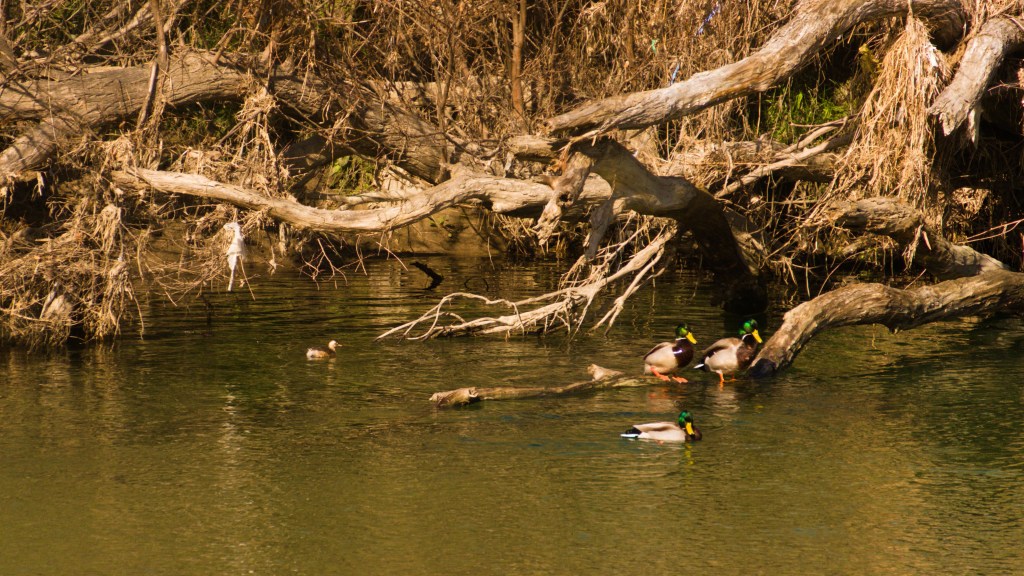
  • Two male mallard ducks are perched on a tree branch projecting out of a river. Another is swimming in front of them. and a female is swimming off to the left among the other branches.
  • Two small birds in silhouette are on the side of a gravel road. They are meadow buntings, which look a lot like sparrows.
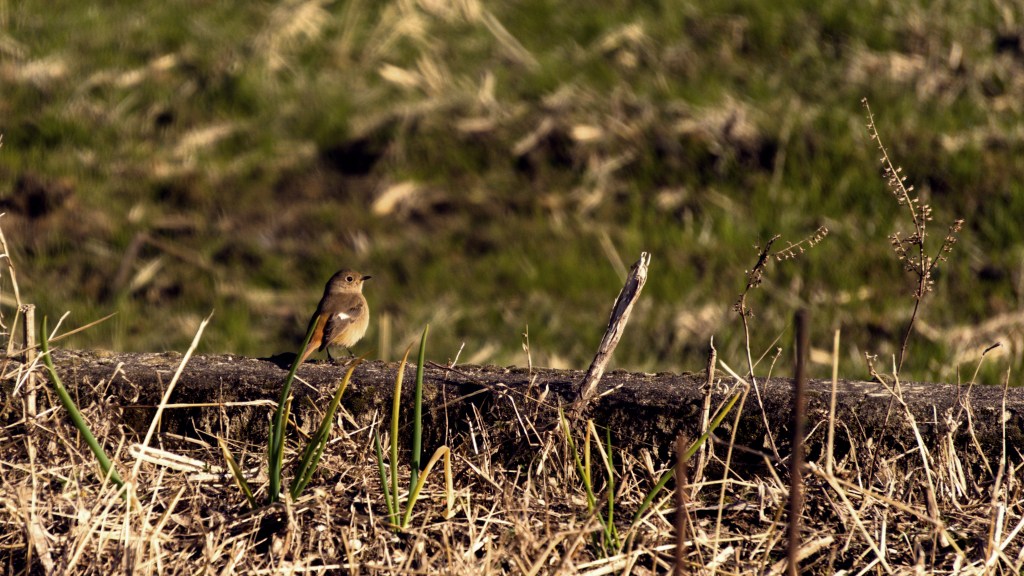
  • A small, round, brown bird with white patches on its wings—a female Daurian redstart—sits on a low concrete wall with weeds in the foreground and background.
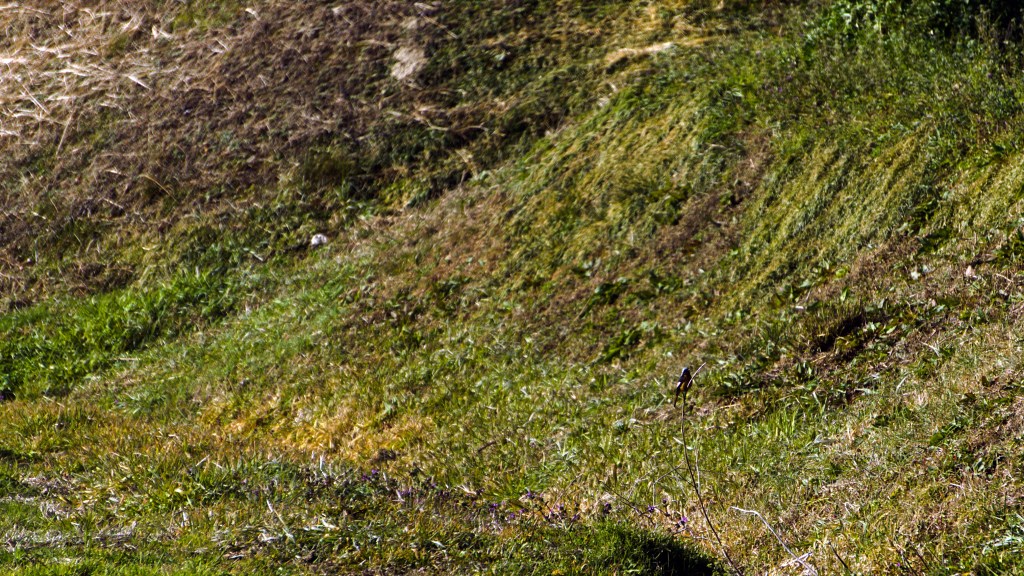
  • A male Daurian redstart is perched at the very tip of a single tall weed far in the distance, with a green hillside in the background.
  • An overgrown camellia bush in full flower with a small, green warbling white-eye bird perched near a flower.
  • The foreground is filled with camellia blossoms, and a small green warbling white-eye is perched among them.
  • In the far distance, a sandpiper is wading in a green river near a gravel bank.
  • A small, yellow-brown shrike is looking at the camera from its perch on a telephone wire.

Review – Ceramics and Modernity in Japan

I’m trying lately to build a solid base of knowledge in ceramics, not only of aesthetics and mechanics, but of culture and context as well. This book, part of the Routledge Research in Art History series, is an excellent resource for exactly that.

The cover of the book Ceramics and Modernity in Japan.
The image is the abstract work Mr. Samsa’s Walk by Yagi Kazuo.

It features 11 scholarly essays (including the intro and epilogue) examining how the whole ceramics world—creating, seeking, purchasing, and appreciating—changed in post-Meiji Japan. The individual topics are relatively specific, but are well arranged and referenced enough to give an excellent overall grasp of the various issues at play.

The articles are all both rigorous and accessible, with the possible exception, perhaps, of “More than “Western”: Porcelain for the Meiji Emperor’s table” by Mary Redfern, which reads like something an undergraduate in social science might write to fill in a word count assignment. Study, overly erudite, and off questionable insight

Of particular interest to me are the many references to the interplay between attitudes toward other Asian nations during Japan’s colonial and post-colonial periods and the concurrent growth of the mingei movement under Yanagi Sōetsu. There is also a very illuminating reference to the circularity of how ceramic science from Europe influenced Japanese pottery, which in turn went on to influence the British studio pottery wave spearheaded by Bernard Leach.

These incidents fundamentally changed my perception of the mingei movement and Leach; particularly his “translation” of Yanagi’s work into “The Unnamed Craftsman.” The clear biases and, dare I say, agenda they shared makes much of what they say very suspect, even as it touches on some clearly vital issues of the intersection of art and Buddhist ideas.

Anyone who is interested in fort insight into the historical context of his Japan came to be “potter’s paradise,” the tension between art and craft in ceramics, and the roots of Japan’s enormous valuation of pottery and the “living national treasures” that create it would do well to read through this one.

Highly recommended.