I pre-ordered Neil McRobert‘s Good Boy from Wild Hunt Books and apparently they take the “pre” part very seriously, because I got it quite a while before it was officially published.
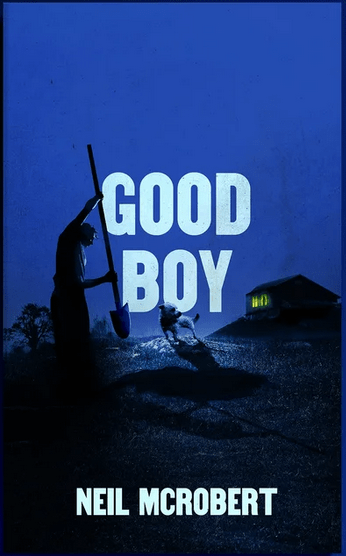
The cover to Good Boy by Neil McRobert.
I’ve been a fan of McRobert’s horror-focused podcast, Talking Scared, for a while now and one of the biggest reasons is the host’s sincere passion for his subject. He matches it with insight and damned good questions to create simply one of the best interview shows around.
So, when he announced he was finally taking the plunge into authorship, I was there for it.
I am pleased to say that it was the right choice.
Good Boy is a novella/short novel about a man and his dog who team up to keep a small northern English village safe from an ancient evil that feeds on local children. There are obvious touches of classic Stephen King, especially It but also a touch of non-horror work like The Body, but the voice is pure McRobert and above all, it is so obviously rooted in love.
I cannot overstate what a relief that is. Horror as a genre is going through what they call a “moment,” with a flood of lauded authors and works getting big all over the place. But a major element of that is a glut of stories centered around trauma and grief. Not simply in the the obvious way—horror has always been about people experiencing traumatic events—but in ways that center traumatized people experiencing horrific events that seem to grow from that trauma. This is a perfectly fine trope, but as it becomes dominant I find myself wondering, what about people who are live their lives without being haunted by the gaping spiritual holes of lost children/horrific accidents/guilt over terrible mistakes etc.? Don’t they get horror stories anymore? Isn’t there some other emotion we can ground our stories in besides grief?
Of course there is, as McRobert shows us. Love is also a fundamental part of the human condition, and it can also serve as a foundation for horror stories. This is a story about love saving people, despite the frustrations and stresses and doubts that assail all our choices, even when made out of love and the desire to do good. And it feels so genuine. Anyone who listens to Talking Scared knows how much McRobert loves his dog, Ted, and the honesty of that emotion comes through crystal clear in the work.
And the horror is still real. The antagonist in Good Boy is a nasty thing indeed, and well worth Jim, the protagonist, making the difficult choices he does.
I read Good Boy in a single sitting and enjoyed every last page of it. Thanks for bringing the love back to horror, Neil.
Despite the risk of getting a little bit too personal, I’ve been feeling kind of lonely lately. Lately being, like, the past five years. Maybe even ten? I don’t know. I’ve lived in Japan, in a relatively small city, for over two decades. The difficulties of socializing as an adult have been compounded by my basic nature as an eternal outsider in Japan and by the fact that I’ve not had an office/company job since 2015.
So, to combat the increasing isolation, I’ve been trying to get out more. I joined a photo club, took Aikido classes (which didn’t work out), started going to book club meetings, and attending more events. But an underlying and ongoing issue is, even when I meet people with similar interests, like books and photography, I’m not really meeting a lot of people who feel the same way about those particular things.
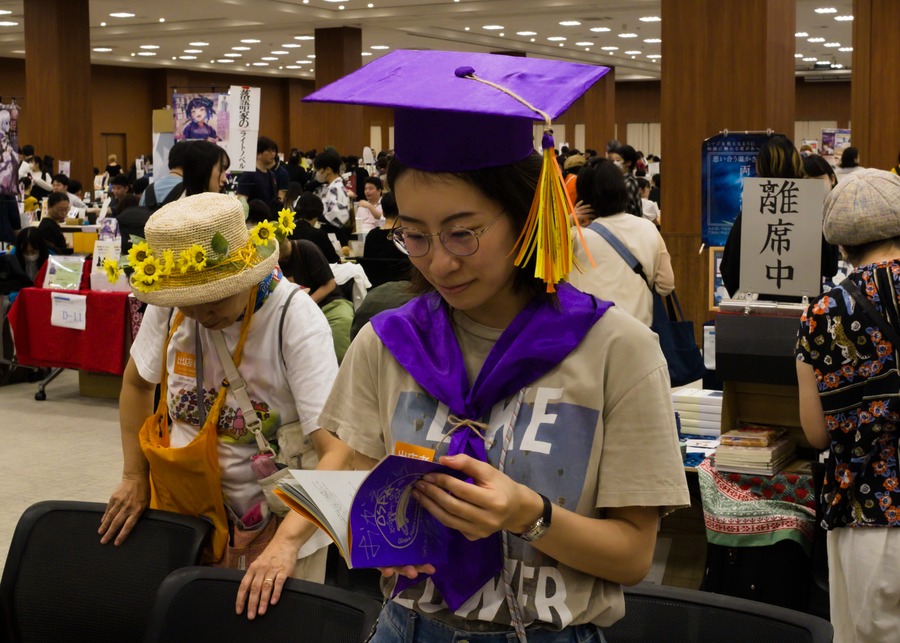
Kotoda Mana “translates” alien poetry into Japanese.
I am more than willing to admit it’s a “me” issue. I’m increasingly hard-headed as I age, and less open to entertaining nonsense. It’s hard to open myself up.
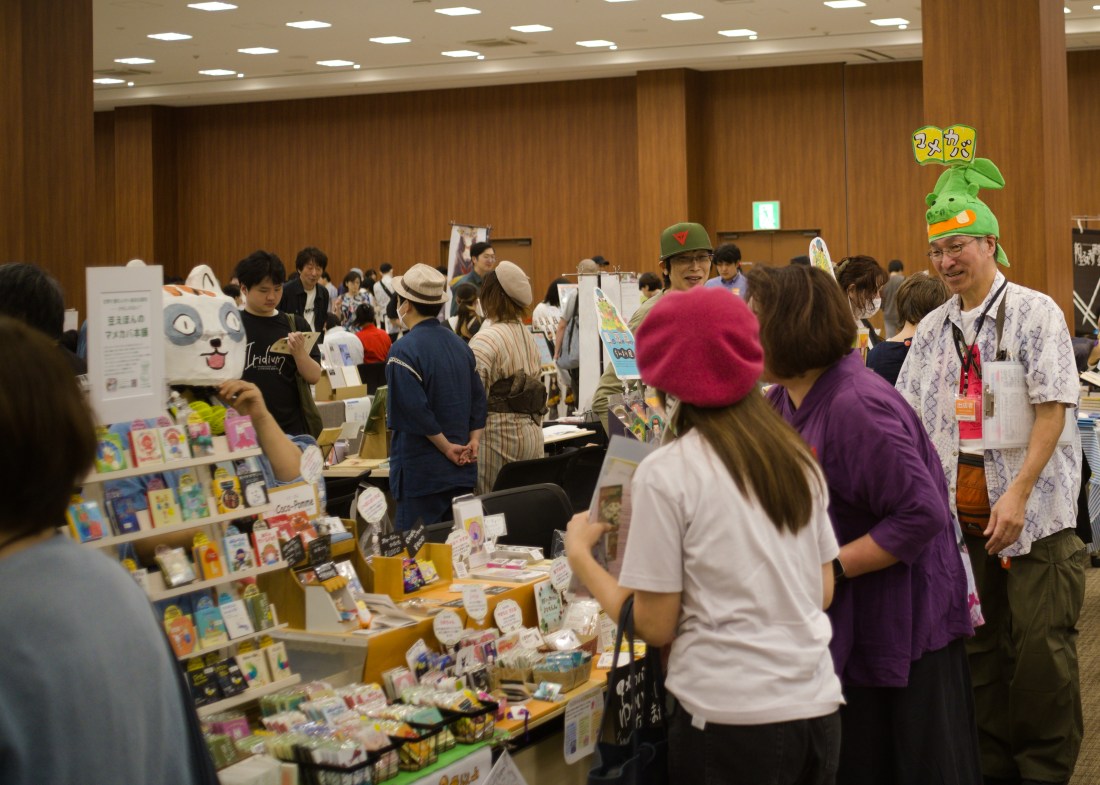
The salespeople at Bungaku Free Market are enthusiastic, to say the least.
So, that’s what I tried to do last weekend. I went to the Bungaku Free Market, a roaming event for people who make books—primarily private, self-published, homemade dojinshi stuff—and other art to sell directly to customers in a communal space. I went to meet passionate creators. I went to talk to people who probably don’t think like I do. And I just went to be around books and other book lovers, because I have been one for as long as I can remember.
It was great. Lots of people with lots of interests just bathing in an atmosphere of passion for creating. I talked to people who I never would have ever met otherwise. I saw books I never would have picked up otherwise. And I let myself just get into it. I bought things and discussed things and took pictures that made me nervous.
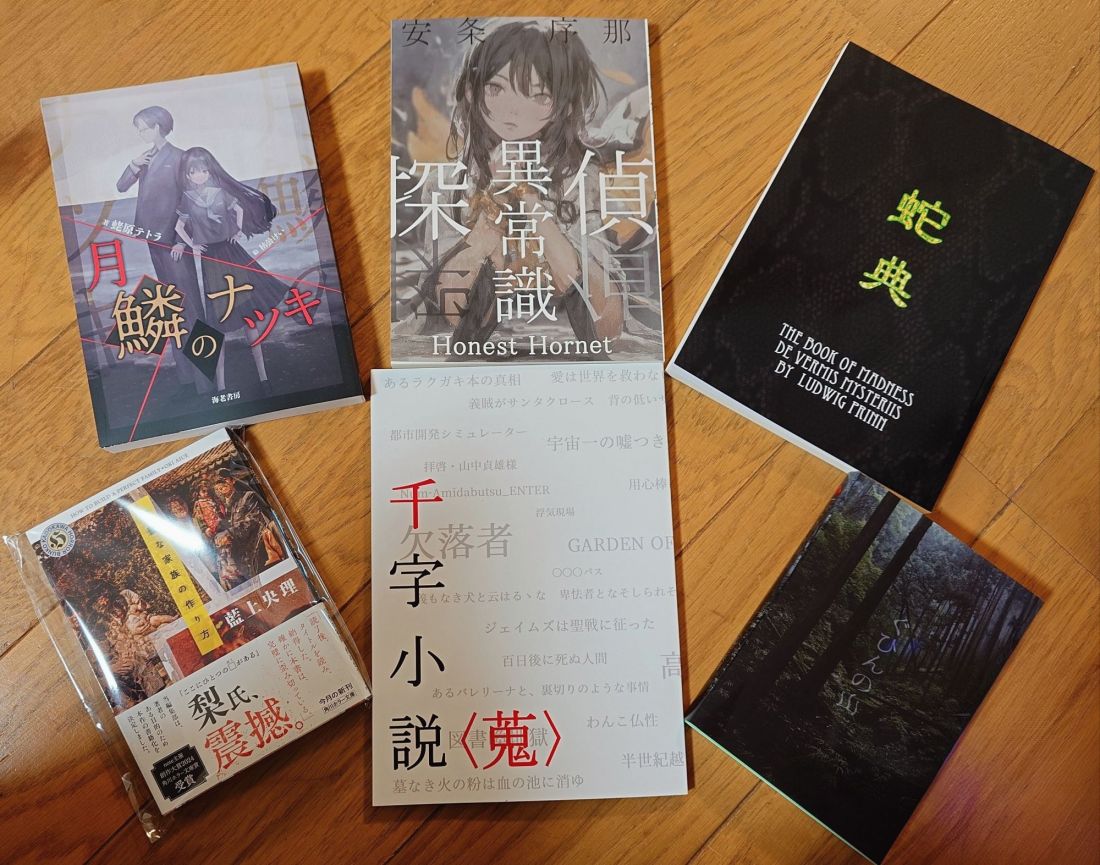
And I came home with some stuff that I’m really looking forward to reading.
The treasures I brought home.
I think a opening myself up a bit more is going to take some time, but book events certainly seem to be a relatively painless way to practice. I just wish there were more of them around here!
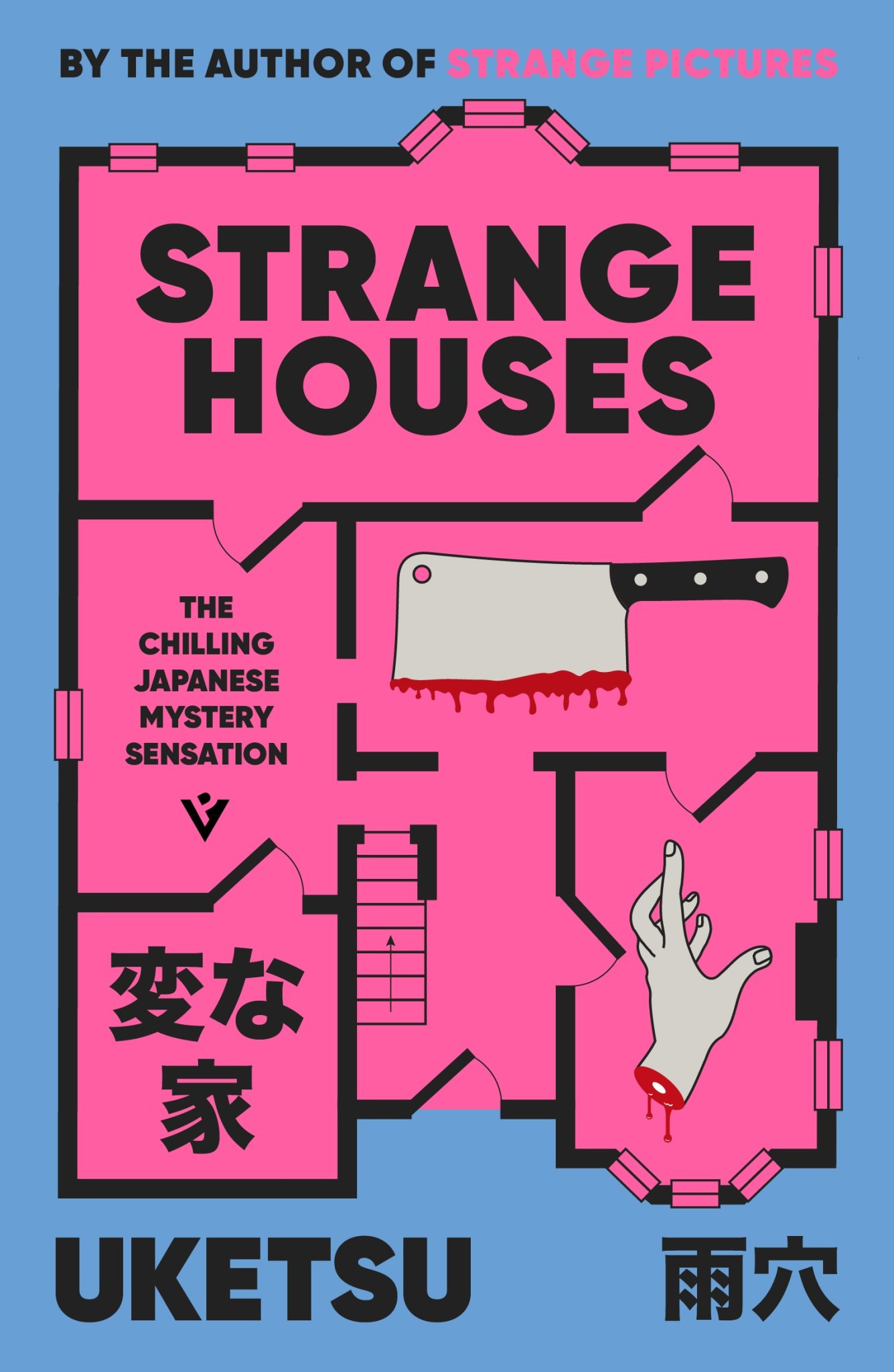
It has been a couple of months since Strange Houses, Uketsu’s debut novel in Japan and second in English translation, came out in both the US and UK. I figure it’s about time to address some of the particular issues translating this one, given that people have probably had a chance to read it.
The UK cover of Strange Houses by Uketsu.
Just to warn you, this is not a spoiler free effort. I won’t go out of the way to include hidden details, but I’m going to go where I’m led.
So.
To recap a bit, I first encountered Uketsu as a YouTuber. My wife became a fan during the height of the pandemic and introduced me in 2022. I shared her interest, but being more interested in books than videos, I was pleased to see that he was also publishing books. Strange Houses actually began from a long-form video and a simultaneous story published on the fiction site Omokoro. An editor at the publisher Asuka Shinsha then reached out to Uketsu and said it would make a great novel if expanded. The existing story became the first chapter of the novel, and I think this helps explains some of the roughness that people might notice in Strange Houses as a whole. Don’t get me wrong, I love the mood and characters it introduces, but in terms of storytelling it is a little loose. And the ending is… Eh. It has its flaws, though I honestly believe the charms outweigh them.
That story is about a friend reaching out to Uketsu about an odd house he was thinking of buying. Poking into the house’s design, Uketsu’s other friend, Kurihara, speculated that the house had been designed for the purpose of murdering and dismembering people. The original friend ended up not buying the house because a dismembered body was discovered in a nearby wooded area and it just felt like a bad omen.
Now, here is where we get to the “translation issue.” In the original publication, that first dead body—the dismembered body missing its left hand, which becomes a significant plot point as other bodies missing hands are discovered—is never mentioned again. The conclusion seems to wrap up all kinds of plot points, but no one even says “Hey, what about that one guy.”
The English editor and I were both rather nonplussed by that. It seemed a rather significant plot point, indeed the instigating incident for the whole book, to just let fade into nothing.
We reached out to Uketsu about this, and about the possibility of adding something, even some simple comment like “It’s crazy that the first body was just a coincidence” so it didn’t feel like people just forgot about a whole dismembered body.
His response was initial surprise, since, as he said. “In the two years since publication not a single person has even asked about that.” But then he said that there was a new mass market paperback edition (or bunkoban) coming out in Japan with a new Afterword “by Kurihara,” which added some doubts and twists to the story as recounted by the fictional Uketsu. Real world Uketsu proposed both adding the Afterword to the English version and making some adjustments that would incorporate the initial body into the doubts Kurihara expressed, which was both a rather neat solution to our doubts and a very cool idea in general.
What this also means is that the English version of Strange Houses is in a very real way a different story from either version in Japanese—and I want to emphasize, it was made so by Uketsu himself. This wasn’t some rogue decision by the editor and I.
I think this should tell you something about the “literary” translation process. On top of cultural/linguistic issues, translators are some of the closest readers you’ll ever find. We dig deep, deep, deep into the stories we translate because, honestly, most of us are terrified of missing something important. We get confused. Sometimes it’s because we do miss things. Sometimes it’s because the author missed something. And sometimes it’s because of a gap in values, world-view, or cultural assumptions. And that’s where we, as translators, start to dig and clarify so we can ensure that the readers of the translated story have the best experience possible.
It also speaks to the role of editors. I think many people assume that in publishing, the author is some kind of towering, monolithic talent whose words are inviolate. It just isn’t true. Editors have enormous power to shape a story and even an author’s voice, and almost always for the better. You think it’s a coincidence that F. Scott Fitzgerald, Thomas Wolfe, and Ernest Hemingway all just happened to be discovered by the same editor? Look up Maxwell Perkins. It is an edifying example of how editors can influence literary output. The same is true of translation, perhaps even more so. See my review of Who We’re Reading when we Read Haruki Murakami for more on that.
So, yeah, it turns out that published stories are far more collaborative than is often believed. That’s not a bad thing! It makes the experience better for readers, if a bit stressful for writers…
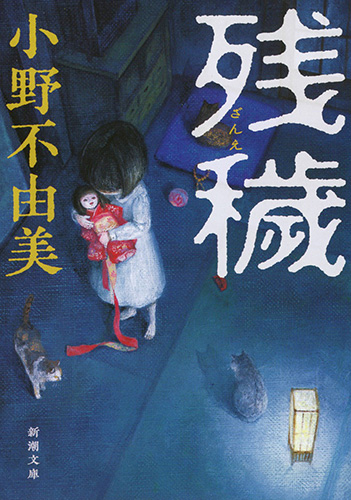
I’m not sure I’d exactly call this a review, but I read Ono Fuyumi’s Zan’e—the movie version is The Inerasable in English but I’d call it “Tainted” if anyone ever asked me—and I have thoughts.
The Japanese cover to Zan’e.
Here’s a bit of a summary, since I’m sure not that many English speakers have read it.
The story is told in the first person by an unnamed “I” who is ostensibly Ono herself. The narrator is a Kyoto-based horror writer and collector of jitsubanashi kaidan, so-called “true ghost stories.” She puts out calls for readers of her work to send her their stories, and one day she gets a letter from a young woman named Kubo who seems to live in a haunted apartment.
Her story reminds Ono of another she’s heard before. She finds another letter in her records with the same story, essentially, sent in by another reader who lived in the same apartment building as Kubo.
And so begins a long investigation. Kubo and Ono interview other residents of the building and of the neighborhood, going back further and further in history to track the haunting. They slowly unravel a story of a diffuse, metamorphic haunting that covers the block where Kubo lives, but also seems to spread and change. They find terrible mass murders, suicides, and arson linked to it, and realize they themselves might be “infected” because the odd things follow them even when they move to new houses.
Eventually, nearly seven years after Kubo’s first letter, they track the origin of the haunting to a terrible accident at a coal mine almost a hundred years ago, on the other side of Japan.
And that’s it. The great conceit of Zan’e, and one of the reasons it has become so influential in Japanese horror is that from start to finish, it maintains the aura of real people investigating a real “strange story.” There are no great climaxes, no battles with evil, no conclusion, really. They encounter something odd, wonder where it came from, and find out.
And this book has left its fingerprints all over Japanese horror since its 2012 publication. It’s on every “Best of” or “Must Read” horror list I’ve ever seen, and authors and filmmakers alike cite it as an influence.
After reading it, I can see the influence they mean. The figure of the “kaidan collector” has become a standard trope now, with examples to be found in Kamijo Kazuki’s Shinen no Terepasu/The Bright Room, Niina Satoshi’s Sorazakana/Fish Story, and many more. The concept of “haunting as infection” is not original to Zan’e, but the evolution of that haunting from a lingering form of resentment or anger a la Sadako in Ring into essentially a mindless natural phenomenon reached its zenith here.
And then there is semi-documentary approach, without any reliance on fiction elements like plot, arc, denouement, etc. It’s just a flat record of events, some of which are really creepy or disturbing but are mostly just… Stuff happening. That has been enormously influential in the “fake documentary” style of horror that is so popular right now. Sesuji, of Kinkichiho no Are Basho ni Tsuite fame, has cited it as an influence for that reason.
For fans, it has earned a reputation as one of the most frightening horror books in the Japanese language. And I get it! At its core, what Zan’e presents is a cosmology that truly is terrifying.
The basic idea is based in the Japanese spiritual concept of kegare. Kegare is a taint, a metaphysical stain that gets on people who come into contact with things considered unclean: death, blood, rot, filth, and (in the dreadfully misogynistic ways of olden days) things involved with being a woman like menstruation and childbirth.
Zan’e takes up kegare based on the very traditional idea that a place where people die is stained by that death. Usually that stain fades naturally, but in her book Ono speculates that perhaps, if more death happens there before it fades, the stain is intensified, and so a cycle can begin. Couple that with the idea that people who simply go that tainted place—simply be present—then become carriers of the kegare, and you begin to see the danger.
Then, she postulates that the very intense kegare may carry echoes of the death, or the deceased’s state of mind at the time. Their misery, or anger, or pain. The stain whispers, it weeps, the sound of a suicide’s belt dragging over the floor lives on in the stain. What if some people are more susceptible to the influence of the kegare than others? The sounds and visions of shadowy figures truly disturb them, the voices whispering in their ears successfully convince them to kill others and themselves… Won’t that create a new, stronger stain? And on and on, ad infinitum…
This is the terrifying heart of Zan’e that made one award judge say “I don’t even want to put this book on my shelf.”
But. With all that said, I don’t know that I would recommend this book to anyone except horror completist nerds (like me). Because this book is dull. Deadly, painfully dull. Which could well be the intention, given the dedication to the realistic style. Anyone who has ever interviewed members of the public knows that most people just aren’t good at telling stories. They meander, they repeat themselves, they get confused. And given that much of this book is a documentary-style record of just such interviews, you get all of that.
There is, for example, a twenty page chapter that is just one elderly neighbor of Kubo’s talking about all the many people who have moved in and moved out, the buildings that have gone up and come down, the changes over the years… You know, old people stuff. Within that twenty pages are roughly two paragraphs that actually pertain to events of interest. The rest is simply there to add weight to the idea that some houses in this neighborhood just don’t get lived in long. Which isn’t all that interesting a point.
I would say that basically nothing interesting as such happens for over half of the book. It’s all just talking, with hints of the taint scattered through to keep the monologues relevant to the story. So. Dull.
I had to force myself to finish Zan’e. I only did it because I want to better understand modern Japanese horror, and it’s such an influential book that I felt it necessary. But God, it took me forever.
The Fisherman made me a fan of John Langan. There is something in the combination he weaves of cosmic horror and emotional grounding, with a hefty dose of simple erudition, that hits with me.
When I learned he had a new collection coming out I was eager.
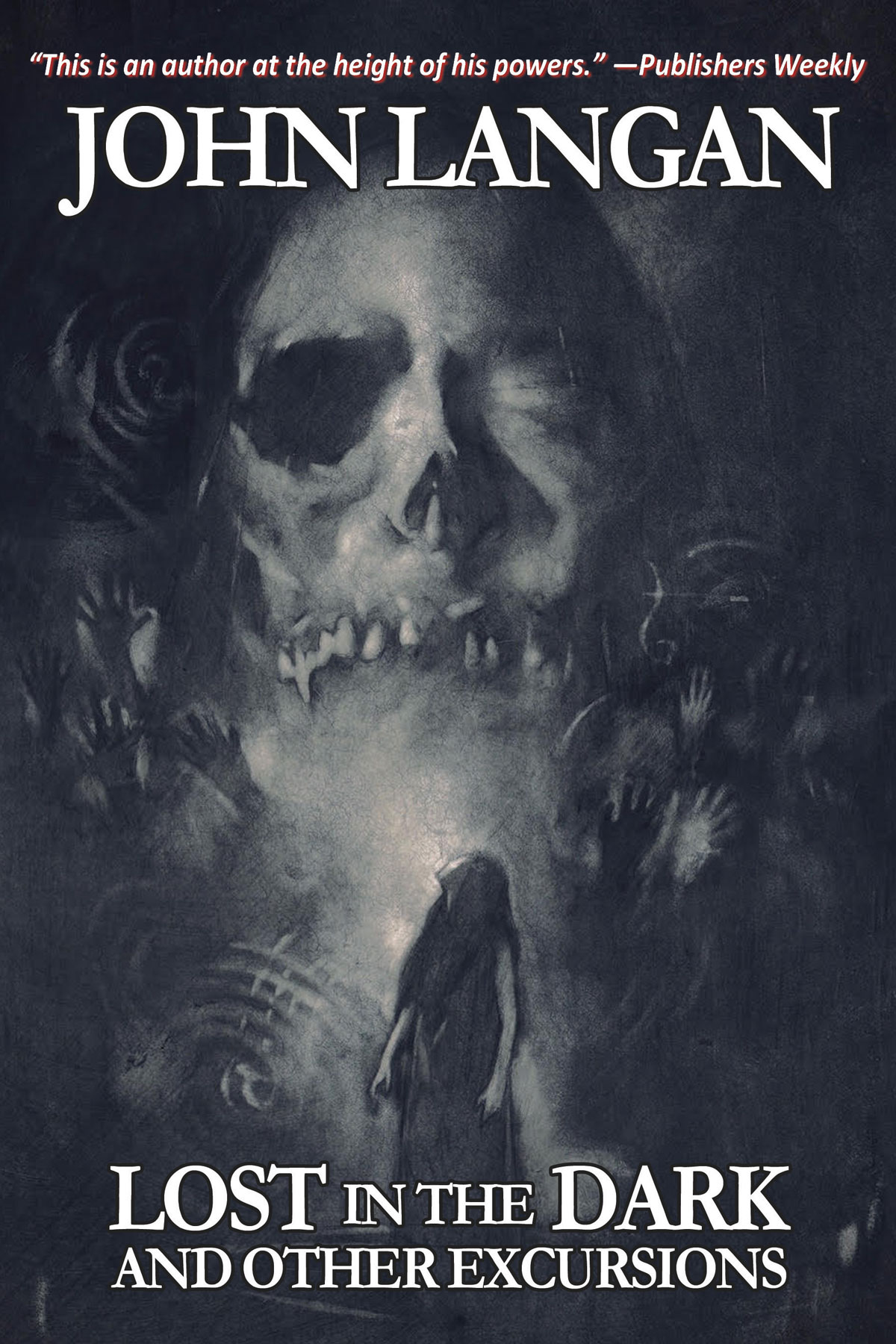
Lost in the Dark and Other Excursions by John Langan. From Word Horde Press
Lost in the Dark and Other Excursions is a collection of short stories and one… Essay-fiction? from the last few years. This is one of the rare collections that does not have any misses, in my opinion, but that may just be because I like Langan already.
The title story, “Lost in the Dark,” was perhaps the fiction highlight for me. It uses the sort of “found footage” style conceit, as a film professor interviews a former student about a horror film she made that might actually have been a documentary. The layered structure and truly creepy atmosphere of the student’s cave story—rather effectively hinted at in the cover art, honestly—work really well.
There are two fun interpretations/extrapolations of classic stories. “Haak” is the one that takes the biggest swing, and took the longest for me to “get” what was going on, while “Alice’s Rebellion” felt a bit too grounded in the state of the world today for comfort.
I also really enjoyed “Natalya, Queen of the Hungry Dogs,” a story about death and family and childish resentment. It felt closest to the writing and worldview of The Fisherman.
But I have to put the essay/fiction of “Snakebit, or Why I (Continue to) Love Horror” is a previously unpublished work that approaches the title idea, why Langan continues to love horror, by embedding a story that begins as a version of “literary fiction” that he then works into the horror mode, while explaining how different approaches translate into effects on the reader.
It’s not only a fascinating insight into horror writing, it’s a fun read. And, I would argue, it’s a crystallization of valuable writing advice for people wanting to play in the horror genre. Honestly, this is the one that has kept me thinking the longest after I finished the book.
I think the book is more than worth the price of entry for “Snakebit” alone, but taken as a whole the collection is just pure winner. And Word Horde sells books themselves, so no need for Amazon!

 Jim Rion - Translator & Writer