The Fisherman made me a fan of John Langan. There is something in the combination he weaves of cosmic horror and emotional grounding, with a hefty dose of simple erudition, that hits with me.
When I learned he had a new collection coming out I was eager.
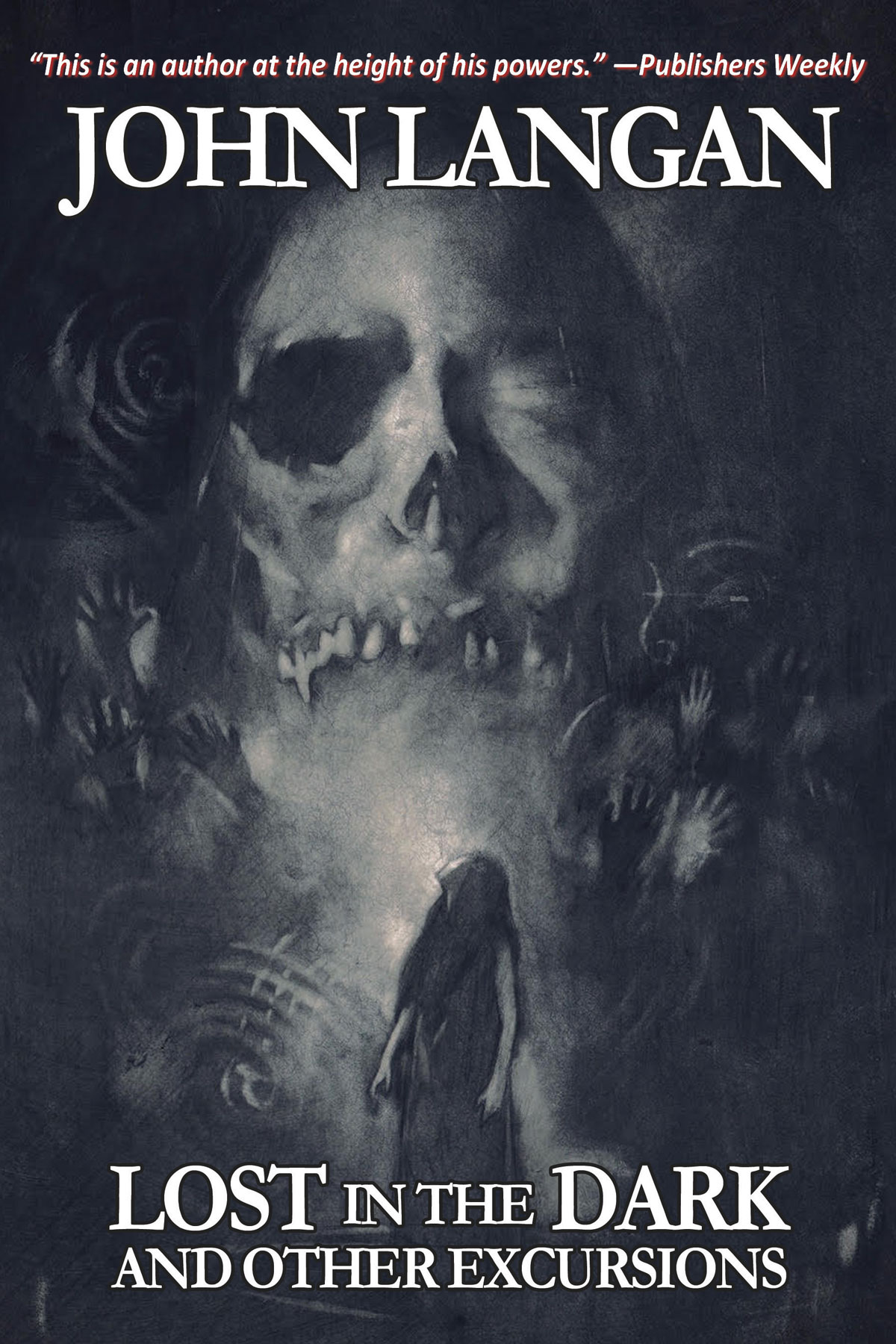
Lost in the Dark and Other Excursions by John Langan. From Word Horde Press
Lost in the Dark and Other Excursions is a collection of short stories and one… Essay-fiction? from the last few years. This is one of the rare collections that does not have any misses, in my opinion, but that may just be because I like Langan already.
The title story, “Lost in the Dark,” was perhaps the fiction highlight for me. It uses the sort of “found footage” style conceit, as a film professor interviews a former student about a horror film she made that might actually have been a documentary. The layered structure and truly creepy atmosphere of the student’s cave story—rather effectively hinted at in the cover art, honestly—work really well.
There are two fun interpretations/extrapolations of classic stories. “Haak” is the one that takes the biggest swing, and took the longest for me to “get” what was going on, while “Alice’s Rebellion” felt a bit too grounded in the state of the world today for comfort.
I also really enjoyed “Natalya, Queen of the Hungry Dogs,” a story about death and family and childish resentment. It felt closest to the writing and worldview of The Fisherman.
But I have to put the essay/fiction of “Snakebit, or Why I (Continue to) Love Horror” is a previously unpublished work that approaches the title idea, why Langan continues to love horror, by embedding a story that begins as a version of “literary fiction” that he then works into the horror mode, while explaining how different approaches translate into effects on the reader.
It’s not only a fascinating insight into horror writing, it’s a fun read. And, I would argue, it’s a crystallization of valuable writing advice for people wanting to play in the horror genre. Honestly, this is the one that has kept me thinking the longest after I finished the book.
I think the book is more than worth the price of entry for “Snakebit” alone, but taken as a whole the collection is just pure winner. And Word Horde sells books themselves, so no need for Amazon!
120 Murders: Dark Fiction Inspired by the Alternative Era is an anthology with an alluringly simple theme: noir/crime/horror-ish stories built around alternative music of the 1990s.
Might as well have just called it “Big Book of Gen X Midlife Crisis.”
I read a copy from Netgalley because apparently the ebook isn’t available in Japan, so… Anyway, yes, thank you etc.
Nick Mamatas is the editor, and I have long enjoyed and trusted Nick’s taste. So, I went into this assured that there was at least a strong editorial vision, and that the stories would be mechanically solid. I wasn’t disappointed on that front, but I have to admit that otherwise, I can only call this collection “OK.”
Like any anthology, there are stories that hit with me and those that didn’t. It’s the nature of the beast, and I’m not surprised at that, but I can say that overall, it felt like the incredibly open guiding theme means that the overall result feels somewhat scattershot. Sci-fi about sex robots on the run, magical realist rumination on goth girls who’ve crossed to the afterlife and returned, noir about murderous college pranks set to Weezer albums… There’s a lot of very, very different stuff going on here, which is going to divide readers, I think.
I suppose another way to look at the wide variety of genres and voices here is to say, there’s probably something for nearly everyone, and all the writers are good at their craft. Or seem to be, anyway, to this reader.
Like I said, some of the stories really hit with me. “We’ve Been Had,” by Alex Jennings, was a painful story about losing friends, the brutal legacy of chattel slavery in the US, and how we get on with grief that I not only loved, actually made me want to look up the song it references (We’ve Been Had by The Walkmen). Molly Tanzer’s “The Best in Basement Radio” is delightfully meta, with references to Nick’s commission for this anthology inciting her to recall the time she was accused of murder (not really.. Or REALLY?!).
I liked the feel of this anthology. I liked the sense of nostalgia, the opportunity to meet new writers, and the prodding to try some different styles of story. Even if not every story was “for me,” they were all worth reading.
I learned about this book from a post on Bluesky, which included the a quote about translation as reading that sparked something in my brain. I had to read more, because I personally view translation as exactly that: I read the text in Japanese, understand it to the best of my ability, and then write my understanding in English. Here, I thought, was someone who not only understood translation the way I do, but who had a career’s worth of experience and the academic training to articulate it in ways I did not. It filled me with hope that I was perhaps not utterly unfounded in my approach to this work.
When I did get my hands on the book, I was not disappointed.
Searls divides this book roughly in half. Indeed, you could say the first half is “philosophy,” and the second is “translation.” He begins with a historical review of theories and approaches to translation, from the Latin roots of the word itself to German Romanticist views of language. He does get quite deep into the weeds, with elevated language and heavy ideas, but he clearly explains not only the meaning and importance of the language an ideas, but why he’s engaging with them.
It’s a refreshing style of academic book that not only maintains rigor, but opens the gate to those without steeping in the particular obfuscated style that plagues academic writing. It is challenging while remaining accessible, in other words.
But most important of all, it is thoroughly rooted in actual translation. Searls brings all the theoretical discussion back to what real, working translators do, not only in the literary realm but in the practical, business-focused work that most people use to pay the bills. The balance is delicate but solid, which is what is most impressive about the book.
All that being said, what takes this book from being a well-written academic treatise on translation and something that I would recommend to anyone even tangentially involved with translation as a practice (academics, budding translators, authors whose books are being translated, game developers looking into localization, the list goes on) is how it reframes the act itself in new words and ideas that just make beautiful, crystalline sense.
Rather than focusing on the common ideas of “fidelity/faithfulness,” freedom, or even accuracy, he talks about translation as an act of reading.
When I’m translating, I’m just reading-trying to pick up on as much as I can of the original utterance, its meaning and sound and allusions and tone and point of view and emotional impact. As I register what I feel is most important and indispensable, I try to write that indispensable thing in English; then, in revising, I reactivate the reading part of my mind and try to anticipate as much as I can of what an English-language reader with no access to the original will pick up on.
(page 224)
This is really the crux of the book, though the discussion of translating “utterance” rather than “words” also rings true. On page 107, for example, he says “To think of what we translate as ‘utterances’ sweeps away a huge amount of lexical analysis, because we don’t translate words of a language, we translate uses of language.” Thus, issues of “accuracy” are less important than issues of “communication.” When we translate, are we bringing the message/impact/effect/resonance that was actually vital in the original to the new audience?
Which, again, brings us back to reading. Because it is only by reading that the translator knows what is vital in the text, what Searls sometimes calls the “force” of it, to be able to bring it to the new audience. As such, rather than faithfulness to any monumental, immutable “original,” translation is always a question of how the translator read, and how they managed to share their reading with their new audience.
[…] [W]hat’s important to preserve depends on what the translator finds in the original-how the translator reads. Everyone thinks … that they’re “following the original,” but they’re working from different originals: each is trying to produce a text that matches, or does the same as (has the same force as), not the source text but his or her reading of the source text. Even the least literal translations, the most wildly divergent “imitations” or “reimaginings,” try to stay true to whatever ineffable aspect of the original’s vibe the writer of the new version feels they are taking up. That is why there is no objectively best translation, one that is “closest” to “the” original, as talk about faithfulness falsely implies.
(p. 195)
One of the things that has always struck me about translation is how every act of reading is different, no matter the language. Every person brings their own filters to reading (and listening and talking and writing). I am no different. So, whenever a translator experiences a text then takes that experience into a new language for new readers, inevitably, that new text will be colored by their filters. Our job, then, is to expand those filters, to be able to grasp as much of the text as we can, to bring all of that with us when we translate. But also, we need to accept that we will never encompass everything that the original was or potentially could be. All we can do is be the clearest filters we can. Searls, of course, puts it much better:
[W]hat I think a translation should be: Attentive to how the translating language works, overriding any demand for “equivalence” with how the original language works. Keeping in mind and keeping to heart the interests of readers, the author, and the author’s ideas. (This, by the way, is how we use the word “interests” in English.) Feeling some responsibility to enable, or at the very least try to enable, the original author and their new readers to interact with one another at their respective best. An act of care, and ultimately love.
(page 194)
And really, I’m not sure I can add anything else.
There is much more to this book. His formulation of translation in terms of arcs/arrows is fascinating, as well, and I think the practical examples are all excellent sources of education and rumination.
I honestly can’t recommend it enough to anyone even remotely interested in the theory, work, and indeed love of translation.
As I become more and more a “literary” translator, I find myself beginning to approach reading as a professional duty, even as I remain steadfastly fixated on choosing books that I think will actually be interesting. This book, a collection of horror stories by a single author, was solidly on both sides of that equation. Japan is in the middle of a bit of a horror story boom, due in no small part to Uketsu’s success, and given my own connection to Uketsu now, I’m kind of in a horror boom, too. With publishers on both sides of the Pacific now plumbing the genre for the Next Big Thing, I am trying to keep up myself to see if I can spot something interesting.
Nashi is an author often associated with Uketsu in the media, it seems, along with Sesuji. One reason might be that they all use pseudonyms with seemingly random meanings. Nashi uses the Japanese character for “pear,” 梨, although there is a stated nod to another character with the same pronunciation, 無し, which means “nothing.” Which would be suitably “horror-esque” on its own, but having read 6, I wonder if there isn’t some other meaning.
This anthology is, in its own way, utterly unique while also being part of a tradition of literature that goes back basically as far as literate goes. In short, it is religious allegory as entertainment fiction. Yes, this thin tome of horror stories follows in the footsteps of Milton and, um, C. S. Lewis? Anyway.
Let’s pull back a minute. 6 comprises six stories, of course. They appear, at first, unconnected, but much like other recent horror hits, there are threads that join them that only become clear as you read further. The story names are all in the Roman alphabet, and contain hints to both their individual content and to the larger meaning of the book. The stories are ROOFy, FIVE by five, FOURierists, THREE times three, TWOnk, and ONE [sic, sic, sic after sic]. Now, I would say the pattern is clear except for ROOFy, which I can’t for the life of me connect to “six.” Even in Japanese, it would be roku or ro. But hey, the world is a flexible place. **EDIT** I finally reached out to the author to sort this out, and I can’t believe that I missed the central metaphor of the book’s structure: elevators. This elevator starts at the roof and takes you to the basement! I can’t believe I missed that for so long.
ROOFy is a nightmare fairy tale, a story in the first person about a young girl who visits a little amusement park on the rooftop of a department store. She wishes she could play there forever without all the other people in the way and, when she comes out of the bathroom, it seems her wish has come true. Her parents are gone, as are all the other children. She has the park to herself… But then it begins to change. It is filled with decay and corruption, and… Well, no spoilers.
FIVE by five presents the story of a magazine writer who disappears and leaves behind stories with odd changes, and the editor who is tracking the reporter’s steps to see what might have happened to him. His investigation takes him to a mountain town with odd stone towers bearing metal antennae along the road, and glimpses of an eerie truth.
As the other stories progress, we find more connections to this disappeared writer and the impact on the editor, but what comes even more clear is something… Other. Because these aren’t just horror stories skirting around the pseudo-documentary style that has grown so common now. They are clear, open Buddhist allegory. The six stories address the Six Realms of Samsara: the realm of gods, the realm of demigods (or asura), the realm of humans, the realm of animals, the realm of hungry ghosts, and the realm of hell. It is a trip through the realms, woven with a story about an impossible death (really. Not, like, in the mystery sense), and a break in the order of the universe. The stories themselves openly mention Samsara and the six realms, so the allegory is pretty on the nose, but for someone who grew up outside the Buddhist tradition, it’s fascinatingly unfamiliar ground.
It is, in other words, heavy, heady stuff. It is also properly “horror” in the traditional sense, but the way this book haunts me is not in the scary stuff. No, it’s the way it presents an almost nihilistic (nihil meaning, of course, “nothing”, which is also one way of understanding liberation from worldly desires in Buddhism, or becoming “Nothing”—See?) view of the Buddhist cosmology. Because the core of Buddhist belief is freedom from the wheel of samsara, of escape from eternal rebirth in a cycle of suffering, but this story offers a counterpoint: a way of escape that breaks the wheel itself, upsetting the order and questioning the very possibility of liberation.
It deserves reading, in my opinion, and is worth it for both horror seekers and those interested in meatier, chewier problems like “What does living even mean if death is not just inevitable, it is inevitable an infinite number of times?”
I’m feeling like this isn’t so much a review as me just meandering about the book. But I am glad I read it, and I will read it again, and it was pretty creepy and chilling in parts, so I think it’s a recommendation for those who like reading that sort of thing. Maybe I’ll even try to see if someone wants to pay for it to be translated?
It’s inevitable, I guess, to get retrospective at this time of year. I’ve more or less stopped keeping careful track of things like media consumption—no Goodreads lists for me, thank you—but it’s still sometimes interesting to review. And so, here is a non-comprehensive list of things that I remember enjoying very much in 2024. Travel, books, TV, whatever, I’m not going to be strict. These are all things that made my 2024 a better year than it would otherwise have been.
First up, I visited Inbe in Bizen, Okayama several times this year. It was wonderful. I met potters, enjoyed the scenery, and learned about its history and culture in a way that was vibrant and exciting.
Another thing that made my 2024 better was engaging more actively and thoughtfully in photography. I’ve written about it before, but even apart from whatever high-minded ideas about “art” or “creativity” people want to layer onto it, the very fact of engaging in a new expressive medium has been great. I have been a “word guy” all my life. Trying to be an “image guy” now is really something special for me.
Macho man
In the world of books, there have been a few standouts. The one that stands largest in my memory is The Saint of Bright Doors by Vajra Chandrasekera, which I reviewed on this blog. There’s not much else to say about it, except that its weight in my memory has only grown with time. Read it.
I also read and loved Premee Mohamed‘s The Siege of Burning Grass. It is a fantasy story set in a world at war, but the central protagonist is a true pacifist despite the brutal social pressures on being a good, patriotic subject of empire. It is a story about the irrationality of war and the true courage that is pacifism, and the pain that occurs when those are placed in irredeemable conflict. I should have reviewed it more thoroughly. It deserves much thought and rereading.
Another standout is the Japanese-language only (so far) horror book Kinkichiho no aru basho ni tsuite (About a certain place in the Kinki region) by Sesuji. It’s a “mocumentary” horror book that presents itself as a collection of research materials for a magazine, but ends up telling a story of generational evil, the terrors of the Japanese countryside, and creepy stuff in general. I loved it. I think the translation rights have been sold, but that is so far unconfirmed.
In related media, I still think about Fake Documentary Q a lot. I wish the book had been better.
Apart from all the old music I mostly listen to (shout out to Eric Satie’s Gymnopédies), the new album I listened to most is Daudi Matsiko’s The King of Misery. It seems perhaps inappropriate to talk about “enjoyment” regarding such an emotionally shredding/shredded work of art, but it is beautiful and alive and well worth listening to.
And, lest anyone get the idea that I went all high-brow and Big-C Cultural in 2024, I also watched the hell out of the Reacher series on Amazon Prime because there’s something unironically appealing about watching a very big man murder the fuck out of the Bad Guys.
What were some things that made your 2024 less terrible?




 Jim Rion - Translator & Writer